Adeptus Arbites Jurisdiction

By eltom13, in Dark Heresy General Discussion

From what I read in the fluff the Adeptus Arbites should be in charge of all crimes involving any of the Adeptus Terra. But is this really true? Any of them? Lets say a group of Arbitrators catch a renegade Tech-Adept would they just execute him on sight or rather hand the Adept over to the AdMech who after some questioning will probably punish her/him by repurposing as a Servitor.

Same goes for the Ecclesiarchy: Would the Adeptus Arbites directly judge a rogue priest or would she/he rather be transferred to the nearest Church for internal judgement?

My guess is it depends on the circumstances, the Arbitrators involved, and how hard the heretic is resisting arrest. I don't think there'd be too many problems if they just shot the guy dead OR transferred him back to the Mechanicus/Ecclesiarchy. If they've already been judged a traitor, they're fair game.

I handle it like it is done today. Arbites are like federal police forces, investigating the bigger crimes or special cases. While local police forces do the usuals stuff.

I also like to defuse the over teh top 40k stereotypes. Not every criminal heretic is shot at sight. The goal is it to capture them and give them a trial. The reasons for that are different from ours. It has nothing to do with the personal rights of an individum, but more it is used to scare the population and keep the fassade of a functioning jurisdiction upward.

Maybe you want to read the Eisenhorn trilogy, it partially deals with social life and in one book there is a bigger purge where many accused heretics are trialed by inquisitorial tribunals.

To answer your question: I would say he is captured if possible and trialed.

Thank both of you for your replies. Ripplo, my question was maybe not to clear. Actually my main point was if the Arbites judge AdMechs and Priests or if this is done in their respective order, the Arbites not having the right to judge such individuals on their own.

Edit:

So the question is: Trialed by whom the Arbites or the Adepta responsible?

Edited by eltom13

I kind of agree with Ripplo with the following exceptions:

The Arbitrators are none to subtly based on Mega-city one's Judges from Judge Dredd . As such I tend to treat them in a similar manner. Ripplo is right, not every lawbreaker is shot on site but often they are sentenced on the spot! The goal is still to capture of course but trials are only for where there is a question of guilt. Generally, This is the typical difference between a local enforcer (Cop) and an Arbiter. The Enforcer must go through the the normal due process whereas the Arbitrator often does not.

Another important distinction is the fuzzy world of juristiction. Arbitrators do not generally deal with petty crimes such as robbery or even murder. They only become involved when such crimes affect the Imperial government or when their help is asked for by the local lords. As such, many crime lords will seek to ensure that their operations do not affect the various adepta lest they bring the wrath of the Arbitrators upon themselves!

Thank both of you for your replies. Ripplo, my question was maybe not to clear. Actually my main point was if the Arbites judge AdMechs and Priests or if this is done in their respective order, the Arbites not having the right to judge such individuals on their own.

Edit:

So the question is: Trialed by whom the Arbites or the Adepta responsible?

In the case of the Adepta the Arbites WILL be the governing authority (At least on an Imperial world. On a forge world it's a little different.) Again, unless the suspect is of Noble birth or VERY highly ranked, The Arbitrator can typically dispense justice as they see fit. In most cases this will not be a death sentence but rather some form of lengthy imprisonment or hard labor (Or both). A sentence of death is only common for the attempted murder of another adept or sedition/treason. Most Arbitrators should carry a dataslate loaded with appropriate laws and/or punishments but they are expected to know most of them from memory.

Thank both of you for your replies. Ripplo, my question was maybe not to clear. Actually my main point was if the Arbites judge AdMechs and Priests or if this is done in their respective order, the Arbites not having the right to judge such individuals on their own.

Edit:

So the question is: Trialed by whom the Arbites or the Adepta responsible?

Well, classical answer of a lawyer...it depends on the individual case ;)

If the Admech commited a crime against the Mechanicus they might handle that internally. If he tried to idk blow up the Administratum ministery the Arbites would step in.

All in all it stays a question of your own interpretation of the 40k lore and even what kind of planet that is. If it is a small world where there is only one suffering marshall doing his duty, he is all in one and will judge and execute everyone he finds guilty.

If there is a giant hive with a with something like a hall of justice, the judges might not be too happy if they are passed over too often. After all in 40k the people of might are greedy and power hungry.

This might become a little confusing...maybe it could go like that

Regular crimes (Theft, assault, murder (normal^^)) - investigated by local police authorities - judged by local judges

Extremer crimes & crimes against the Imperium - investigated by the Arbites - judged by Arbites judges or supreme tribunals

Crimes against the Ekklesarchie/church - investigated by Arbites / Inquisition - judged by inquisition (inquisitor or inquistorial tribunal)

Crimes against the Ommnissah (ill treatment of machines etc) - investigated by Mechanicus - judged by Magos

But this is just an idea or concept...

Thank you all very much for your input!

I tend to follow the pattern of (U.S.) Federal law enforcement; so, if a member of the U.S. military commits a crime, the Feds would either put him on trial in a civilian court or turn him over to the military to be court-martialed (sp?), depending on if the crime in question directly involved the soldier's duty. So, if a Techpriest commits a crime unrelated to his duties in the Mechanicus, the Arbites would have final say on his sentence, while if his crime involved tech-heresy, the Arbites would likely be legally compelled to turn the suspect over to the Mechanicus, and testify against him in a trail in in AdMech 'court'.

So, if a Techpriest commits a crime unrelated to his duties in the Mechanicus

it's not that simple.

Technically, Techpriests are outside Administratum jurisdiction, being an institution of their own right, just under High Lords of Terra. Same for Ecclesiarchy, btw. And, I believe. same for military. So if you want to punish tech-priest you're going to ask local magos to do so, no matter what's the crime.

Arbitres are mainly kind of 'inner investigations' for Administratum.

Yep, the Ecclesiarchy has its own courts of law (a little like with the real world!), and I imagine it's the same for the AdMech. Of note, Ministorum clergy even judges ordinary Imperial citizens if their crime is in any way religiously connected, from obvious heresy to failing to pay the tithe or disrespecting/assaulting a member of the clergy.

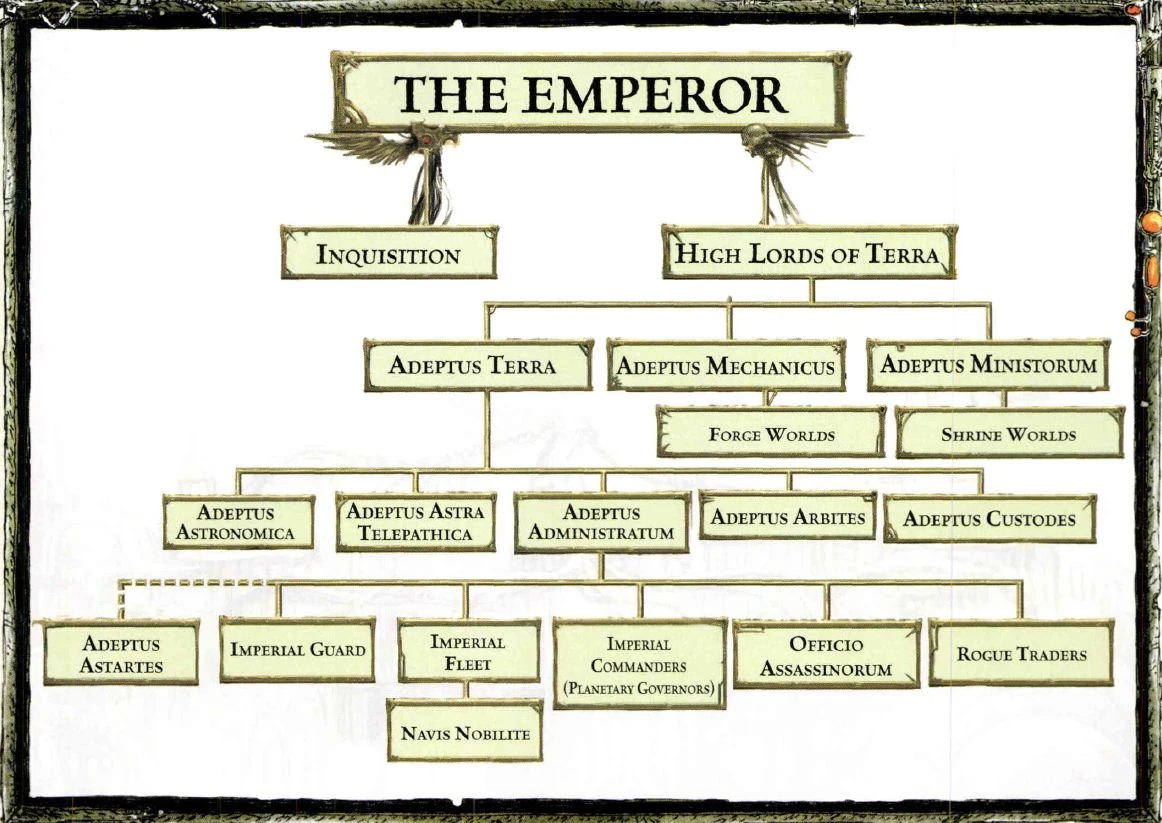
Perhaps it would be of use to consult the organisational chart of the Imperium as printed in the 5E tabletop rulebook. The Arbites are an enforcement subdivision of the Adeptus Terra, similar to how the Sororitas are the enforcement subdivision of the Ministorum. This suggests they could be used to police the Administratum and anything that is attached to it, from Planetary Governors to even rogue Imperial Guard commanders or Navy admirals (actually mentioned as examples in the 2E Codex Imperialis).

When confronted with crimes outside their own Adeptus jurisdiction, however, I imagine the Arbites would have to tread more carefully, but they'd still investigate. It's just that they would probably pass on their findings to the Adeptus the culprit is a part of to have them judged by their own peers (if it was an internal crime), or act as legal mediators between the two or more Adepta if the crime involved members and/or property of other organisations. Such a case would likely end up being settled by the higher-ups of both Adepta, with the sentence largely being a result of the Adeptus' influence or how valuable the criminal is to their own bosses (meaning what their Adeptus is willing to sacrifice to resolve the matter peacefully).

In extreme cases (obvious heresy/treason), the Arbites would of course not hesitate to pull the trigger themselves, but I imagine it would be a thin line to walk. Ironically, this could then trigger the aforementioned negotiation between the higher-ups of the "victim" and the Arbites as the two Adepta then try to settle things. :D

That's just my interpretation, mind you, but I think it plays into the idea of overlapping jurisdictions, bureaucratic nightmare and legal chaos the Imperium is all about.

@Adeptus-B: Yes, the Tech-Adept I am thinking of is a Heretek. Thanks!

@Aenno and Lynata: That's what I thought but I was unsure. I think this interpretation will fit my campaign the best. Thanks a lot!

Edited by eltom13

The Imperium doesn't have a unified code of law like those of modern/"civilized" countries.

There is no criminal law, civil code, etc for all the citizen of the imperium

So, crime/heresy amongst the adeptas (Mechanicum/Ministorum/Munitorum) are ruled by inner councils of these organisations (witch finders of the ecclesiarchy, Mechanicus Provost, Commissars of the Guard, etc.). When there are civil crimes amongst a given community, its the job of the local law enforcement to rule it out (if the local enforcers aren't corrupt).

The Adeptus Arbites fields of expertise is when it touches directly the imperial interests (dime, imperial taxes, imperial ressources, etc.), so yes, Arbitrators could judge a magos/ecclesiarch/officer of the guard if he did something that goes against the stability of the Imperium in a broad sense. Othersiwe, they'll generally stay put, arm crossed, looking at what is happening.

The only higher Echelon is the Inquisition that can do everything and is above all jurisdiction.

All of this, of course, in pure theory, where politics and self interests doesn't get in the way of a job "well" done.

The Imperium doesn't have a unified code of law like those of modern/"civilized" countries.

There is no criminal law, civil code, etc for all the citizen of the imperium

It's complicated again.

It's not pointed directly, but by all descriptions system looks that way: there are common citizens of planet, who are not subjects of Imperial Law as it is, but only of local laws created by Imperial Governor (and, of course, they are not under protection of Imperial Law or Adeptus Arbitres). And there are Imperial Citizens - Adepta primarly - who are subjects of great, vast Imperial laws rulebooks mentioning (Core Rulebook of tabletop game for example), so Arbitres looks for that's law compliance. And of course they're looking for imperial institutions for corruption. I believe it's funny enough to see Arbitre and Governor who are discussing who have more legal powers in any particular case.

Don't forget we don't even know full list of Adepta. ****, Adepta themselves don't know full list of Adepta! And Adeptus Mechanicus with Adeptus Ministorum are VERY special.

Well, no.

Arbites can go political with an aribtes officer about who will judge a case or somewhat, but in the end, the Adeptus Arbites can just get in and say "you're terminated" and shot the governor. This is valid for any servants, whatever the important persons of that world think.

Arbites can arrest guard commander, governor, nobles, simple citizens, etc.

The reason they don,t is simple: they've got a very precise mission to accomplish and they do not have the ressources to lose about simple stuff. But if they invovle themselves, they won't lose ressources bickering about it.

You don't understand. With every common human, who is not Adepta, no protection against Arbitres existed. They are not subjects to Imperial Law => Arbiter can do everything he want, not Arbiter can't do nothing. Governor have a right to be courted, he can appeal to law. Common citizen can't.

And, after all, Imperial Governor have final authority in his domain; with Arbitres "fanaticism for the enforcement of the governmental edicts and rigid adherence to the letter of the law are paramount", but Imperial Governors ARE humans who give edicts in His name. So it will be matter of authority each time situation arise.

But Arbitres aren't Punishers or Inquisition. They are judges as well as investigators, but it's not something "hey, I believe you're bad, so I just shoot you". It's "by the Adeptus Arbitres authority, I've accuse you of violating Imperial Law №***-****-******* proclaimed in ***.M36. How do you plead?" Dredd isn't create laws, but he can interpret them, and I believe we can agree Arbitres based on 2000AD Judges.

So yeah. He can arrest guard commander (better to leave it for Officio Perfectus, but it's matter of law applied and jurisdictional courtesy), governor (with known political aftermath so he better be **** sure what he is doing!), noble (but of course!), simple citizen (who count them?!). But when you're speaking about Magos or Cardinal - sorry, guys, they're not Adeptus Terra at all, so they are outside their law and their jurisdiction. You want to punish them? great, plead to Magos or Cardinal superiors. They are superiors? ****, you're screwed.

They are judges as well as investigators, but it's not something "hey, I believe you're bad, so I just shoot you". It's "by the Adeptus Arbitres authority, I've accuse you of violating Imperial Law №***-****-******* proclaimed in ***.M36. How do you plead?" Dredd isn't create laws, but he can interpret them, and I believe we can agree Arbitres based on 2000AD Judges.

Exactly what I said. Dredd can execute people on the spot. Of course, an aribtrator does it in the name of the Law and we hope he does it right.

But when you're speaking about Magos or Cardinal - sorry, guys, they're not Adeptus Terra at all, so they are outside their law and their jurisdiction. You want to punish them? great, plead to Magos or Cardinal superiors. They are superiors? ****, you're screwed.

No one, except Inquisition and Adeptus Astartes is above law. A judge can go an trial a cardinal and execute him, same for a Magos. The problem is, *****n good luck to trial someone with such connexions, even an Inquisitor would find it hard.

Exactly what I said. Dredd can execute people on the spot.

Yes he can, but not for something he invented himself. There is a BIG LAW BOOK, that he knows by heart, and he shouldn't do anything until you really violate some rule. If he don't... hello, stripping powers, welcome to jail.

No one, except Inquisition and Adeptus Astartes is above law. A judge can go an trial a cardinal and execute him, same for a Magos.

Why do you think so?

6th Edition Rulebook poses just the opposite.

"The Arbitrators and Judges of the Adeptus Terra enforce law in the Imperium."

And what's Adeptus Terra? "The Adeptus Terra is the central bureaucratic organisation of the Imperium and not really an agency itself. It is made up of many autonomous departments that receive the orders of the High Iords of Terra, passing them down to the different branches that will enact the commands. There are only a few organisations in the whole of the Imperium that do not fall under this central command, most notable of which are the Inquisition, the Adeptus Mechanicus and the Ecclesiarchy. "

Funny enough by the lawbook Adeptus Astartes ARE NOT above law. But it can be funny try - to sue a Chapter Master.

Edited by Aenno

My understanding was that the Arbites were supposed to stand apart from other organizations and protect them from any infractions that affect the proper running of the Imperium. Effectively, any actions that would hinder a member of the Adeptus Anything fall under the jurisdiction of the Arbites. If that is another Adeptus organization or just some hive scum, it doesn't matter.

Effectively, any actions that would hinder a member of the Adeptus Anything fall under the jurisdiction of the Arbites. If that is another Adeptus organization or just some hive scum, it doesn't matter.

Thing isn't "it's not thier jurisdiction", Magos or Cardinal just has legal immunity as diplomats have. They are effectivly self-governing, so you will came to them and ask them to punish a criminal. After all we all are in the same boat.

Or Inquisition will arrive. There is not any legal immunity before Inquisitor.

Thing isn't "it's not thier jurisdiction", Magos or Cardinal just has legal immunity as diplomats have. They are effectivly self-governing, so you will came to them and ask them to punish a criminal. After all we all are in the same boat.

There we go the contradictions of the setting; in many other places it is said that there is no one, except Inquisitors, that are above the law of a Judge, that includes Mechanicus and Ecclesiarchy. At this moment, it's just the choice of your headcanon. It is precised many places that Arbites have jurisdiction on anything that hinder the Imperium's Interests. So they won't stop, except by political bickering, to arrest a tech-priest.

Thing isn't "it's not thier jurisdiction", Magos or Cardinal just has legal immunity as diplomats have. They are effectivly self-governing, so you will came to them and ask them to punish a criminal. After all we all are in the same boat.

Why repeat to me things I've already said? The part exactly after the one you quoted.

There we go the contradictions of the setting; in many other places it is said that there is no one, except Inquisitors, that are above the law of a Judge, that includes Mechanicus and Ecclesiarchy. At this moment, it's just the choice of your headcanon. It is precised many places that Arbites have jurisdiction on anything that hinder the Imperium's Interests. So they won't stop, except by political bickering, to arrest a tech-priest.

I like to think it could be something in between -- Imperial Law is so byzantine and loaded with exceptions that jurisdiction isn't clearly defined. In practice, the Arbites would exercise caution when dealing with anyone outside the Adeptus Terra (meaning, Ecclesiarchy and AdMech) ... but they'd still involve themselves if they perceive obvious wrongdoing.

Even if individual Judges or Enforcers might overstep the letter of the law (which could well be a matter of interpretation even in-universe) .. if they uncover obvious heresy, who is going to stand in their way? Chances are the superior Cardinal or Magos might lodge a complaint, but otherwise exercise damage control and cut off the exposed bad apple from any support before the Inquisition swoops in.

As long as the Arbites actually has any proof to justify their investigation. ;)

Edited by Lynata

Why do you think so?

6th Edition Rulebook poses just the opposite.

"The Arbitrators and Judges of the Adeptus Terra enforce law in the Imperium."

And what's Adeptus Terra? "The Adeptus Terra is the central bureaucratic organisation of the Imperium and not really an agency itself. It is made up of many autonomous departments that receive the orders of the High Iords of Terra, passing them down to the different branches that will enact the commands. There are only a few organisations in the whole of the Imperium that do not fall under this central command, most notable of which are the Inquisition, the Adeptus Mechanicus and the Ecclesiarchy. "

Funny enough by the lawbook Adeptus Astartes ARE NOT above law. But it can be funny try - to sue a Chapter Master.

First of all, the Adeptus Mechanicus and Adeptus Ministorum may not be part of the Adeptus Terra but they are still part of the Imperium so you're quote of "The arbitrators and Judges of the adeptus terra enforce the law in the imperium" would still indicate that they have authority to judge members of those organizations if they break the imperium's laws. The arbites may be part of the adeptus terra but they don't just enforce law within the adeptus terra but the imperium as a whole. The chart even shows that the ad mech and ministorum still fall under the High lords just as the adeptus terra does and therefore all are still part of Imperial law.

But that's not really important since jurisdiction is more often about what crimes are commited and where, more than who commited them. A cleric who has commited a crime against the Adeptus Terra (such as harming the tithe in some way) would be under the jurisdiction of the arbites due to the law they broke, not the jurisdiction of the ministorum because they are a priest(unless they commited a crime against the ministorum as well). Of course the Ad mech and Ministorum would have the political pull to potentially get the charges dropped or to have the guilty party transferred back to their custody for judgement and punishment but investigation, arrest and prosecution would start with the arbites for a violation of imperial law.

The ad mech and ministorum obviously have rules/laws of their own and would be responsible for dealing with crimes/heresies commited against themselves but if one of their number commited a crime against the adeptus terra it would be prosecuted by the arbites.

This is also somewhat dependent on what type of world we are talking about. On a shrine or forge world without much other adeptus presense all law enforcement would have to fall to the respective controlling organization but on a hive world where the adeptus terra has equal or greater authority the arbites would be primarily responsible.

Of course with the Imperium being the bureaucratic nightmare that it is jurisdiction probably should often be presented as fuzzy at best and often politically charged and motivated.

But that's not really important since jurisdiction is more often about what crimes are commited and where, more than who commited them.

https://en.wikipedia.org/wiki/Legal_immunity

But that's not really important since jurisdiction is more often about what crimes are commited and where, more than who commited them.

https://en.wikipedia.org/wiki/Legal_immunity

We weren't really discussing legal immunity, just jurisdiction. Most legal immunities can be revoked one way or another under severe enough circumstances or can be ignored (with fallout of course). An ambassador killing a head of state for example may find themselves being disavowed by their home government and losing their immunity to avoid war (presumming he isn't immediately killed) or that the government who's head of state was killed might just ignore the immunity considering the act of war commited against them. Most crimes that the arbites would care about would likely be on a level like this in which its better for the other adeptus to just give the person up especially if the person wasn't particularly valuable anyway.

You've provided zero evidence/fluff examples that would suggest members of the adeptus mechanicus or adeptus ministorum would have legal immunity against the arbites just for being members of those organizations. I would agree that very high ranked or valuable members would have enough power/leverage/influence to effectively have certain legal immunities but I don't think it would be anything as official as the versions in the link you provided. It would not be worth the political leverage required to get lesser members of the organization out of trouble or to cover up very severe crimes against other powerful imperial organizations. In most cases to save face I would expect the organizations to give up obvious criminal members to avoid escalating the incident.

Pretty much anyone in an adeptus or of high enough status has immunity from local planetary laws and customs (even this isn't perfect defense with the shoot first ask questions later and the innocence proves nothing mindsets of the setting) but no one is above the laws of the Imperium. However it would be a political and bureaucratic nightmare to go after particular people. It can even be tricky for Inquisitors to take down some people without suffering political backlash of some sort.

Also immunity wouldn't mean anything to a fanatical cleric with a flamer who thinks you are a heretic so why would it mean anything to a fanatical arbitrator with a shotgun who thinks you are a criminal. The 40k universe does not come across to me as a place where yelling "you can't do this I have legal immunity" would do any good when facing down an official of any major organization that is armed, fanatical and thinks you are guilty of something.