Narrative Vs. Mechanic.

By bdshow, in Star Wars: Age of Rebellion RPG

So I posted another thread a while back in the beginner game forum about coming from a rigid background of Heroclix and Imperial Assault. I was wondering about something though.

The reason I still lean towards a more mechanical approach instead of overly narrative (again I know preferences) is that while playing a heroclix tournament I overheard a Pathfinder group spend an hour and a half (no exaggeration) deliberating over if they were going to buy eggs in a market, not a dice roll to be found. Another example is another Pathfinder session in which every few minutes the party would enter a new room and someone would invariably say, "I'll check for traps." Now I get that that's a dungeon crawl with a grid map, but I'm right in assuming that every single room a PC enters doesn't need a (I'm guessing on equivalents here) perception check since things are a bit more abstract?

No they don't, a good GM should tell everyone when they enter a room (or one PC, if that's what you want) to roll a perception chk if there is something there to find, if said chk "fails" no more rolls,adjust difficulty for flavor depending on what's in there, a trap should be easy to adv depending on the story maybe a little harder, a light saber or holocron hard to daunting roll. That's the beauty of a narrative system and how the RPs were played when I was a kid. Rolling for everything gets a little time consuming and it should be as much about the story AND the action.

Stop hittins the button on the game console to get through the narrative and the cut scenes sort of thing and be the hero in the story.

The issues you are referring to having overheard are.... Player and game specific.

Yes, sometimes you will have the players spend significant time debating the best course of action. Usually this is more front door assault vs. Back door stealth, but I could see how deciding the best course of action for acquiring a quest item might get weird (the kobold will trade the secret route through the mountains for a dozen eggs, do we buy them at the market and go on poor, or do we steal them and risk arrest?)

And checking for traps in every room is very dungeon crawl specific and shouldn't happen at all in star wars, unless you're exploring a dungeon, in which case I guess it's possible...

These are both very very very dependant on the story and adventure style though, both things under the control of the GM. That's actually part of the GMs job, if the game starts to get bogged down he can make it move along, or design it to be hard to bog down.

The issues you are referring to having overheard are.... Player and game specific.

Yes, sometimes you will have the players spend significant time debating the best course of action. Usually this is more front door assault vs. Back door stealth, but I could see how deciding the best course of action for acquiring a quest item might get weird (the kobold will trade the secret route through the mountains for a dozen eggs, do we buy them at the market and go on poor, or do we steal them and risk arrest?)

And checking for traps in every room is very dungeon crawl specific and shouldn't happen at all in star wars, unless you're exploring a dungeon, in which case I guess it's possible...

These are both very very very dependant on the story and adventure style though, both things under the control of the GM. That's actually part of the GMs job, if the game starts to get bogged down he can make it move along, or design it to be hard to bog down.

Exactly, kind of reminds me of a PSA, break the cycle of unnecessary rolls.

I really don't believe that its game specific or even specific to the area within the game, I believe it evolved with DMs/GMs going overboard with traps. The old Baldur's Gate is a good example, AD&D on the PC, as you were doing a quest you would go through a dungeon and if you did not go too fast, the game rolled for you and you would find the trap or secret door or miss it LOL. If you were in a dungeon that was beyond your abilities in finding said trap, then you would miss it, you could also stop in said room and roll yourself. That's why I said a good GM should ask for a roll if one needs to be made when you enter a room.

Edited by Osprey

I really don't believe that its game specific or even specific to the area within the game,

OK true.

It's more common with that game (and it's relative D&D) because there's enough people out there that think it's how the game is supposed to work. And because of the popularity of D&D/Pathfinder, that kind of playstyle can spill over into other RPGs.

A well run adventure in Star Wars will typically not spend an hour on the best best place to purchase eggs, or make a roll in every room to look for traps.

Better?

A well run adventure in Star Wars will typically not spend an hour on the best best place to purchase eggs, or make a roll in every room to look for traps.

Better?

Please people stop the unnecessary rolls so we can play and not be caged. Pleas stop freaking players out when they walk in a room by hitting them with unnecessary traps! Not every room is trapped. Just say a room is not trapped if it's not trapped, the cycle of violence causing the trapped room rolls need to stop, for less than a cup of ordinary cup of Joe, you can do this and make our gaming experience more enjoyable, it should never be the GM against the PC I the games. Thanks you for listening to this PSA.

BTW, don'the do spice either, it's bad.

anigif_enhanced-buzz-20392-1422840785-34

-The more you know tagline.

And now we know!

knowing1.png

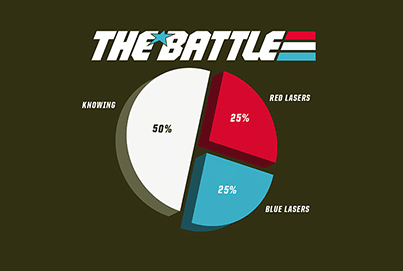
(Pie chart titled "The Battle." "Knowing" is at 50%, and 25% each are given to Red Lasers and Blue Lasers)

Yeah that's kind of what I was thinking even as someone who had not played before. That's honestly why I was leery of AOR at first until I saw people playing it. It's kind of like watching guys sweat while playing warhammer thinking that looks more like work than a game.

Yeah that's kind of what I was thinking even as someone who had not played before. That's honestly why I was leery of AOR at first until I saw people playing it. It's kind of like watching guys sweat while playing warhammer thinking that looks more like work than a game.

Like Ghost said, it is spill over from other games, those games were not supposed to do the bartering for eggs, and rolling for traps every time, it came around from GMs not wanting a player to find stuff or be unscathed going into a dungeon to fight. Laziness for the most part because the GM didn't want to do the work to properly populate the area, so it was easier to put traps in every room, or to stress players out.

I started playing AD&D in the early 80s and it was fun then evolved into numbers/skills micro management as the game grew older. If a player says to the GM he wants to roll a "perception chk" for the sake of time the GM should just say there is no traps and nothing else there. The argument could be but there is furniture, like a dresser, there should be something, again that is on the GM possibly being lazy or there really isn't anything there. Use common sense when in these situations.

Personally, if there is a trap in the room I will tell the players to roll, but not why, if the roll is unsuccessful then the trap gets sprung and all PCs close enough suffer the affects, if the PCs find the trap I make a judgement call on how easy the trap is for the disarm on whether I will actually force a disarm chk or hand wave, in this instance, it would probably depend on how bogged down we have been previously in other areas of play.

If there is an object in there I ask the players to roll but not why. Just remember, limit the amount of rolls to find said object, or you could be there forever. That is where the players need to separate their out of game knowledge and in game knowledge. Role playing is acting. The game is impromptu acting, to where only certain people actually know whats going on, the GM is the director.

BTW, I can't put the whole bartering thing on the GM, that could be over zealous players wanting things extremely cheap, but all in all the GM can put his foot down.

Edited by Osprey

Yeah, and a lot of inexperienced GMs get in over their heads, especially back then when there weren't all these internets to mine for assistance. A big part of why the GM job is so hard is because you have to take what the players give you, and turn that into a coherent story, while improvising solutions to get back on story when the players decide to do the unexpected.

Some GMs just assume "You're in D&D..... Go!" is enough to work with, and usually ended up just moving from dungeon crawl to dungeon crawl. Do that enough times and that's what people expect from an RPG, even though it can offer so much more.

If my play group spent any significant length of time arguing whether to buy eggs, I'd have someone else come and buy all the eggs while they argued.

Problem solved! .

I don't like to spend any significant time shopping in real life and I refuse to spend me gaming time pretending to shop. If players want to buy stuff I tell them to do it between sessions or give them a price and they can take it or leave it. No haggling,

In my one SW Saga campaign (I was a player) one of the PCs spent over an hour of game time buying bacta tanks and hiring someone to haul it to the ship. The GM had him roll something every step of the way. That GM also had us roll the piloting skill for every routine starship landing. It was maddening so I didn't last long in that group,

The old dungeon crawl attitude of D&D players can very very hard to break. I love D&D but when I DM. Run more heroic games and rarely use secret doors or traps.

Yeah that's kind of what I was thinking even as someone who had not played before. That's honestly why I was leery of AOR at first until I saw people playing it. It's kind of like watching guys sweat while playing warhammer thinking that looks more like work than a game.

Like Ghost said, it is spill over from other games, those games were not supposed to do the bartering for eggs, and rolling for traps every time, it came around from GMs not wanting a player to find stuff or be unscathed going into a dungeon to fight. Laziness for the most part because the GM didn't want to do the work to properly populate the area, so it was easier to put traps in every room, or to stress players out.

I started playing AD&D in the early 80s and it was fun then evolved into numbers/skills micro management as the game grew older. If a player says to the GM he wants to roll a "perception chk" for the sake of time the GM should just say there is no traps and nothing else there. The argument could be but there is furniture, like a dresser, there should be something, again that is on the GM possibly being lazy or there really isn't anything there. Use common sense when in these situations.

Personally, if there is a trap in the room I will tell the players to roll, but not why, if the roll is unsuccessful then the trap gets sprung and all PCs close enough suffer the affects, if the PCs find the trap I make a judgement call on how easy the trap is for the disarm on whether I will actually force a disarm chk or hand wave, in this instance, it would probably depend on how bogged down we have been previously in other areas of play.

If there is an object in there I ask the players to roll but not why. Just remember, limit the amount of rolls to find said object, or you could be there forever. That is where the players need to separate their out of game knowledge and in game knowledge. Role playing is acting. The game is impromptu acting, to where only certain people actually know whats going on, the GM is the director.

BTW, I can't put the whole bartering thing on the GM, that could be over zealous players wanting things extremely cheap, but all in all the GM can put his foot down.

Good advice in here. I really like the "there is a trap here, roll to see if you find it before it goes off" idea.

I don't like to spend any significant time shopping in real life and I refuse to spend me gaming time pretending to shop. If players want to buy stuff I tell them to do it between sessions or give them a price and they can take it or leave it. No haggling,

In my one SW Saga campaign (I was a player) one of the PCs spent over an hour of game time buying bacta tanks and hiring someone to haul it to the ship. The GM had him roll something every step of the way. That GM also had us roll the piloting skill for every routine starship landing. It was maddening so I didn't last long in that group,

The old dungeon crawl attitude of D&D players can very very hard to break. I love D&D but when I DM. Run more heroic games and rarely use secret doors or traps.

As the Core book is very adamant about having fun, this slow roll for every step just isn't fun nor does it feel like Star Wars. There's nothing slow paced about the movies therefore the games should reflect that.

I don't like to spend any significant time shopping in real life and I refuse to spend me gaming time pretending to shop. If players want to buy stuff I tell them to do it between sessions or give them a price and they can take it or leave it. No haggling,

In my one SW Saga campaign (I was a player) one of the PCs spent over an hour of game time buying bacta tanks and hiring someone to haul it to the ship. The GM had him roll something every step of the way. That GM also had us roll the piloting skill for every routine starship landing. It was maddening so I didn't last long in that group,

The old dungeon crawl attitude of D&D players can very very hard to break. I love D&D but when I DM. Run more heroic games and rarely use secret doors or traps.

As the Core book is very adamant about having fun, this slow roll for every step just isn't fun nor does it feel like Star Wars. There's nothing slow paced about the movies therefore the games should reflect that.

Yes, and since I was a Star Wars fan before I was an Rpg fan I have always preferred fast-paced action packed RPG play.