Armor stacking.

By Dared, in Talisman

4th edition.

If I have all the armor, can't I roll per piece, if I get killed?

If I cannot then a question comes to mind.

Why get the helmet if you already have the armour piece?

I suggest that I get one roll per piece after a death. Hence the 3 pieces to complete a full suit.

Wrong?

There are house rules in the Home Brew subforum that pertain to graduate or stackable armor. The "Armour" card was mislabeled from the very start in the first edition. If you look at the picture, its actually just torso armor... breastplate and backplate... or carapace if you prefer.

And yes, by the standard rules there is not point to getting a helmet if you have armor. Stacking or graduated armour use it against the standard rules.

Not officially but ive always house ruled that theyre stackable - gives more excuse to use gold too!

Officially, you may only use one Armor per combat.

But as others have already said, you can house rule that you can use all three if you really want to.

katana_one said:

Officially, you may only use one Armor per combat.

But as others have already said, you can house rule that you can use all three if you really want to.

But then you are too powerful, and then chance to lose a life will decrease..

So you can better use only one armor in battle..

Hey V., you are forgetting that the character can only carry 4 objects. Each extra armour card eliminates having (carrying, wearing) another needed object... such as all the magic goodies.

Stackable armour has its sacrifices... if you also rule that a mule, horse & cart, etc., aren't mobile grab bags one can dip into in an instant while one is under attack in Battle, Psychic Combat, etc. Yes, the standard rules allow this (or don't explicitly rule against it), including someone who has built up a mule train, and then thinks they can run up and down the line for equipment while a dragon is on the attack. Sooner or later we've all seen that at least once.

Just "Armour" by itself has a 50% chance of saving a life. Armour, Shield, and Helmet used in decending protective order have a maximum of about 74% compound chance of saving a life. But you've only got a one slot available for a weapon, and no magic objects (unless the weapon is one).

Hi

I still miss the corroding armour, breaking swords rules.... when you roll a 1.

These to me were providing a better reason to carry 2 armours than staking for the benefit of rolling for each armour!!!

Anyway, since 1st edition, we've been playing as you roll only once for an item, no matter how many you carry, and I don't think I've seen any novelty idea, up to now, that can convice me and my other player to change this!

Cheers

I remember the breakage rule, and some groups still use it. However, a 16.7% chance of breakage is way too high, considering I've actually sparred with combat steel. If there were a way to mitigate that excess percentage in Talisman, I'd see playing that rule again. But in using just 1D6, there's no convenient way to do that... so our group doesn't use it anymore.

A little verisimilitude is nice and good for any fantasy game. But just like a game that's too much artificial mechanics that disregard verisimilitude, improperly executed verisimilitude can have its faults too.

To be honest, I find that in my games most players tend to dump armour as soon as they find a better item (magic weapon, item or whatever) because it's usefulness is fairly limited. It won't generally be long before players get powerful enough to win most battles against enemies they encounter (particularly when questing in the dungeon; with all those strong or beasts to get experience from). A crafty player will likely get many spells which are probably more useful than armour anyway.

Against a stronger player opponent, armour is not going to stop them being beaten and having an item - which could after all be the armour itself - taken away; and if you are stronger than the other players then you really arn't going to need it. Still, I always thought it was a bit silly that you couldn't get any extra benefit for having a shield as well as armour. Funnily enough though, you can't use a shield and armour together in Runebound either (barring certain special cards).

Yes, I've noticed that nonsense in Runebound as well, though its mechanics are slightly different than Talisman. Still, Runebound 2.0 was developed by the same company that did Talisman 4ER.

As to armor being dumped, you're correct, even in our games... but only when we play the standard 1D6 combat. When we play the 2d6 system, with autowin (12) and autoloss (2) rules, armor becomes more important than ever. It is almost impossible to build up Strength / Battle Skill (or Craft / Psychic Skill) to reach an "untouchable" state.

Whether armor saves a life after the fact, or is part of a margin in Battlel where you lose but your opponent (player or enemy) can't take a life, armor gets seriously important in PvP and vs bigger, badder enemies in the 2D6 system. And the newbs who occassionally join in those games and think otherwise can die real fast. In those games, it is not uncommon for people to lean heavily on the GAS (Graduated Armor System) which is 95% the same as the stackable armor approach, and sacrifice "toys" that are only good under certain conditions.

We don't always play that way, especially if its supposed to be a social beer and chips night. But sometimes its just gotta be the grittier, nastier approach that isn't just new cards with different pictures and bigger numbers. In 2d6, a wild boar still has a reasonable if slim chance to tear a new one on knight with full armor and a magic sword. And in that form of play using armor, if you fight and lose and your armor fails, you lose a life... and then if you were facing another player, your opponent still get to chooses victory spoils as well... like the way it would really happen.

That any game involving physical combat is built to where armor is undesirable means the combat mechanics were poorly implemented. Much as I love Talisman, this has always been one of its unfixed problems since the beginning. Especially since you're not alone in your viewpoint on armor cards; its the prevalent view among many players.

vandimar77 said:

armour is not going to stop them being beaten and having an item - which could after all be the armour itself - taken away;

Another houserule we play is that a character gets to save if the winning player wants to take a peice of armour.

JCHendee said:

I remember the breakage rule, and some groups still use it. However, a 16.7% chance of breakage is way too high, considering I've actually sparred with combat steel. If there were a way to mitigate that excess percentage in Talisman, I'd see playing that rule again. But in using just 1D6, there's no convenient way to do that... so our group doesn't use it anymore.

Hi,

It's funny that we too founded that 16.7% was too high and we decided to use a 1D12 to solve the problem, of course this means that you need to buy a D12 but they are not too hard to find if you don't have one already gran_risa.gif

Another dilema that came forward was the lack of adventure cards that would break, rust, or melt the object you are wearing when you need it most, it would have to be considered to be numbered as a "1 event type" card so as to be faced before an enemy card.

I never had the chance to actually use combat steel, but I'm pretty sure that if I would be facing a dragon with only steel in hands, I would pray to any gods to keep "Murphy's law" as far away as possible from me so my steel will not break in my hands before the battle!

I don't know about you but the group I play with agree that 4er is seriously lacking in the "random object breakage" department, your objects are either good for all times or used only once.

Cheers

Hi O.M... we too considered the D12 at one time but decided against it for two reasons.

First, in sharing the 2D6 rules with others, particularly those new to the base game, we didn't want people to have to acquire special dice. Many who play Talisman are not from the RPG community, so are not familiar with either what they are or how to find them. Second, it's a flat range, and much as we wanted to pound down the chance of reaching autowin status, the Bell curve in using multiple dice (one's already in the box) works better for still giving those with the higher attribute a legitimate if not exaggerated edge.

We also smirked at the idea that equipment was somehow forevermore once it was acquired. But "events" outside of actual usage don't work. Weapons or armor always break at the worst possible moment (unless you're using them for a purpose not intended). And with proper care, and barring the effect of environment and weather upon the harder types, they don't break too often. You're example with the dragon isn't wholly accurate, for Talisman dragons are small beastial wimps. Hitting one, or fighting one, wouldn't have any additional drastic effect on equipment. And the eastern and western giant style dragons were simply harder to hurt (less damage in striking a larger opponent); by physics, there isn't any greater chance of breaking a weapon. That's stuff for the movies.

Breakage might happen even if you win where weapons are concerned, but we couldn't find a way to account for that as a very slim chance without additional rolls. (As it stands, the armor approach in Talisman is a bit hinky anyway, but it works for simple boardgame.) Rolling 2 on a 2D6 was already an autoloss, so throwing in weapon breakage on top of that was too much... even though rolling 2 is a very slim percentage and would have been acceptable for a breakage of a well cared for weapon. (NOTE: rolling a 2 on 2D6 is about 2.7%; a 1 on D12 is 8.3%, still too much; a 1 on D6 is 16.7% and ridiculously high.)

Dealing with breakage on armor was a whole other challenge. We considered a margin between opponent's rolls of greater than 6. Of course this only happens if one is NOT using a 1D6 approach. And in one armor system we have used, the margin was to see if in losing you lost a life for your armor being bypassed. (No separate armor roll... everything was determined in the 2D6 Battle roll... clean and fast). So adding breakage again got too complicated and too severe.

Murphy's Law has very little influence on combat quality steel. Usage, abusage, and disregrad for proper care are the factors that affect steel. I have actually swung a 175 year old transitional broadsword (narrower than the ones most people think of from movies) against a lead pipe with full force. They owner asked me too, to show me what a quality weapon of age could do, but didn't want to risk it against steel. It cut about an inch into that pipe. Well cared for weapons last.

So in the end, with fixing the combat system in a graduate set of three levels of rules that could be used all or just one, we gave up on the breakage. There used to be some happenstance to destroy equipment in the game's past, and maybe we'll see that again. Until then, well, it's a small thing and probably not worth the fuss for now.

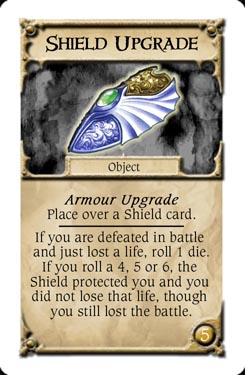
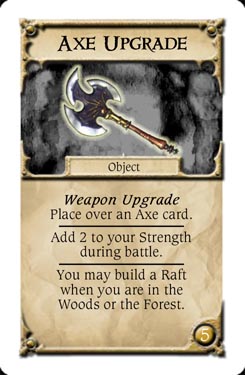
I've made a few cards based on Upgrading the various Armour and Weapon items in the game. One was seen in the original Talisman plug-in for Strange Eons as the Purchase Card example.

They are bought by visiting the Blacksmith and are placed over your exisiting item. I intended to have them able to be destroyed in some way, either reverting to the original item and losing the Upgrade if you lost a combat (or something). Perhaps they can be thought of as an outer layer of some sort...

se_shieldupgrade_sm.jpg se_axeupgrade_sm.jpg

Thoughts?

Hmm.... how much would that cost? Probably best that they cost as much as the original item, that way you really have to pay for them. Don't make 'em too cheap. As to losing the upgrade... boy, I don't know how you'd work that. By the standard from of Battle rules with 1D6, maybe on a 1 you have to roll again? If you get another 1 on that weapon check (with no Fate use) then the upgrade is lost? Maybe something similar for the shield upgrade, but rolling 1 on the armor roll is the trigger for a 2nd roll? Or is that too many rolls for the average kind of player?

On the weapon upgrade providinng +2 instead of (not in addition to?) +1 in Battle... that's getting up there for a mundane weapon. Most magic weapons have a higher bonus only against certain types of enemies, or they have some other extra ability. That weapon upgrade should be rather expensive by comparison, maybe the original weapon cost and +1 to get it, so a Sword or Axe with upgrade might be (cost x 2) + 1 = TOTAL COST. Cost of a sword upgrade at 3G and axe at 4G?

ASIDE: Other than the axe's use to build a raft, it's always struck a little funny that an axe costs more than a sword... must be some poor quality sword.

You might also want to note that any weapon or armor can only have 1 upgrade on it. Granted, in 4ER is unlikely most players would bother and will just go after the magic objects and other freebies in the adventure deck. But I have seen some games where people amass a fistful of gold and put it to good use, and they'd exploit that the upgrade system, though the card's bonus is obviously not cumulative. If I show these to my crew, I can already imagine the amounts of gold they'll be trying to steal from each other for that extra edge in our 2D6 combat. gui%C3%B1o.gif

The idea is that each upgrade only gives a +1 bonus to the original item, and that would be it. Perhaps charging the same cost as an original item would be the way to go as it offers more protection and there is very little currently to spend your cash on anyway.

I am not sure it needs the clarification that you cannot use more than one as you put the upgrade over the original item. That's why I didn't go with "this gives you +1" and went with definitive wording for the upgrade.

I think if I have some spare cash and already have a sword or helmet I would be more likely to buy an upgrade.

As for losing the upgrade.. how about throwing a second (or third!) die in combat? Mind you, that still gives a 1 in 6 chance of losing it, which is probably too much even if you are only losing the upgrade. Perhaps it could be argued that upgrades are more fragile... I don't really know. I did envisage that upgrades could be lost, but maybe they should not be. They might just stay attached to the item until it is lost...

Hi,

Nice cards Jon gran_risa.gif , these are nice alternative to the different strengh +1,+2, +3 armours, helmets, shields... proposed in another thread.

JCHendee, I understand what you mean about the D12 with new players, and since I play mostly with the same Talisman veteran players, this situation didn't come to mind, anyway, that was only to let you know that this was the solution that we came up with and is integrated into our games for the last 20 or so years. 8% is considered acceptable and representative in our group with the D12 opposed to the D20 who some of us consider to negligable and was looked only as another tossed of the dice since in games played that way, most didn't see any breaking happening!

Event card stating that your sword, armour or helmet is broken for whatever reason, was discuss in our group kind of represent the fact that, like "murphy's law", when you really need something that's the moment it choose to break llorando.gif .

Can you imagine, you are about to meet the Lord of Darkness and your sword breaks!!! demonio.gif

I can hear laughter in the room....

Cheers

talismanisland said:

The idea is that each upgrade only gives a +1 bonus to the original item, and that would be it. Perhaps charging the same cost as an original item would be the way to go as it offers more protection and there is very little currently to spend your cash on anyway.

I follow on the upgrade issue, and that sounds find... ignoring that there is little way that a weaponsmith can upgrade or reforge a weapon (in reality that actually weakens the blade). I'm wondering... maybe the Alchemist is the one from whom to seek the upgrades? Or even the enchantress (though maybe that's too risky in most players eyes). You could turn the upgrades into a form of alchemical emersion or enchantment... and hence they become "Magic Objects" of a simplified form. Instead of breakage, they are susceptible to dispells and event based loss of bonus versus true magic objects. Just a notion to get around the whole breakage issue with adding extra mechanics.

I think if I have some spare cash and already have a sword or helmet I would be more likely to buy an upgrade.

talismanisland said:

As for losing the upgrade.. how about throwing a second (or third!) die in combat?

talismanisland said:

Perhaps it could be argued that upgrades are more fragile... I don't really know.

You are actually correct. The problem with Talisman's combat system is that the re-honed and hardened blade (not the same as sharpening) wouldn't make you better in Battle. It it didn't break (and it would be more brittle), it might [?] have better pentration, meaning more "damage" or perhaps making armor less effective against it. But that's all too much for Talisman... unless you wanted to make their bonus be taking and extra Life from an opponent in victory. But even that just doesn't sound right by any reasoning.

The more I think about it... the concept of an alchemically treated weapon does offer a way out of some of the problems, puts a new twist on a standard personae on the board, and still offers lost of the upgrade by standard game mechanics. If that appeals, I think a standard price for all upgrades of 3G would be a decent way to go as well.

We play an adaption of the 3rd edition; when rolling for combat (weapons) or rolling an armour save on a result of 1 roll another die, on a further 1 the weapon or armour breaks.

A further change we are considering is making a difference between mudane and magic weapons and armour. On the 2nd d6 roll a mudane weapon/armour breaks on a 1-3 and a magic weapon/armour only breaks on a 1.

Mind Robber said:

...rolling for combat (weapons) or rolling an armour save on a result of 1 roll another die, on a further 1 the weapon or armour breaks.

Fairly sound, but keep in mind that penetrated armor is still effective. Armor doesn't "break" (become utterly unusable) as easily as a weapon because even the hard / metal stuff is designed to redistribute impact force. That's its primary purpose for the kind seen in Talisman. This of course led to such weapons as the alhspeiss, used for "staking" a heavily armored knight once you knocked him down. Armor should be very difficult to "break" compared to a weapon, by whatever percentages you choose in the end.

Mind Robber said:

A further change we are considering is making a difference between mudane and magic weapons and armour. On the 2nd d6 roll a mudane weapon/armour breaks on a 1-3 and a magic weapon/armour only breaks on a 1.

Not bad. The chance of a 1 on the first roll is 16.7%; a 1-3 on the second roll gives a final compound chance of breakage at 8.35%. It's still a little high, but pretty good for a weapon. If you're going to stick to multiple rolls, you might consider a mundane weapon requiring two 1s in a row... and then something even more remote for a magic weapon.... and then magic armor isn't unheard of as well. What about this...

Weapon: on a 1, roll for a 1-3
Armor: on a 1, roll for a 1
Weapon, Magic: on a 1, roll for a 1; if so, roll again for a 1-3
Armor, Magic: on a 1, roll for a 1; if so, roll again for a 1

Normal equipment goes only to a second roll. Magic equipment must go to a third roll before it breaks. It's a bit much for my tastes, but it puts "magic" vs "mudane" as well as "weapon" vs "armor" on a more realistic scale.

JCHendee said:

The more I think about it... the concept of an alchemically treated weapon does offer a way out of some of the problems, puts a new twist on a standard personae on the board, and still offers lost of the upgrade by standard game mechanics. If that appeals, I think a standard price for all upgrades of 3G would be a decent way to go as well.

Hmmm.... Okay, how's this?

Armour upgrades can be purchased at the Blacksmith and weapon upgrades at the Alchemist? 2 or 3 Gold I'm thinking...

I am veering away from making them "breakable" though as I think there is a place for them rather than just flooding the deck with stronger items and giving something else to spend your cash on. Maybe there can be a couple of "downgrade" cards, probably spells, to remove them instead. Perhaps they can be considered permanents, so your objects will be a little more tempting to a character who defeats you in battle?

Your new options sound good. And I think a quick note for the alchemist's weapon "upgrade" on the card could state that it is susceptible to a "Nullify" spell. Though I see you want to lean away from the breakables, perhaps for the Armor upgrade, anything that would destroy or cause armor to be discarded, the bearer can save the armor by discarding the upgrade instead. It's not completely logical, considering the upgrade is built into the armor, but its the only notion that popped up. Just some thoughts. And the temptation factor has been there from the start of your concept, so that's good.

I agree with avoiding throwing more "toys" into the varied decks. There's enough already, proportionally.

I think I may add in a rules sheet with the breakages as an optional rule.

2 Gold should be a reasonable price and it leaves open the chance for more expensive upgrades in future... maybe...

I am not sure about using Nullify as once an object had been meddled with alchemically, surely it would just "be" the new element? You would need to cast some other form of alchemy to change it to something else. <ponder>

I'll probably make some note about how a Weapon Upgrade is still classed as a Weapon. I am also thinking of calling them Enhancements too... a little less techy. Making the keyword - "Enhanced Armour/Weapon".

It all sounds fine to me... though alchemy should not be thought of as actual chemistry. Alchemy by modern paradigms on classical magic is a subset of the three methodologies for enacting magic (be Sorcery, Thaumaturgy, or Conjury). It is a subset of the "artificing" methodolgy of enacting magic, as opposed to the method categories of "ritual" and "spell." It is still inherently magical and not craft or science oriented. And if it is some form of permanent unalterable change, it would be highly expensive and time consuming. But reason it however you like.

I've never cared for the concept of the alchemist "turning" items into gold... it's silly. Obviously he's just getting a deal from desperate adventurers for raw materials to serve his own needs.

The wording change for "enhanced" is a good one! Almost echoes the word "enchant" without being obvious. And now that you mention it, "upgrade" is indeed a little "tech" oriented.