Either... or...

By leptokurt, in Strategy and deck-building

I am ashamed to admit that I forgot how to deal with the "either... or.." effects*. I know this has been ruled, but I can't find it.

In the example below, can I choose the first option even when there are no resource tokens on the quest card?

I ffg_MEC45_45.jpg
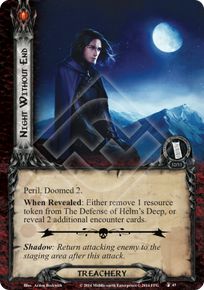
* and for posting into the wrong forums... <_<

Edited by leptokurt

(I think this is meant to go in the Rules section)

You can choose when it says "either," but you have to choose one that can be fully resolved.

From the FAQ:

(1.44) “Must X or Y” vs “must either X or Y” If a card instructs a player to perform one task or perform a second task using the structure “... must X or Y...” then the player must attempt to perform the first task, and performs the second task instead only if the first task cannot be performed. If a card instead uses the structure “... must either X or Y. ..” then the player may choose which task to perform, although one of them must be performed in full, if able.

Either...or means you can usually pick whatever one, but it has to resolve. So you can't choose the first one because it won't resolve. (Like how in Conquest each action you take has to change the board state.)

Thank god, for a moment I thought my post was lost.

(yes, it was meant for the rules section)

Ok, does that mean that I cannot choose the former, but I have to go for the latter 8which i did, just in case)?

And Spleen, you're such a great guy! Thanks! :)

This card sucks, but at least that game I talked about was so, so epic! And a win nonetheless! May as well post my super-dooper Hobbit-Ent deck when I have the time.

We have a nice community with lots of folks willing to help out with all sorts of questions, nice to be here!

Helm's Deep is difficult, so congrats on your victory. Endless Night: If there are no resource tokens on it, you have to reveal more cards. It is one of those treacheries you would really like to cancel. That or, the 'Devilry of Orthanc,' if that's correct (blanks text boxes and puts 3 progress on the quest). I hear this one is easier in pure solo, but I have only tried in 2- and 3-player games.

Edited by GrandSpleen

I have no specific card in mind, but as far as I remember there are cards the game with the structure "the player must X or Y, if able" which confuses me every time. Does that has to be interpreted as "(X or Y), if able" or "X or (Y, if able)"?

The player must X, if able; else Y.

Yup, and just to highlight the relevant portion of the FAQ (also quoted above in this thread):

" If a card instructs a player to perform one task or perform a second task using the structure “... must X or Y...” then the player must attempt to perform the first task,"

I am not a native english speaker... at the moment I am wondering why they print "X or Y, if able" then and not "X, if able or do Y". Well, anyhow: thanks for clarification.

That would be less ambiguous. I couldn't say why they print "must do X or Y." Once you know that it is supposed to be interpreted "[must do X], or [do Y]," then it is easy to parse and.. I suppose it saves them text space so they don't have to write "if able" every time? But yes, certainly "[must do X if able], or [do Y]" would result in less confusion.

You can choose when it says "either," but you have to choose one that can be fully resolved.

I'm always puzzled when I can choose one that can resolves, but has no real effect (like all location gain +X when no location is in play, or stacking with an effect already active, or when it has no consequences at that time).

I guess the golden rule should be used here ("choose the worst one").

You can choose when it says "either," but you have to choose one that can be fully resolved.

I'm always puzzled when I can choose one that can resolves, but has no real effect (like all location gain +X when no location is in play, or stacking with an effect already active, or when it has no consequences at that time).

I guess the golden rule should be used here ("choose the worst one").

They way I've seen it explained is passive vs active. "Add +x threat to locations until the end of the phase" is a passive, constant effect and can always resolve. You never know, maybe a location will get revealed later in the phase. But "Return all goblins to staging area" cannot be resolved if there are no goblins in play, because it is telling you to actively do something right now that you can't do.

You can choose when it says "either," but you have to choose one that can be fully resolved.

I'm always puzzled when I can choose one that can resolves, but has no real effect (like all location gain +X when no location is in play, or stacking with an effect already active, or when it has no consequences at that time).

I guess the golden rule should be used here ("choose the worst one").

They way I've seen it explained is passive vs active. "Add +x threat to locations until the end of the phase" is a passive, constant effect and can always resolve. You never know, maybe a location will get revealed later in the phase. But "Return all goblins to staging area" cannot be resolved if there are no goblins in play, because it is telling you to actively do something right now that you can't do.

Actually, "Return all Goblin enemies to the staging area" is something you can always do, because 'all' can include 0. If it was ' each ' Goblin, then that would be different, because 'each' can't include 0.

Edited by PocketWraith

You can choose when it says "either," but you have to choose one that can be fully resolved.

I'm always puzzled when I can choose one that can resolves, but has no real effect (like all location gain +X when no location is in play, or stacking with an effect already active, or when it has no consequences at that time).

I guess the golden rule should be used here ("choose the worst one").

They way I've seen it explained is passive vs active. "Add +x threat to locations until the end of the phase" is a passive, constant effect and can always resolve. You never know, maybe a location will get revealed later in the phase. But "Return all goblins to staging area" cannot be resolved if there are no goblins in play, because it is telling you to actively do something right now that you can't do.

Actually, "Return all Goblin enemies to the staging area" is something you can always do, because 'all' can include 0. If it was ' each ' Goblin, then that would be different, because 'each' can't include 0.

Well, I got my example from here: http://www.cardgamedb.com/forums/index.php?/topic/1702-official-nate-rule-clarifications/?p=86990

Chaos in the Cavern : has an immediate effect (return all enemies to the staging area) that if it triggers creates a lasting effect (each Goblin gets +1 threat strength until the end of the phase). If there are no enemies engaged with players at the time Chaos is revealed, then it cannot trigger because no enemies are returned to the staging area. That means the "then" clause will not trigger and Goblins will not get +1 threat strength.

Treacherous Fog : works the opposite way. It creates a lasting effect (locations in the staging area gets +1 threat strength) that triggers an immediate effect (players with 35+ threat must discard 1 card). Since this lasting effect affect the game state, it will always resolve. Even if there are no locations in the staging area at the time Treacherous Fog is revealed, locations will still get +1 threat strength until the end of the phase. That means if a location is added to the staging area after Treacherous Fog is revealed, it will get +1 threat until the end of the phase. Because the lasting effect of Treacherous Fog always resolves, it also means the "then" clause will also always resolve.

So, if there are no locations when Treacherous Fog is revealed, it still resolves because it has successfully created a lasting effect. However, if there are no enemies engaged with players at the time Chaos in the Cavern is revealed, it cannot resolve its immediate effect and you should not resolve the "then" effect.

Cheers,

Caleb

Well, the ruling on the difference between 'all' and 'each' is just one post further down that thread, so I don't know what to tell you.

Yes, the two rulings seem in direct contradiction. I guess we go with the more recent one.