Squadron Markings & Colors: Take 2

By Commander Kahlain, in Star Wars: Armada

First, the goal here is to summarize useful resources on squadron colors and markings.

I am moving highlights of a thread created back in January. Extropia had an excellent and concise answer to a question I posed back then -- so hats off to him.

I can add a little to this:

Known Rebel Squadron names:

Grey

Blue

Red

Green

Gold Colour schemes for this lot pretty obvious

http://starwars.wikia.com/wiki/Category:Rebel_Alliance_starfighter_squadrons

This is a much more comprehensive list. Many of them (most?) d not have established colour schemes however.

Fighter designations I think are either done through the "tabs", or done individually. It all depends how organised that particular Rebel command is. I think following the tab system that MilleniumFalsehood has done decals for is a good guide for "coloured" squadrons though. Ace squadrons are probably more individual.

Imperial squadrons are usually just grey or blue. Some had squadron markings of various sorts, and some aces were known to have personalised schemes and kill markings.

Here is a full list of known Imperial squadrons:

http://starwars.wikia.com/wiki/Category:Imperial_starfighter_squadrons

Here is a Tie Fighter with either a sqadron or ship marker, and you can see these in the original trilogy:

pentagon_tie.jpg

and a better, no movie image:

DSC_0312_zps97f03e11.jpg

On that note, the red stripe is not for aces in general. it is specifically Soontir Fels marking, which he passed on to his command (the 181st Fighter Wing).

I cant help with the painting side yet, but i'll be doing the same and will share notes later. Hopefully this helped a tiny bit!

If you want to look at the original thread, it is here: Squadron Colors & Markings

I plan to post my efforts as replies to this thread -- as soon as I get them done.
Leifer has some really good TIE/Ln's and X-wings over in Test Models . His are harder to find since they were posted prior to the sub-forums being introduced.

His post gives some good information on how he got the look he did.

Edited by Commander Kahlain

This is the single best mini-painting summary I have found to date: Thanks to MadTulip for this one:

A good all through the painting topic guide can be found here.:

http://www.how-to-paint-miniatures.com

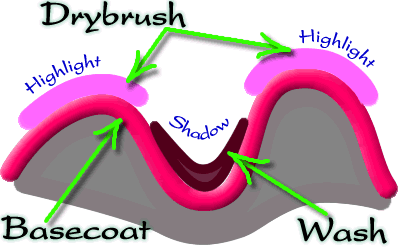
The main "trick" which is easy to do can be seen in this picture.:

paint_layers.gif

- you basically paint everthing in one base color (which might not be needed for the small TIEs).

- you then water down a i.e. black unti you can see through it quite well when the paint is running over the walls of your mixture glas. apply that paint everywhere over the model without any precision. pick up very large pools of paint going over multiple textured sections. while it dries it will receed to pool inside the cracks and valleys on the model and make them look shaded/darker. this is what people call washing or inking. its maybe the only step needed for the TIEs as ppl. where suggesting.

- afterwards you can do the opposite with a highlight color. you apply very little thick(unwatered) color to a brush with short hairs similar to a thoothbrush. then you stroke that brush over some cardboard until it only leaves some very dry color residuals on the cardboard. with that brush you can then "drybrush" over the miniature which will effectively only hit the higher areas as the paint cant flow into the cracks anymore as its already to dry and the brush hair is short and more stiff than usual.

by that sceme you can easily (without the need for accuracy with the brush) apply 3 layers of shades to the valleys and hills of a model. without any brush precision this looks quite nice and far supperior to just painting base color which always loos kinda artificial. the "skill" with wash and drybrush which you will develop over time is to judge how well you have to be able to see through the ink while its running over the wall of your mixture glass and how "dry" the color has to be in the drybrush step. watering more and drying more in the first run and then doing it multiple times is the save way.

vallejo colors are imo industries best, if you dont have colors yet.

for models the size of TIEs you can probably skip the base color compleetly. if you want to do base color (i.e. red striped on the x-wings) then the base color step is the one where you need precision with a very small brush. one thing important while appliing base color is to not use too thick color! it should not change the texture on the model at all if possible. i usualy water the color down with like 10% to 25% water (just dip the brush in water, shake the drop of and then dip that brush in the color). the skill with base color you will develop is pricision with the brush. try to avoid painting 90° to the brush axis. try to allways pull from brush tip towards end of the brush. do the difficult outline of areas first then fill it. With drawing a precise line between two neigthbouring areas i use to paint the one area which has the slope at the border first and then the other which is flat. i.e. large boot over pants the boot usualy slopes down to the pants. so paint the boot first as paiting on the slop is more difficult. dont worry to much about precision as wash and drybrush will blur out those boarders anyway.

if you go for larger models there is a 4th step of painting the whole miniature in the same "primer color" first in order to make the other layers stick better to it. if you use black as that color the mini will get darkder overall. if you use white it will be shiny. if most parts of the mini in the end should be glorious shiny knigts in bright yellow or red armor you should not use black primer but plain white or bright gray instead.

if your uncertain if you would mess up your first model trial you can try this stuff out using any kind of exposable textured ebject first. i.e. a walnut or some other thinigs with finer structure than that.

Original Source: here

Edited by Commander Kahlain