You're allowed to make those measurements though. After the activation phase.
Abusing checking for Target Locks?
You're allowed to make those measurements though.
You're allowed to measure for TL during the activation phase... So how is that different?
Because that's all you're allowed to measure.
Because that's all you're allowed to measure.
Again I ask how is that different?
If I'm checking for range, I can check the range to my target and my target only. It's not like I can check the range for a ship that's behind me, if I don't have turret.
So how exactly is there any difference between measuring for TL and to see if something in in range for an attack?
I am amazed that you are still trying to enforce a personal opinion as a fact. Also still waiting for that rule citation.
You've had one... in fact you've had several. Just because you disagree doesn't make the ruling invalid or non-existent
Also how do we know the dimensions of the board? If we had no knowledge of the board's size beforehand we would have to measure it or acquire the knowledge from someone who did. And if we know the dimensions of the board we got accidental information on the game which seems to be a big no-no to some people.
You know because the board is 36", as per the rules for standard tournament play (which we know is Range 9, as each range band is 4")
I must have missed the part where measuring to my intended target is wrong, please do show it for me, i checked and not seeing there.Not trolling or anything here but i already made my statements about the target lock rule and sportsmanship rule, which both of them don't have anything that says "you can't measure for target lock for ships that are clearly out of range" or "you can not get any other information when you are measuring for a target lock".
because you should have better spacial awareness than an infant?
Thanks for the compliment, yet people are talking about banning people from tournaments here for doing something within the rules.
(can't seem to remove the empty quote box underneath, please do ignore that)
Edited by pizzaguardian
I remember we took 'no pre measuring' out of 40k because it penalised players who had poor depth perception.
The old rules used to allow 'guess range' weapons like mortars which in theory were great fun as you'd have an element of 'ranging' from the first shots.
But as said some people have real issues with depth perception so the rules changed. Allowing people to measure ranges didnt slow down 40k noticably, i cant see it being a massive issue in xwing.
Because that's all you're allowed to measure.
Again I ask how is that different?
If I'm checking for range, I can check the range to my target and my target only. It's not like I can check the range for a ship that's behind me, if I don't have turret.
So how exactly is there any difference between measuring for TL and to see if something in in range for an attack?
This isn't correct (Vanor), though. When the time comes to activate your ship, you are explicitly allowed to measure to any and all possible targets before selecting one. That's notably different than being allowed to measure to only a single selected target, and being explicitly prohibited from measuring to other targets.
You're allowed to make those measurements though.
You're allowed to measure for TL during the activation phase... So how is that different?
When declaring a target lock action, or aquiring a target lock, it specifically says that you measure to the ship you have targeted and ONLY to the intended target. Making it clear that you are not supposed to be gathering information on the other ships ranges. Is it possible you may gain some information? yes. But if you are declaring a target lock and your sole intention is to gather that secondary information, then you are breaching the tournament rules relating to abusing the rules in the game. Can we always tell your intention? No, and some close ones will and should be let go, but you know you are cheating the rules. However obvious ones (such as my range 8 example) can and should be pulled up as blatent cheating.
During the combat phase you are explicitly allowed to measure range to ALL targets before deciding who you will shoot at, but only measure to and from the currently active ship.
Let me preface this by saying that I'm very much a "in the spirit of the game" sorry of person and will only declare/measure TL if I genuinely think it'll be in range.
The rule is just kind of dumb. If you are not supposed to get any information outside of "is my target in range of TL" then the measuring mechanic is wrong because it's so easy to exploit, intentionally or otherwise.
If players are already pre-measuring in the activation phase by exploiting TL and it isn't damaging the game, what's the point of the rule? It serves no function other than to make players dishonest with each other.
serves no function other than to make players dishonest with each other.
Leaving aside the general point of whether measuring should be allowed, I have to take exception to this.
The rule does not serve to make players dishonest with each other. Those players are already, and always will be, dishonest. It's perfectly possible to play with the current rule without trying to target lock something halfway across the board, and even possible to check for something legitimately close without checking range to intermediate elements. The rules certainly don't make anyone do anything dishonest.
It certainly gives dishonest players an opening to exploit, which is unfortunate, but put the blame where it's due - the players, not the rule.
Leaving aside the general point of whether measuring should be allowed, I have to take exception to this.serves no function other than to make players dishonest with each other.
It certainly gives dishonest players an opening to exploit, which is unfortunate, but put the blame where it's due - the players, not the rule.
You misunderstand my point. I'm not talking about a player that declares a TL from the other side of the board, I'm talking about any time the range ruler is placed on the table outside of the combat phase.
Even if you are in range, you know if you are in range 2 or 3 and you know range of near by ships both your opponents and your own.
Target locks do more than just increase accuracy and fire ordnance. The incidental information they provide affect your decisions for all your ships that haven't yet activated.
So now we have a situation in which if you at range 1-3.5 ish is okay to gain all that extra information because it falls into an acceptable margin of error but outside that is a bad.
My point about dishonesty is that even if you are in range, the moment you put the ruler on the table you gain information you otherwise shouldn't have, and the only way you can claim the moral high ground is by having an independent 3rd party measure your declared Target Locks while your back is turned.
Target locks do more than just increase accuracy and fire ordnance. The incidental information they provide affect your decisions for all your ships that haven't yet activated.So now we have a situation in which if you at range 1-3.5 ish is okay to gain all that extra information because it falls into an acceptable margin of error but outside that is a bad.
My point about dishonesty is that even if you are in range, the moment you put the ruler on the table you gain information you otherwise shouldn't have, and the only way you can claim the moral high ground is by having an independent 3rd party measure your declared Target Locks while your back is turned.
Not at all.
If a model is clearly inside Range 3, I never even pull out the ruler. If it's clearly outside range, I never even declare the lock. If it's close enough to need measuring I focus on the ship at hand and don't eyeball everything else on the board, or do it with a quick check that barely even sets the ruler down.
I don't expect everyone to do that. I recognize that there is incidental information to be had, and if you choose to exploit that, then that's up to you. But when you're intentionally declaring impossible-to-complete actions to create an excuse to put the range ruler on the board, you're measuring. And contra the ever-deceptive guardian of pie, that is something which you are explicitly prohibited from doing.
As you and Vanor point out, there's some potential problem with that ruling. But even greater problems exist on the other side, too - if "measuring" means solely and only using the range ruler directly between two specific ships involved in an ability, then you're free to use any other means you might like to "not measure". Use your hand and fingers, use the dials, throw a card down. Heck, if it's not measuring to a close ship just because the range ruler isn't pointed directly at it, why can't you just drop the range ruler at will? So long as you don't point it at a ship, you're not actually measuring anything, per their definition.
So yes, there's potential incidental information to be had no matter what... but there are different lengths to go to in achieving that, and there is most certainly a moral high ground here, and the guy who claims with a straight face that you can't know if two ships at opposite corners are in range is not standing on it.
Edited by BuhallinIf a model is clearly inside Range 3, I never even pull out the ruler. If it's clearly outside range, I never even declare the lock. If it's close enough to need measuring I focus on the ship at hand and don't eyeball everything else on the board, or do it with a quick check that barely even sets the ruler down.
While I have no reason to doubt your claim, I'm more inclined to believe that you do use the incidental information you gain when you do lay down the ruler, even subconsciously.
I would also go further and say that even if you do exactly as you say, your method of playing the game is a far more idealistic version of the game that most of us either play or have to play against.
The issue is the point where the mechanics are being exploited varies from person to person or area to area.
Measuring from the other side of the table is obvious
Measuring from effective range 4 (or 2.5 ship bases from range 3) is obvious for some but not so for others.
Measuring from just in or out of range 3 is obvious for a few, but not for most
Measuring from around range 2 is obvious for some but not for others.
It would be great if no one needed to measure TL unless it fell between R 2.9-3.1 but that's just not the case.
So yes, there's potential incidental information to be had no matter what... but there are different lengths to go to in achieving that, and there is most certainly a moral high ground here, and the guy who claims with a straight face that you can't know if two ships at opposite corners are in range is not standing on it.
I'm certainly not suggesting that the guy claiming target locks from the other side of the board so he can pre-measure is of strong moral character, it's obviously exploiting the spirit and intent of the rules. I am saying because there are no rules regarding the incidental information, the line is wherever we agree it is, which is a big part of the problem.
The actual problem though, is the rule. It restricts information that affects your choice, then offers it back to you if you have 1 particular action on your action bar, but only if you are between range X - Y of your target ship. The values of X and Y are filled out by the two players and so are just way to subjective for it to be a rule.
While I have no reason to doubt your claim, I'm more inclined to believe that you do use the incidental information you gain when you do lay down the ruler, even subconsciously.
I would also go further and say that even if you do exactly as you say, your method of playing the game is a far more idealistic version of the game that most of us either play or have to play against.
I'm not sure calling my play idealistic is actually "going farther" than challenging my subconscious behavior, especially when you've never actually played with me, but you're not wrong about the idealism. More idealistic than most play, though, does not mean it's not in line with the actual printed rules.
I am saying because there are no rules regarding the incidental information, the line is wherever we agree it is, which is a big part of the problem.
Again, there is a rule that you cannot measure to any ship other than the one you're taking the lock on. We could be debating what "measuring" actually means (a subject I've tried to approach) and how that affects it. I think the one put forward by the exploiters - that anything they do short of pointing the ruler directly at another ship is fair game - is basically meaningless.
That does create a rule which is prone to be accidentally broken on a regular basis. It's not the only one in X-wing - bumping ships, placing the wrong dials, accidentally picking up the wrong dial, forgetting critical or other mandatory effects... I'd wager there are very few games which get by without at least some accidental issue in the rules. Being a rule that's prone to accidental breakage very arguably makes it a bad rule. But it's also not the only one of those in X-wing.
But I'm also not sure that matters. The real question should be what the rule actually is, good or bad. There is an explicit rule that you cannot measure to any ship other than the target during a target lock. The only issue is whether "Oh, I'm measuring to that ship on the other side of the board, not this one right at the edge of Range 1" is true, or whether you're actually measuring to that ship right at the edge of Range 1 even though your ruler isn't pointed directly at it. I think the only way the former flies is if you have a measurement definition that's so strict that it allows near-infinite means of measuring that aren't "measuring".
Edited by BuhallinAgain, there is a rule that you cannot measure to any ship other than the one you're taking the lock on. We could be debating what "measuring" actually means (a subject I've tried to approach) and how that affects it. I think the one put forward by the exploiters - that anything they do short of pointing the ruler directly at another ship is fair game - is basically meaningless.
So, implicitly, if I were to declare a TL to your ship at R3, and it was reasonable to measure because it's just at the edge of R3, and you had a second ship somewhere between my ship and my desired TL, we would have to remove that ship before I place the ruler down because that would result in me 'accidentally' measuring range to a ship I didn't declare a TL on.
Only we'd have to mark that ship's position so we know where to put it back.
Only we'd have to place a sheet of paper over the mark so I couldn't see where the ship would go back.
I accept that some rules have corner cases, but if you have exceptions to rules that occur every other turn, when players are trying very hard *not* to exploit it, it's a very bad rule.
But I'm also not sure that matters. The real question should be what the rule actually is, good or bad. There is an explicit rule that you cannot measure to any ship other than the target during a target lock.
Completely disagree on whether it matters or not. Like you said, the rule is clear, you get to measure to a ship, and only that ship, you declare a TL on, even if it is on the other side of the board. And because there is no explicit rule on what precisely is measuring (as you mentioned already), people do it and 'accidentally' measure to every ship along the way.
That's why it's a bad rule. That's why it gets exploited even by people who aren't trying to. That's why we are having this conversation. Bad rules should be fixed. Which was the initial point I made before I started waffling, the game loses nothing by allowing pre-measure in the activation phase, because it's already happening to varying degrees.
Edited by RividiusThat's notably different than being allowed to measure to only a single selected target, and being explicitly prohibited from measuring to other targets.
There is nothing in the rules that state you can't gain additional information when making a measurement, only that you have to measure directly to the ship in question. As long as you are measuring to the selected target any other information you may or may not gain is not prohibited by the rules.
Because what you're saying would make the following example illegal...
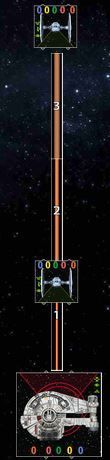
I gained information and in fact measured to the closer Tie, are you saying that checking for TL in this example would be illegal?
I could in fact by the rules decide that since the farter Tie is out of TL range, use a barrel roll to get out of range 1 of the closer tie.
But if you are declaring a target lock and your sole intention is to gather that secondary information, then you are breaching the tournament rules relating to abusing the rules in the game.
That's why we have TO's, and as I said as a TO if I saw someone checking for TL ranges at 5+ I'd stop them.
Edited by VanorDMDuring the combat phase you are explicitly allowed to measure range to ALL targets before deciding who you will shoot at, but only measure to and from the currently active ship.
And during the activation phase, you're explicitly allowed to measure range to any ship you wish to TL, with the additional rule in the competitive rules, that if a ship in in range you must TL it.
No where in the rules does it say you can only measure if you think it may be in range but you're not sure. The method used to measure is exactly the same when you are checking for TL or for attacking.
More idealistic than most play, though, does not mean it's not in line with the actual printed rules.
Yet the printed rules don't actually say anything about additional information gained when taking a measurement.
There are times as Rividius points out that there is no way you can avoid measuring to another ship even if it's indirectly, in the process of measuring to the target ship, as I showed in my above example.
So any time someone tries to claim something is against the rules, when that thing is blatantly impossible, then either the rule is hopelessly bad, or their interpretation of the rule is the problem.
The only issue is whether "Oh, I'm measuring to that ship on the other side of the board, not this one right at the edge of Range 1" is true, or whether you're actually measuring to that ship right at the edge of Range 1 even though your ruler isn't pointed directly at it.
And again this is something a TO or the players need to address. Because you can't reasonably write rules that say "you are allowed to measure but only if you think it may be close anyway."
The problem here, as Rividius and Buhallin, have both said... Is you have a rule that can't actually be enforced as some people are interpreting it.
If you try to enforce the rule as it is in the FAQ, then TL's are pretty much broken, because there is always the chance and IME quite often the reality that checking for a TL is going to put the ruler either over or very near other ships.
So if you can not legally check for TL if doing so means you measure other ships, then there is no way to legally check for a TL in many or even most cases. So if there is any question on if the target ship is or is not in range 3, then what exactly are you supposed to do?
Have the TO come and measure it for you, while you're not looking? Or perhaps just not pay attention to other ships... Because everyone is so mentally disciplined that they can completely ignore even subconscious awareness of data...
In the measuring range section it also says the following...
You can check range to any enemy ship before declaring one as it's target. It also says that when checking range for an abillity you can check the range to any valid ships before resolving the ability.
That means that there are two cases where clearly you can gain additional information about other ships with in the rules. I can check range to any ship in arc, and even check the arc, there's all kinds of cases where you'll have the ruler over or very near other ships, even ones you're not targeting with an action. Since you can be forced to use the Range 3 ruler that FFG provides they clearly don't have an issue if you happen to find out something about other ships.
If I'm using Palob, I can check the range to enemy ships to see if I can still an evade or focus token from them. I can in fact check any enemy ship, because I don't have to declare a target prior to using his ability. There's a fairly large possibility I'll find out the range of other ships in that process, because the range ruler doesn't just go to 2.
So either the rule works like some are saying... Which would make my example image above illegal, which again would pretty much break the whole TL system. Or else the rule doesn't mean quite what people are saying it does. But rather it means when I put the ruler on the table I can't point it off at an angle trying to measure some other ship.
I'm inclined to think FFG wasn't trying to say that any time the ruler passes over another ship, you're breaking the rules, or that you have to ignore the other ships on the table when checking for TL.
Edit: I emailed FFG about this, and will post their answer when or if I get one. But seeing how I'm waiting on 2 other questions, both sent a couple weeks ago...
Edited by VanorDMBumping this again, because I actually got a reply already...
No, that would be fine. The rule is not meant to be extremely restrictive, it’s just meant to discourage players from checking range to every target on the board. Simply choosing a target and measuring range to it is fine, no matter what other information might be inadvertently gleaned.
Cheers,
Alex Davy
Creative Content Developer
Fantasy Flight Games
Here's the question I sent him.
Rules Question:
We're having a rousing debate on the forms about Target Locks and the Competitive Rules section in the FAQ. In the FAQ on page 9 it says... "After declaring the intended target of a target lock action, the active player may measure range to the intended target, and only to the intended target." The debate in part revolves around that last part, the 'only to the intended target' part. Lets say I have a YT-2400 and I'm checking the Target Lock to a tie fighter that looks to be about range 3. There happens to be another Tie Fighter directly in front of the YT at what looks like range 1 and between the YT and the Tie Fighter. When I measure the Target Lock to the Tie Fighter at range 3, I have to place the ruler over the range 1 tie fighter. Would this be a violation of the rule from page 9? Because in the process of measuring to the range 3 Tie Fighter, I'm also effectively measuring the range to the range 1 tie fighter.
Well, seems to be a Rebels problem anyway...
only 6 of 9 ships at the empire can take a TL naturally... if you leave out large base ships its only... 3 out of 6... so 50%.
On the Rebel side on the other hand... we always have 100%... with or without Large Ships.
How else they are supposed to win.. there is a reason why we Imps call them scum... they need to premeasure since they cant fly! 
*take that with a grain of salt please.. thanks*
The first organized play game I participated in was a Regional in 2013. In the one game I lost, my opponent constantly measured range during the activation phase. This was before rules were enacted that forced a player to complete an action that was attempted if the attempt was legal. He would measure then barrel roll or boost and then measure again. He would adjust his barrel roll or decide to do something completely different when the measure showed he was in my arc, or not at the range he wanted to be. It was time consuming and felt like an abuse of the rules.
Given that experience, I was very happy when tournament rules limited when players could measure range. As target locks require a target to be in a certain range, obviously players needed to measure to determine if the action was legal or not. Even with the potential for gaining information, I have found that the current limitation on measuring during the activation phase has kept games moving better, resulted in less "exploitation," and rewarded sound tactical decisions more than before that limitation was enacted.
Personally, I find that not only is the present state of the rules better than when measuring was all wild west, but that the incidental information gained is even flavorful. If you are using a computer system to precisely gauge the relationship between your ship and its target, you could expect at the very least to receive detailed information on that targets position (if not all viable targets). Relational information is a natural side effect of gaining precise information on your target.
Vanor,
The question you asked of Alex has never been in dispute. Of course in that situation measuring is reasonable and expected, and yes you accidentally gain new information.
The intention there though, with how close it is, is to target lock the back fighter. Intentions are where the Sportsmanlike conduct and abuse of the rule comes up. If you are measuring something at Range 5+, it is no longer a matter of maybe, you are definitely measuring SPECIFICALLY to gain the other information.
Under the Fly Casual mantra, I would hate to see the rule have to be changed to be punitive, but thats where players need to understand it's unacceptable and TO's need to warn and then if necessary, DQ "That Guy"
Edited by PewPewPewAgain I ask how is that different?If I'm checking for range, I can check the range to my target and my target only. It's not like I can check the range for a ship that's behind me, if I don't have turret.So how exactly is there any difference between measuring for TL and to see if something in in range for an attack?Because that's all you're allowed to measure.
Under the Fly Casual mantra, I would hate to see the rule have to be changed to be punitive, but thats where players need to understand it's unacceptable and TO's need to warn and then if necessary, DQ "That Guy"
You wouldn't want to see a rule change that results in losing the action, because that wouldn't be "casual", so you'd rather kick people out of the game?
The question you asked of Alex has never been in dispute.
Sure it was. A number of people in this thread were saying that you couldn't measure a TL if doing so also measured the distance to another ship. Because you can "Only measure to the intended target"
Clearly that is not what the rule is actually trying to say, based on Alex's email. How far away the target is, isn't relevant to the rules because the rules don't say "you can only measure if it seems close anyway."
Intentions are where the Sportsmanlike conduct and abuse of the rule comes up.
Both of which are as I've said a number of times, issues for the TO to sort though, not the rules. Because the rules can't really address Sportsmanlike conduct other than to give the TO the authority to deal with it.