Can Beorn joins into a defender team by Stand Together effect?


Can Beorn joins into a defender team by Stand Together effect?
I believe so as Stand Together targets the player and not Beorn.
That's vitually +1 def for all the character for one player. But so few people play beorn...
That's vitually +1 def for all the character for one player. But so few people play beorn...
Not really, is it? As I read it it, only one player can declare multiple characters he controls to defend. So Beorn could only join your own defenders. And next to this you cannot use the Sentinel ability either since it only works against enemies attacking you. so you also need to be the defending player. for being able to select multiple defenders.
Apart from these downsides, I really like playing stand together with Beorn! Too bad the sentinel doesn't work for it (hoping I'm wrong), anyone knows if my interpretation is correct?
I completely forgot that this card exists. Reminds me that it would also work well with the Chief Turch objective ally in the Antlered Crown.
Edited by tricil
That's vitually +1 def for all the character for one player. But so few people play beorn...
Not really, is it? As I read it it, only one player can declare multiple characters he controls to defend. So Beorn could only join your own defenders. And next to this you cannot use the Sentinel ability either since it only works against enemies attacking you. so you also need to be the defending player. for being able to select multiple defenders.
Apart from these downsides, I really like playing stand together with Beorn! Too bad the sentinel doesn't work for it (hoping I'm wrong), anyone knows if my interpretation is correct?
Hum, didn't think of that. It's not for one player but for the player owning Beorn only.
Unfortunately, this combo doesn't work (as much as I want to) according to an official ruling in this thread:
http://www.cardgamedb.com/forums/index.php?/topic/1702-official-nate-rule-clarifications/page-5
Unfortunately, this combo doesn't work (as much as I want to) according to an official ruling in this thread:
http://www.cardgamedb.com/forums/index.php?/topic/1702-official-nate-rule-clarifications/page-5
That ruling seems really counter-intuitive, seeing as Stand Together, as pointed out elsewhere, targets the player and not Beorn; I would expect it to fall in the same category as the Dori-ruling.
Unfortunately, this combo doesn't work (as much as I want to) according to an official ruling in this thread:
http://www.cardgamedb.com/forums/index.php?/topic/1702-official-nate-rule-clarifications/page-5
That ruling seems really counter-intuitive, seeing as Stand Together, as pointed out elsewhere, targets the player and not Beorn; I would expect it to fall in the same category as the Dori-ruling.
I agree with you. When putting this deck together a couple of years ago , I included Stand Together with Beorn because I thought it should pretty obviously work given that you target a player and not Beorn. I'm guessing that the ruling is based on the fact that Beorn is being enabled to perform a certain action (defending, in this case) by a card effect.
The ruleset from the Hobbit OHaUH expansion simply states "Cards with the text “Immune to player card effects” ignore the effects of all player cards." I think this is what they were getting at. It's the same reason that a card such as Thicket of Spears (which targets a player) has been confirmed not to prevent attacks by immune enemies.
The Beorn ruling for Stand and Fight doesn't make a lot of sense to me though. Why can't he be declared as the primary defender for each attack? Then add other characters through the Stand and Fight card effect.
Edited by GrandSpleenI recall that "immune to player card effect" works like if the card wasn't in the game so it is not affected.
But I do wonder why shadow cards and ressources pool can be targeted...
The ruleset from the Hobbit OHaUH expansion simply states "Cards with the text “Immune to player card effects” ignore the effects of all player cards."
But again by that definition you could make the argument that Dori can´t save Beorn; even if Dori targets the damage, Beorn would still ignore that ability, because it is a player effect...
What is preventing us from making that argument is only the simple fact that it has been rules otherwise...
I seem to be ending in an infinite logical loop on how to make both these points valid as they have been ruled. Maybe I should just concede to "cause the devs said so" but that´s kind of a sad thing to have to do 
This ruling makes no sense if you ask me.
1.The card targets a player so nothing to Beorn yet.
2.The card does not declare my defenders for me so therefor I'd say it also does not affect Beorn. It just says I could declare any of my eligible (ready, and allowed to defend) defenders for a certain attack. Still no violation.
For the moment taking the card out of some of my decks and put it back in the box for it to catch some dust.
Edited by JbanAnother question: if 2 characters are defending together by the Stand Together effect, can they defend against an immune enemy?
I don't see why not. But who knows... 
Disregard, deleted post.
Edited by TwiceBornhThe ruleset from the Hobbit OHaUH expansion simply states "Cards with the text “Immune to player card effects” ignore the effects of all player cards." I think this is what they were getting at. It's the same reason that a card such as Thicket of Spears (which targets a player) has been confirmed not to prevent attacks by immune enemies.
The Beorn ruling for Stand and Fight doesn't make a lot of sense to me though. Why can't he be declared as the primary defender for each attack? Then add other characters through the Stand and Fight card effect.
But wouldn't declaring Beorn as the primary defender through Stand Together bestow a higher defence value on him if he were the primary defender (i.e., effectively alters one of his card stats)?
FAQ 1.47
Cards with the text “Immune to player card effects” ignore the effects of all player cards. This means that player card effects cannot directly influence or interact with a card that is immune to player card effects. Examples include dealing damage to an enemy, placing progress on a location, altering a card’s text or statistics, moving a card, engaging an enemy, traveling to a location, or discarding a card.
Edited by TwiceBornhIt depends on how you see Stand Together working.
There was some ruling about Heavy Stroke a long time back-- Heavy Stroke says that you can deal X damage to an enemy after a dwarf deals X damage to it. So the question was: if the attack uses a dwarf and 2 elves, and the total damage dealt was 2, but the dwarf only contributed 1 attack, power----- is X going to be 1 (the dwarf's maximum contribution) or 2 (the actual damage dealt by the attack).
The answer was 1. That meant that, when declaring multiple attackers, each of the attackers' attack strength remains their own: nobody's statistics are altered.
In my head at least, this is the parallel situation. When you defend, normally you can only use 1 defender. Stand Together allows multiple. Now you have the opportunity to count multiple characters' defense stats, just like you can normally do while attacking. The defense values don't modify Beorn's base stats, any more than those elves modify the dwarf's attack statistic when you want to use Heavy Stroke. You still have to deal all of the damage to a single defender, but the defense values are counted individually and not added to Beorn's.
Anyway, it's purely academic since Beorn+Stand Togther has already been ruled against.
Edited by GrandSpleen@GrandSpleen, i think you mean Stand Together instead of Stand & Fight
Yes, thanks! edited to fit
This ruling makes no sense if you ask me.
1.The card targets a player so nothing to Beorn yet.
2.The card does not declare my defenders for me so therefor I'd say it also does not affect Beorn. It just says I could declare any of my eligible (ready, and allowed to defend) defenders for a certain attack. Still no violation.
For the moment taking the card out of some of my decks and put it back in the box for it to catch some dust.
Point 2 is clearly a violation. You declare Beorn as a defender as a result of SaF, so he gets targeted by that player card effect.
if SaF was worded something like "player may add additonal defenders" it would be ok IMO. But as it is, it makes sense that it doesn't work on Beorn.
You declare Beorn as a defender as a result of SaF,
The card does not cause you to exhaust any characters, or declare any defenders. It doesn't directly interact with Beorn. "Clearly a violation" is a big overstatement.
Edited by GrandSpleen
You declare Beorn as a defender as a result of SaF,
The card does not cause you to exhaust any characters, or declare any defenders. It doesn't directly interact with Beorn. "Clearly a violation" is a big overstatement.
You declare Beorn as a defender as a result of this card's effect. He cannot be declared as a defender, because he's immune to whatever the card tells you to do with him. Perhaps I was making an overstatement, but still it is a violation.
You do not declare Beorn as a defender as a result of this card's effect. Such a card would read "Exhaust a hero to declare it as a defender and...." After you play Stand Together, nobody is immediately exhausted. You can then proceed to begin resolving enemy attacks against you. One of these steps is a framework effect that allows you to exhaust a hero. This is where Beorn becomes exhausted and declared as a defender.
Edited by GrandSpleenWe're probably talking semantics here. To make my point more clear, let's take a look at Blade Mastery:
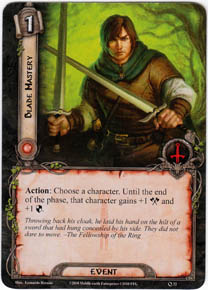
I think we all agree that Beorn is immune to that card. But what if it was worded: "Choose a player. That player may add 1 ATT and 1 DEF to one eligible character for the rest of the turn". Could you boost Beorn in that case? I don't think so, because the card effect still targets him in the same way.
I guess the problem of SaF is the initial instruction to "choose a player":
I believe so as Stand Together targets the player and not Beorn.
That's an intuitive and logical assumption, but it doesn't consider that the card's effect doesn't stop or even start here. Choosing a player is simply the first step of excecuting the card's action, but it is not the card action itself. The action is to declare eligible characters as defenders. Which Beorn is totally going to ignore because he's NOT LISTENING...
Edited by leptokurt