Star Wars Armada Unboxing video

By Microscop, in Star Wars: Armada

The range ruler thing is weird to me. Especially because even a small ship could angle incorrectly and jump from long range to short on that scale.

I think that's the point. That is going to be where the skill comes in with this game, especially as Rebels, is keeping the opponent at medium range but out of close range.

Considering how limited the movement is (it isn't like X-Wing where you can change speed on a whim), this really limits the effectiveness of ships with primarily blue dice. If it is split up into 5ths, with only 1/5th in the middle being range 2, it will be nearly impossible for ships to intentionally be at that range.

Don't forget that Blue dice don't just fire at medium range, but short range also, and it is just about as much about the dice faces/results/odds as the range factor.

A ship with blues and no blacks will want to remain in range 2 when going after anything with black dice. I have not looked at the various models for these kinds of match ups, but the shortened range 2 really gives black dice an extra oomph.

Then again, shooting seems more of an opportunity thing in this game since you move after you shoot. Takes extra planning and anticipation to line up a shot. That added difficulty will mean most shots are taken because they can be, not because they were planned to be taken.
I believe this system is leading itself well to the two very different philosophies of the factions.


Rebels want to arc dodge, and stand off where their longer range weaponry has a chance against the lumbering grey triangles, whilst trying to flank around to get at their sterns, but doing everything they can to avoid range one. They are also serving as a screen so that the far superior rebel fighter-bombers can get in range to unleash space murder.


Imperials want to bulldoze their way through a fleet, to get in close and hammer way using large, short range batteries. But they will rely on that initial short range alpha strike to stop the target in its tracks, otherwise next turn they will be flanked.


Its the whole quantity verse quality approach, but each side has an aspect of each


I believe this system is leading itself well to the two very different philosophies of the factions.

Rebels want to arc dodge, and stand off where their longer range weaponry has a chance against the lumbering grey triangles, whilst trying to flank around to get at their sterns, but doing everything they can to avoid range one. They are also serving as a screen so that the far superior rebel fighter-bombers can get in range to unleash space murder.

Imperials want to bulldoze their way through a fleet, to get in close and hammer way using large, short range batteries. But they will rely on that initial short range alpha strike to stop the target in its tracks, otherwise next turn they will be flanked.

Its the whole quantity verse quality approach, but each side has an aspect of each

I think your spot on for rebels, but would say the Imperial approach is more about zones of control. They got slower ships in general with far less finesse but are much heftier firepower in general. Their squadrons, engineering, and beefiness all support their approach of move where you want and dare the rebels to approach.

also for the imperial squadron its imo the other way around than for their capital ships. they are faster and more fragile than the rebels counterpart and will have initiative in positioning in order to hunt down the slow and hard hitting rebel bomber squadrons

The squadrons are going to need paint.

The squadrons are going to need paint.

Drybrush for the TIE's and a wash for the repels and they're good to go I'd say. Could do a little extra touching up if you enjoy painting, but the basics seem enough for those that don't or can't.

Edited by keroko

This all goes to show that release is closer than you may think.

The squadrons are going to need paint.

Drybrush for the TIE's and a wash for the repels and they're good to go I'd say. Could do a little extra touching up if you enjoy painting, but the basics seem enough for those that don't or can't.

For the xwings at least have to paint some black for the cockpit and a red stripe down the side before the wash.

Are there any good sites with instructions on how to paint these tiny miniatures?

... so that the far superior rebel fighter-bombers can get in range to unleash space murder .

This made me crack up.

Are there any good sites with instructions on how to paint these tiny miniatures?

Mega: I have a thread here where we are compiling techniques along with color schemes: Squadron Markings & Colors

The thread starts out very basic. The community has added some useful links. I will be adding pics of the fighter painting process -- as soon as I have some to paint. I will also link others' work that is relevant.

A good all through the painting topic guide can be found here.:

http://www.how-to-paint-miniatures.com

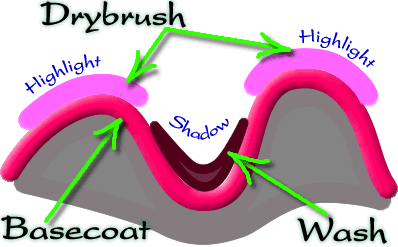
The main "trick" which is easy to do can be seen in this picture.:

paint_layers.gif

- you basically paint everthing in one base color (which might not be needed for the small TIEs).

- you then water down a i.e. black unti you can see through it quite well when the paint is running over the walls of your mixture glas. apply that paint everywhere over the model without any precision. pick up very large pools of paint going over multiple textured sections. while it dries it will receed to pool inside the cracks and valleys on the model and make them look shaded/darker. this is what people call washing or inking. its maybe the only step needed for the TIEs as ppl. where suggesting.

- afterwards you can do the opposite with a highlight color. you apply very little thick(unwatered) color to a brush with short hairs similar to a thoothbrush. then you stroke that brush over some cardboard until it only leaves some very dry color residuals on the cardboard. with that brush you can then "drybrush" over the miniature which will effectively only hit the higher areas as the paint cant flow into the cracks anymore as its already to dry and the brush hair is short and more stiff than usual.

by that sceme you can easily (without the need for accuracy with the brush) apply 3 layers of shades to the valleys and hills of a model. without any brush precision this looks quite nice and far supperior to just painting base color which always loos kinda artificial. the "skill" with wash and drybrush which you will develop over time is to judge how well you have to be able to see through the ink while its running over the wall of your mixture glass and how "dry" the color has to be in the drybrush step. watering more and drying more in the first run and then doing it multiple times is the save way.

vallejo colors are imo industries best, if you dont have colors yet.

for models the size of TIEs you can probably skip the base color compleetly. if you want to do base color (i.e. red striped on the x-wings) then the base color step is the one where you need precision with a very small brush. one thing important while appliing base color is to not use too thick color! it should not change the texture on the model at all if possible. i usualy water the color down with like 10% to 25% water (just dip the brush in water, shake the drop of and then dip that brush in the color). the skill with base color you will develop is pricision with the brush. try to avoid painting 90° to the brush axis. try to allways pull from brush tip towards end of the brush. do the difficult outline of areas first then fill it. With drawing a precise line between two neigthbouring areas i use to paint the one area which has the slope at the border first and then the other which is flat. i.e. large boot over pants the boot usualy slopes down to the pants. so paint the boot first as paiting on the slop is more difficult. dont worry to much about precision as wash and drybrush will blur out those boarders anyway.

if you go for larger models there is a 4th step of painting the whole miniature in the same "primer color" first in order to make the other layers stick better to it. if you use black as that color the mini will get darkder overall. if you use white it will be shiny. if most parts of the mini in the end should be glorious shiny knigts in bright yellow or red armor you should not use black primer but plain white or bright gray instead.

if your uncertain if you would mess up your first model trial you can try this stuff out using any kind of exposable textured ebject first. i.e. a walnut or some other thinigs with finer structure than that.

Edited by madtulip

This is the most concise and straight forward summary of miniture painting I've ever seen. Bra-freaking-vo. Very well done.

Proxy for the deathstar:

IBDMS-Gymnastikball-450x299.jpg

I feel like there's a line in there about targeting exhausts ports... Double entendre meter overload!

Proxy for the deathstar:

IBDMS-Gymnastikball-450x299.jpg

I feel like there's a line in there about targeting exhausts ports... Double entendre meter overload!

I'd turn off her targeting compu......wait, thats not right.