Easy hex grid conversion for Space Combat ?

By JP_JP, in Star Wars: Edge of the Empire RPG

I look from time to time at the forums but never really found a good conversion for Space Combat using an hex grid. So did anyone came up with a way to match speed and range bands for space combat ?

I'm looking at something like :

Range bands : Close = hex 1 ; Short = hex 2-3 ; Medium = hex 4-5 ; Long = hex 6-7-8 ; Extreme = hex 9-10-11.

Speed : Speed 1-2 = 1hex/maneuver ; Speed 3-4 = 2 hex/maneuver ; Speed 5+ = 3 hex/maneuver.

I just made those up and didn't even see if they matched... but you get the idea.

Thanks in advance.

<Insert universal caveat against the use of grids/squares.>

Regardless, I would only allow 1 maneuver to be used for lateral movement (ie, changing hex). If you run the method your looking at, you'll also have to have really, really big hexes - as multiple capital ships could, in theory, all be within close of each other. If you're committed to going this route, I'd multiply all those values by ten.

I look from time to time at the forums but never really found a good conversion for Space Combat using an hex grid. So did anyone came up with a way to match speed and range bands for space combat ?

I'm looking at something like :

Range bands : Close = hex 1 ; Short = hex 2-3 ; Medium = hex 4-5 ; Long = hex 6-7-8 ; Extreme = hex 9-10-11.

Speed : Speed 1-2 = 1hex/maneuver ; Speed 3-4 = 2 hex/maneuver ; Speed 5+ = 3 hex/maneuver.

I just made those up and didn't even see if they matched... but you get the idea.

Thanks in advance.

Won't work very well. Speed doesnt equal movement in this system remember?

If you want to use a hex grid make it oversized with each hex representative of a single band. I'll post a pic illustrating it tomorrow.

Or, you could make a way-cool range band meter, like I did today! :)

RangeMeter1.png

This side is for planetary scale, and has number of maneuvers needed to go through bands based on speed. The other side is is for personal scale (and has a running man icon, instead of an X-wing icon). It's 18" long, as you can tell better in the next picture:

RangeMeter2.png

The sizes of the bands are actually arbitrary since it's all abstract anyway, but I went with the concept that the bands grow somewhat exponentially. Anything that goes past the meter is considered extreme range. I haven't had the chance to actually play with this yet, but I figure it'll work good using 1" = 5-10 feet (or 2-3 meters) for personal scale. Since it's all abstract anyway, you can just adjust the size of your map or drawing to suit. With planetary scale, the distances are so vast that any token or miniature you use will always be a lot larger than they would be, so you can just scale the combat to the meter.

I'll let you know how it works out :)

CloseMedLong.jpg

My visual as promised, though (as usual) Oggdudes system is quite good too, especially if you're physically present.

The idea behind the hex grid is that my players need a little help to narrate their actions and really take part in the story we are telling. I think it's easier for them to use environmental effects when they can visualize their surroundings. So for ground combat, I use detailed maps and it really helps them make better action descriptions. I wanted to use the same strategy for space combat.

In my next game, I will have them fight pirates in an asteroid belt : they will have to get to certain places during the fight to take some readings. Time and speed will be crucial to the fight. The players will have to choose which path to take into the asteroid belt : the faster but more dangerous path, or the longer but safer path ? the path where you ship suffers automatic strain, or the path where you could get hit and suffer hull trauma ?

All the propositions made are really interesting, but I'm still left wondering which one is gonna be easier to use in the setting I chose for my game. The range band meter is a great idea and I might make one for ground combat. Kallabecca's tread is another great idea that might fit more with my game plan. Ghostofaman is good too, but too simplified, a range band meter would work better in my opinion.

Thanks all for the info.

Keep it coming.

Are you players going to all be in one ship?

I use Roll20 for my game, and I have implemented a horizontal hex grid for combat.

Been using this for awhile now and while a lot of the combat is still fairly abstract, it has done wonders for combat for everyone to be able to see precisely where they are in relation to everyone (and everything) else on the field.

I use the same scale measurements for personal, vehicle, and starship combat. 1 hex is 5 feet.

At this range, you are engaged with your target.

From 5' to 10', you are at close range..

From 10' to 25', you are at short range.

25' to 50' feet, you are at medium range.

From 50' to 100', you are at long range.

And beyond that, you are at extreme range.

I do not always strictly adhere to this. If the target is at 105', I may round down from extreme. It just offers a foundation to start from.

The biggest thing to keep in mind is that even though I use the same measurement scale between them, I do respect the massive differences between personal and vehicle scale combat. A vehicle can cross a personal scale battlefield in only a handful of maneuvers at most. And a starship could pass over the entire affair in one, with moves to spare.

I allow my players to move 5 hexes per maneuver, which is in line with the range band change outlined in the books. 2 maneuvers gives them 10 hexes of movement.

I feel that my measurements are fairly accurate based on the approximations given to us in the core books for range bands, though I would be happy to hear any feedback offered.

Hope this helps, JP

We use stacks of tokens (actually poker chips) placed between the different engagements(things within close of each other) to indicate the number of manouvers between, it requires less space on the table and accuracy is less of an issue.

For space/air encounters we are going to trial putting tokens under minutes to represent the z axis.

Mostly we use narrative but when things get complicated this has worked well.

I used this for a Roll20 game.

I'm not sure where I found it, but I wish it was higher res.

https://www.dropbox.com/s/f6fie6jjbfla1i6/8442890881_7c6dcdc88e_b.jpg?dl=0

That's a good one, too. Works better for a single unit, like a starship that all the players are on.

There is also this alternative, which is clear.

range-bands.jpg

I used this for a Roll20 game.

I'm not sure where I found it, but I wish it was higher res.

https://www.dropbox.com/s/f6fie6jjbfla1i6/8442890881_7c6dcdc88e_b.jpg?dl=0

Sorry, what is the point of this graphic? I don’t get the percentile numbers for the different sectors in the outer rim, the reason behind the “S” versus “M” columns, etc…. And I can’t read any of the text in the corners.

It would be easy enough to re-create this in a much higher resolution form, if we knew what it was that we were trying to re-create.

I used this for a Roll20 game.

I'm not sure where I found it, but I wish it was higher res.

https://www.dropbox.com/s/f6fie6jjbfla1i6/8442890881_7c6dcdc88e_b.jpg?dl=0

Sorry, what is the point of this graphic? I don’t get the percentile numbers for the different sectors in the outer rim, the reason behind the “S” versus “M” columns, etc…. And I can’t read any of the text in the corners.

It would be easy enough to re-create this in a much higher resolution form, if we knew what it was that we were trying to re-create.

I found the original with a reverse image search:

http://www.d20radio.com/forums/viewtopic.php?f=149&t=11681

It looks a little better on there and explains some of what they were going for.

I found the original with a reverse image search:

http://www.d20radio.com/forums/viewtopic.php?f=149&t=11681

It looks a little better on there and explains some of what they were going for.

I found the specific post at http://www.d20radio.com/forums/viewtopic.php?p=109605#p109605 but that just says that the links are in his signature, which I can’t see.

If you can give us a direct link to the high-res file, we can try to work from that.

I used this for a Roll20 game. I'm not sure where I found it, but I wish it was higher res. https://www.dropbox.com/s/f6fie6jjbfla1i6/8442890881_7c6dcdc88e_b.jpg?dl=0

Sorry, what is the point of this graphic? I don’t get the percentile numbers for the different sectors in the outer rim, the reason behind the “S” versus “M” columns, etc…. And I can’t read any of the text in the corners.It would be easy enough to re-create this in a much higher resolution form, if we knew what it was that we were trying to re-create.

S = short, M = medium. Number columns up the middle are maneuvers/speed to change range bands. Percentiles are an optional rule by the creator for determine direction of new entries into the encounter.

Intention is the players ship is in the middle and you move the other craft around it. Works well if everyone is in one ship. Less so when they are in different ones.

Are you players going to all be in one ship?

Sorry for taking this long to reply....

In the encounter I designed, my players should be flying 2 X-wings and 1 transport. If they had been all in the same ship, I wouldn't have tried to find an alternative hex grid to design the encounter.

I've been thinking about all this for a long time ; I've reread the rules this morning to make sure. In the AoR Rulebook, it is written (didn't find it in the EotE Rulebook) that "Moving between one range band and the next always takes two maneuvers regardless of speed, with the following exceptions..."

So a speed 1 ship would take 2 maneuvers to move from Close to Short and 2 maneuvers to move from Extreme to long. While a speed 6 ship would take 1 maneuver to move from Close to Medium but 2 maneuvers to move from Extreme to long. It seems a little illogical.

Hex grid

So using a hex grid like the one above, movement would go like this :

- Speed 1 ships move 1 hex per maneuver ;

- Speed 2-4 ships move 2 hex per maneuver ;

- Speed 5-6 ships move 4 hex per maneuver.

These fit with the Exceptions noted in the AoR and EotE rulebooks. Using these values for tactical movement would be more logical and fit with RAW. If you want more variations between ships of different speed, just say that they move a number of hex equal to their speed rating.

Another thing that troubles me are the grey hexes. In the core rulebook, it is written for Personnal Scale combat that " the character is not considered to be in the new range increment until all required maneuvers have been performed ". I haven't found the same ruling for Planetary Scale combat, but I guess it's the same logic. Unfortunately, it isn't very logical.

Character Bob is at medium range from Target 1 while Character Joe is at Long range from Target 1. Character Bob takes 1 maneuver away from Target 1 while Character Joe takes 1 maneuver towards Target 1. So both Bob and Joe are at the same distance from target, but Bob would still be Medium while Joe would still be Long range.

I wonder how you guys deal with this.

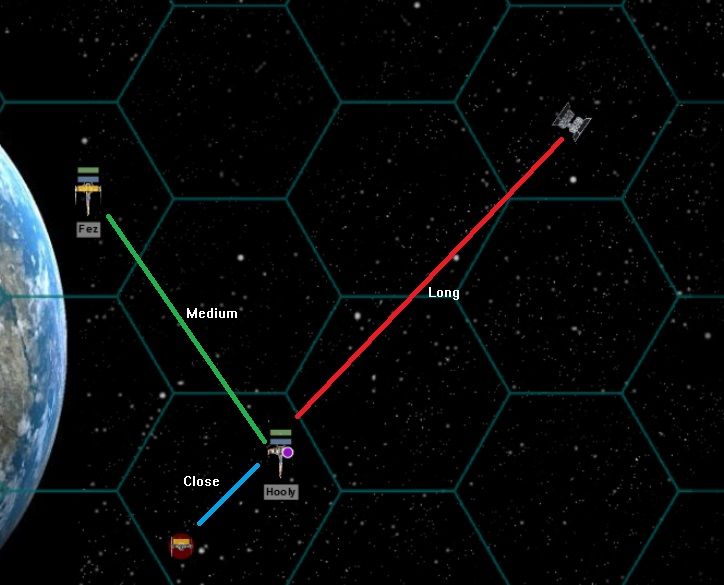
I learned the system from Ghost of Man and basically 1 Hex equals a range band:

In the same hex = Close

1 Hex away = Short

2 Hex away = Medium

3 Hex Away = Long

4 Hex Away = Extreme

Do everything else as per RAW and its so simple it hurts.

Edited by GM Hooly

Are you players going to all be in one ship?

Sorry for taking this long to reply....

In the encounter I designed, my players should be flying 2 X-wings and 1 transport. If they had been all in the same ship, I wouldn't have tried to find an alternative hex grid to design the encounter.

I've been thinking about all this for a long time ; I've reread the rules this morning to make sure. In the AoR Rulebook, it is written (didn't find it in the EotE Rulebook) that "Moving between one range band and the next always takes two maneuvers regardless of speed, with the following exceptions..."

So a speed 1 ship would take 2 maneuvers to move from Close to Short and 2 maneuvers to move from Extreme to long. While a speed 6 ship would take 1 maneuver to move from Close to Medium but 2 maneuvers to move from Extreme to long. It seems a little illogical.

Hex grid

So using a hex grid like the one above, movement would go like this :

- Speed 1 ships move 1 hex per maneuver ;

- Speed 2-4 ships move 2 hex per maneuver ;

- Speed 5-6 ships move 4 hex per maneuver.

These fit with the Exceptions noted in the AoR and EotE rulebooks. Using these values for tactical movement would be more logical and fit with RAW. If you want more variations between ships of different speed, just say that they move a number of hex equal to their speed rating.

Another thing that troubles me are the grey hexes. In the core rulebook, it is written for Personnal Scale combat that " the character is not considered to be in the new range increment until all required maneuvers have been performed ". I haven't found the same ruling for Planetary Scale combat, but I guess it's the same logic. Unfortunately, it isn't very logical.

Character Bob is at medium range from Target 1 while Character Joe is at Long range from Target 1. Character Bob takes 1 maneuver away from Target 1 while Character Joe takes 1 maneuver towards Target 1. So both Bob and Joe are at the same distance from target, but Bob would still be Medium while Joe would still be Long range.

I wonder how you guys deal with this.

Yeah a weakness I've noticed is the system seems to play nicer when all the players are in a single ship. I suspect that's an artifact of the entire system launching from the Freighter heavy Edge instead of a more starfighter heavy setting like Age. So if you've got a lot of craft moving around keep ranges dead-on with RAW is gonna be a booger. Ogg's band ruler and a nice big table probabyl being the only way to do it, and you'll still have the occasional artifact of a craft "teleporting" across the table even though it's range setting are correct, it just has to go way over there suddenly to maintain actual distance continuity with everything else.

The other thing I notice about your hex band is that "close" is an awful small band, when you get a couple TIE groups and 2 or 3 players that close it's gonna get messy.

.

You don't think it's a big deal, but one of my campaigns is about to...

Have a space battle with each player in an X-wing or cap-ship and an entire squadron of TIEs. So it's gonna be a busy board.

As a side note, I made a point of running the numbers on that mess of a scenario. Don't just toss that many TIEs at your players unless you're sure they are equipped to handle it first.

So far for what I do the superhex, with 1 band per hex, is the way to go. If you come up with better, by all means, share

Are you players going to all be in one ship?

Sorry for taking this long to reply....

In the encounter I designed, my players should be flying 2 X-wings and 1 transport. If they had been all in the same ship, I wouldn't have tried to find an alternative hex grid to design the encounter.

I've been thinking about all this for a long time ; I've reread the rules this morning to make sure. In the AoR Rulebook, it is written (didn't find it in the EotE Rulebook) that "Moving between one range band and the next always takes two maneuvers regardless of speed, with the following exceptions..."

So a speed 1 ship would take 2 maneuvers to move from Close to Short and 2 maneuvers to move from Extreme to long. While a speed 6 ship would take 1 maneuver to move from Close to Medium but 2 maneuvers to move from Extreme to long. It seems a little illogical.

Hex grid

So using a hex grid like the one above, movement would go like this :

- Speed 1 ships move 1 hex per maneuver ;

- Speed 2-4 ships move 2 hex per maneuver ;

- Speed 5-6 ships move 4 hex per maneuver.

These fit with the Exceptions noted in the AoR and EotE rulebooks. Using these values for tactical movement would be more logical and fit with RAW. If you want more variations between ships of different speed, just say that they move a number of hex equal to their speed rating.

Another thing that troubles me are the grey hexes. In the core rulebook, it is written for Personnal Scale combat that " the character is not considered to be in the new range increment until all required maneuvers have been performed ". I haven't found the same ruling for Planetary Scale combat, but I guess it's the same logic. Unfortunately, it isn't very logical.

Character Bob is at medium range from Target 1 while Character Joe is at Long range from Target 1. Character Bob takes 1 maneuver away from Target 1 while Character Joe takes 1 maneuver towards Target 1. So both Bob and Joe are at the same distance from target, but Bob would still be Medium while Joe would still be Long range.

I wonder how you guys deal with this.

Yeah a weakness I've noticed is the system seems to play nicer when all the players are in a single ship. I suspect that's an artifact of the entire system launching from the Freighter heavy Edge instead of a more starfighter heavy setting like Age. So if you've got a lot of craft moving around keep ranges dead-on with RAW is gonna be a booger. Ogg's band ruler and a nice big table probabyl being the only way to do it, and you'll still have the occasional artifact of a craft "teleporting" across the table even though it's range setting are correct, it just has to go way over there suddenly to maintain actual distance continuity with everything else.

Remember, this is a 3D battle. Maybe it didn't "teleport", but someone did a roll around an axis and now what was near the right is showing on the left, or the bottom... Kind of like the Threat assessors in the old X-wing and TIE fighter games where something would jump from one screen to the other as you pitched around.

Are you players going to all be in one ship?

Sorry for taking this long to reply....

In the encounter I designed, my players should be flying 2 X-wings and 1 transport. If they had been all in the same ship, I wouldn't have tried to find an alternative hex grid to design the encounter.

I've been thinking about all this for a long time ; I've reread the rules this morning to make sure. In the AoR Rulebook, it is written (didn't find it in the EotE Rulebook) that "Moving between one range band and the next always takes two maneuvers regardless of speed, with the following exceptions..."

So a speed 1 ship would take 2 maneuvers to move from Close to Short and 2 maneuvers to move from Extreme to long. While a speed 6 ship would take 1 maneuver to move from Close to Medium but 2 maneuvers to move from Extreme to long. It seems a little illogical.

Hex grid

So using a hex grid like the one above, movement would go like this :

- Speed 1 ships move 1 hex per maneuver ;

- Speed 2-4 ships move 2 hex per maneuver ;

- Speed 5-6 ships move 4 hex per maneuver.

These fit with the Exceptions noted in the AoR and EotE rulebooks. Using these values for tactical movement would be more logical and fit with RAW. If you want more variations between ships of different speed, just say that they move a number of hex equal to their speed rating.

Another thing that troubles me are the grey hexes. In the core rulebook, it is written for Personnal Scale combat that " the character is not considered to be in the new range increment until all required maneuvers have been performed ". I haven't found the same ruling for Planetary Scale combat, but I guess it's the same logic. Unfortunately, it isn't very logical.

Character Bob is at medium range from Target 1 while Character Joe is at Long range from Target 1. Character Bob takes 1 maneuver away from Target 1 while Character Joe takes 1 maneuver towards Target 1. So both Bob and Joe are at the same distance from target, but Bob would still be Medium while Joe would still be Long range.

I wonder how you guys deal with this.

Yeah a weakness I've noticed is the system seems to play nicer when all the players are in a single ship. I suspect that's an artifact of the entire system launching from the Freighter heavy Edge instead of a more starfighter heavy setting like Age. So if you've got a lot of craft moving around keep ranges dead-on with RAW is gonna be a booger. Ogg's band ruler and a nice big table probabyl being the only way to do it, and you'll still have the occasional artifact of a craft "teleporting" across the table even though it's range setting are correct, it just has to go way over there suddenly to maintain actual distance continuity with everything else.

Remember, this is a 3D battle. Maybe it didn't "teleport", but someone did a roll around an axis and now what was near the right is showing on the left, or the bottom... Kind of like the Threat assessors in the old X-wing and TIE fighter games where something would jump from one screen to the other as you pitched around.

Yes, that's why "teleporting" was in quotes. Translating 3 dimensional space on a 2 dimensional representation does weird things.

It's only supposed to give an "indication" as the whole starship combat is completely abstract with some "placement" rules thrown in.

I just wanted people to see what I'll be using for Starship Combat in my new campaign and first Star Wars RPG Campaign under the FFG system:

untitled_by_hooly1138-d8idxax.jpg

untitled_by_hooly1138-d8idx42.jpg

untitled_by_hooly1138-d8idx52.jpg

untitled_by_hooly1138-d8idx5u.jpg

untitled_by_hooly1138-d8idx6u.jpg

Each hex will be a range band which does work with the current system very well.

I'm yet to decide on the scale of the minis though. I just revert to counters as the X-Wing (and even WOTC) minis are just that little bit too unwieldy.