Questions about Stay on Target? Andy Fischer and Jason Marker return to the Order 66 Podcast...

By GM Chris, in Star Wars: Age of Rebellion RPG

That forces one to have to explain that that single TIE that just vaped your A-Wing in a single attack roll through your angled double-front because both dice ended up blank though.

You were apparently just THAT bad with your 4agi 4 piloting, compared to the 2 agi 1 piloting rookie, that he managed to batter down your shields over that entire minute (seriously who came up with a minute for starfighter combat turns) until somehow exactly only two shots out of all that time ever got through where none did before, and are instantly fatal, as nothing in between happened; no partial bleedthrough, no damage in between volleys, just 59 seconds of plink plink plink plink plink plink plink plink boom.

Kiton, I feel like you're still applying the rules wrong. As much as I hate to use that word (wrong).

1) Combat rounds are not supposed to be cut-and-dry "1 minute turns." Again, the language of the rules is that "combat rounds can last for roughly a minute or so in time." Emphases mine. I'm trying to figure out where you're getting the idea of "exactly two shots" and "plink plink plink boom." That indeed does sound ridiculous; however, I do not get the sense that combat is supposed to work like that anywhere in the rules.

2) An A-Wing has a sensor range of Medium, which makes it a whole lot more capable than a TIE fighter (with a sensor range of Close). They are fast-attack vehicle, not built for dogfights but for strike-and-fade tactics. They ping an enemy fighter on their sensors (even up to long range if on active mode), spend a maneuver at top speed to move in and attack, then once the attack has resolved, they can fly out again to Medium range. The TIE fighter, limited in its sensor capabilities, is essentially defenseless against such tactics and is easy pickings for the A-Wing.

Now, if the A-Wing does muck up and allow a TIE fighter to get a lock, it can survive up to 8 damage (2 Success) on a single hit. This means that a single TIE fighter (flown by a minion TIE pilot) has an 8% chance of destroying an A-Wing in a single hit. This chance increases to 16% in the case of a TIE ace flying that fighter, or 18% if you've got 5 TIE pilot minions flying in a minion group.

I'm not too worried about my chances in the A-Wing, especially against the lowly TIE fighter.

Edited by awayputurwpn

I was referring to "a round can be up to a minute" being used as an explanation for shields being worthless sometimes-dodge-a-little dice.

My point was that you can't just use that variable length to wave away the system errors we're dealing with here. The example I gave was exactly the kind of ridiculous borderline-railroading situation one's forced to explain away at a player when a simple gunnery check - unaffected by things like the target's speed, handling or pilot-skill - annihilates that A-Wing, X-Wing, Headhunter or anything you want because it apparently was actually multiple volleys that downed its shields and tore it apart with no actual effect or chance to try to disengage/avoid the situation, until the fatal hit. I can't imagine anyone using minute long rounds for a dogfight, since it simplifies the entire battle down to just that unbelievable a degree; potentially a *SINGLE* gunnery roll!

I'm well aware of the disparity in sensors there (and comms, by the way. Don't forget a starfighter with [close] sensors can't talk to his friends in [short]. Not to mention that, yes, the A-Wing would vaporize the entire formation with a linked pair of AoE concussion missiles. (edit: BEFORE they know he's there, most likely.)

A-Wing was just an example of something that outspeeds TIEs, is just as maneuverable, and by all means should not have been sticking around for an entire minute of never being able to get the bead despite the massive swivel on its guns (some were modified to have even 360 arcs) against that TIE Ace (the kid with 2 agi, 1 piloting 1 gunnery who can ignnore all of that A-Wing's advantages if he somehow did get close).

Don't forget, though, that if linked triggers you never needed TWO successes to blow it up.

Edited by Kiton

This is my first post, and I specifically have been lurking these forums in order to gain better insight on how experienced GMs who love this game run starfighter combat. I think it is regrettable that the conversation regarding Agatheron's observation has been dropped. It seems to me to offer a way for GMs to achieve what, according to my impression, seems like a primary desire: make piloting and handling contribute more to survivability while remaining within the RAW.

I assumed, like Darth GM, that the wording on page 127 of AoR related to the Gain the Advantage action, because the flavor text sounded like what GtA accomplishes; however, Agatheron rightfully pointed out that the wording on page 127 discusses an opposed check. It's worth looking at this again.


During space conflict, pilots may jockey for position to determine which shields face the enemy and which weapons may be brought to bear. When opponents attempt to negate these efforts, the winner is identified through an opposed Piloting (Space) check.

This is a tricky sentence, because there is a lot of flavor text, but with the reference to a check, the flavor text can be interpreted as parts of the system. If it is simply a reference to GtA, then why doesn't the second sentence just make a direct reference to GtA? If that's what the authors intended, then this sentence should be edited to reflect that or the reference to an opposed check should be changed, because GtA is not an opposed check, although it functions oppositionally, in a give-and-take manner much like the flavor of the text reflects, thus the confusion perhaps.

If we go strictly by what is written, then, I as a pilot can say, I would like to bring my weapons to bear on ship X. Then the opponent, who will try to negate that effect, will call for the opposed roll. I like this idea, because it does bring the nature of the ship into play via the handling characteristic that will affect the piloting roll (not to mention the implications for the skilled jockey talent). The question to my mind (and the reason why I wanted this discussion to continue and make more hay than it has) then becomes, what happens if I lose? Did that count as one of my FLY maneuvers? Did that count as an action (since it was a skill check)? The latter would be pretty harsh. Was it just an incidental prereq to an attack? If so, then do I still have my maneuver and action? I like the incidental option, because it opens up more things to do with your ship.

I think much of it depends upon our interpretation of bringing weapons to bear, and how we would interpret the call for an opposed check and what kind of opportunity that costs. Again, I wanted to revive this conversation, because it seems to me that we can make some hay out of it and finally have a reason for small silhouette ships to have firing arcs included in their descriptions at all. The firing arc question also sent me scrambling to the EoE and AoR forums until it seemed to me that the consensus was that firing arcs don't really matter for small ships. When someone asked, "Why include them at all?" Everyone shrugged. Therefore, I was interested in reviving Agatheron's point, also in part because perhaps we can interpret the RAW concept of bringing weapons to bear in order to breathe life into information that is included in starfighter descriptions (namely firing arcs) but currently plays little role in gameplay.

I don't think it necessarily increases the amount of rolls in a given turn, but the opposed check would be necessary if the pilot is specifically not trying to gain the advantage, but rather trying to blast away at an opponent indiscriminately rather than trying to line up a kill shot.

Here I will say what others have pointed out, it will increase the rolls. No one is going to allow another fighter to "bring weapons to bear." This means there will always be two dice rolls for this attempt, until GtA comes into play. Nevertheless, it seems to me that there is a great deal of interest in 1) upping starfighter survivability, 2) keeping combat fast, 3) also staying within RAW. The desire for #2 caused some dissatisfaction with Agatheron's point and the increasing die rolls it would inevitably call for. However, it seems to me that 1 and 2 are in some ways contradictory. Furthermore, it seems that adding more hull trauma or creating extra rules for juking and dodging also violate the desire for #2 by creating creating extra rolls anyway while furthermore violating the desire for #3 too.

Others have done the math on GtA and decided that it does not help as much as it should in theory. If we interpret the rules on page 127 more broadly, then perhaps a few things could occur:

1) GtA becomes a much stronger option than 1) win initiative 2) win

2) Piloting skill comes into play for survivability, much to the desire of many posters, both through the opposed check and in the increased value of GtA. Indirectly, handling will become more of factor than mere silhouette and by extension, good pilots with skilled jockey will find more uses than using it in GtA or flying through obstacles.

3) We may actually find some creative ways to understand why in the world fire arcs were included in starfighter descriptions.

Perhaps someone will come along and clarify that 127 was meant to refer to GtA all along, in which case we are back at square one. Until then, questions such as, "Does "bringing weapons to bear" count as an incidental, maneuver, action or what?" are still not answered and would need to be. I do think, however, that this may be a way for creative GMs to find RAW to fit their goals, which is why I wanted to continue the discussion and ask more questions. I cannot commit as much time to this discussion as some of you great GMs out there. I would, however, really appreciate it if this conversation were continued, and if you stats junkies could foresee any wider implications for the point at hand. Thank you so much for your time and attention.

LadysingstheLando, welcome to the forums!

Your post gives me an idea...

Given that

1) I want to keep combat fast,

2) I want GtA to be an actually attractive option,

3) and I want piloting skill to play a factor in how hard a starfighter is to hit.

How about this: If a pilot has successfully Gained the Advantage on a ship, that ship's combat rolls are opposed by the pilot's skill. Handling and Silhouette both play factors in this, adding Boost/Setback dice and increasing/decreasing the difficulty accordingly.

So, if the pilot in question has Agility 4 and Piloting 2 and his handling is 3, once he's Gained the Advantage on an enemy, that enemy's difficulty to hit (if they are within 1 Silhouette rating of each other) is Challenge 2, Difficulty 2, Setback 3.

I think it's balanced since it only applies to one target, and that target can turn the tables with another GtA check.

Edited by awayputurwpn

I like that house rule.

Edited by kaosoe

I think one possibility is that if one cannot bring their weapons to bear, then the incentive for taking the Gain the Advantage action kicks in, trying to line up a shot in the following turn. Alternatively, there are a number of Actions that a pilot could choose to take that go beyond simply pulling the trigger. If, for example, one is concerned about incoming ordnance, a pilot could choose to spoof potential incoming missiles as an action. While normally set as something that other crewmembers can do, there's no reason why a pilot can't choose to do this.... It'd be the equivalent of launching chaff.

Keep in mind an opposed piloting check to try to get one's weapons to bear will also generate advantage/threat/triumph/despair. It creates all kinds of narrative results: Good news, you can shoot at your target, bad news, to get the shot you piloted your craft through a small cloud of debris! (Inflict appropriate strain/system strain here).

Another point that I'd make is evasive maneuvers pretty much preclude trying to bring weapons to bear. I can't speak for the devs, but a logical sequence does seem to be Take Evasive Maneuvers, attempt Gain the Advantage.

Lastly, an opposed check to bring weapons to bear is a LOT more risky than gaining the advantage, which is why the latter should be considered as the better alternative. Opposed checks guarantee Red dice and lots of setbacks, whereas GtA could have as a few as a single purple. However, if someone wants to try to snap off their missiles first, then out comes the opposed check. :)

Edited by Agatheron

@awayputurwpn, I actually implemented that house rule yesterday with my group. Talk about synchronicity...

@Ladysingsthelando: After reading through this thread, I figured I'd add my completed unasked for two cents regarding firing arcs, with a bit of insight from an old system called Feng Shui. For those of you that don't know about it, it's an old system (with a sequel in the works) that bills itself as a "Hong-Kong movie action RPG" that tried to emulate the fast-and-furious action of that genre (and it was **** fun to play too!). One section included a guide on how range affected the difficulty to hit someone with with a caveat along the lines of, "We included this here just in case, like if some guys trying to run and your sniper wants to sit in his lawn chair and shoot the target in the rump. But for the most part, everyone can take a swing on anyone."

For starfighters it seems to be a similar situation. Take a chase, for example. Let's say you're in an X-Wing trying to flee a swarm of TIE fighters and have managed to win the first round of competitive checks (and let's assume we're on world where the X-Wing's sensor range is increased by Alliance control towers and satellites or a CR90 in low-orbit providing AWACS assistance). You're now at Short range, still within range of your proton torpedoes. So you want to do a sharp turn, lock on to a random minion group, fire the torpedo, and then continue fleeing. In this case, the GM can say, "No, you've already said you're trying to flee at top speed, S-foils locked and everything." Or "Yes, but you'll have to take either two Setback dice to your Gunnery check for the rushed lock-on or to your next competitive Piloting check"

Or let's say you're on a runaway speeder-train and your friend brings up their BTL-S3 Y-Wing, flying parallel to the train, with the cockpit open so you can jump in and escape. There are still mooks blasting away at you from the a cars to the rear of the Y-Wing. So your friend is like, "Can I strafe those guys?" and the GM can respond, "The only weapon you have that can fire back is the Ion Cannon, and those don't do much to organics, unless you want to break off the rescue approach to use your laser cannons."

And so on.

Edited by InSilence

I've been following this thread for a while and I think it is time to stop lurking and weigh in.

The way I see it, to make GtA a useful option (and to stay as closely within the RAW as possible) we need to buff Evasive Maneuvers. If a ship using that maneuver is very difficult to hit then GtA becomes very useful as it negates its effects. Doubly so as we can assume that in a dogfight situation both parties are using Evasive maneuvers and thus any Gunnery checks would have their difficulty upgraded twice.

I still haven't decided what would be a sufficent buff to Evasive Maneuvers. I'm currently leaning towards this:

Executing Evasive Maneuvers upgrades the difficulty of the dice pool once per point of Handling. Minumum of one. It likewise upgrades the difficulty of all attacks by the same amount.

This I think would buff the defense of agile ships but not too much. E.g. the difficulty for an X-Wing to hit a TIE fighter would be RRP. Or RRR if the X-Wing was also using Evasive Maneuvers. Makes GtA a lot more useful as it would drop the difficulty to PP.

As for GtA, it could be an opposed Pilot check. Unless you want the give-and-take to last for a couple of rounds in which case keep it RAW.

And speaking of GtA, what happens if the target ships just moves away? Say an A-wing moving at speed 6 uses two maneuvers to move to long range. Any minion TIE fighter that had GtA on it would be unable to shoot at it because it would have to use both its action and maneuver just to keep up.

Edited by Ohrana

And speaking of GtA, what happens if the target ships just moves away? Say an A-wing moving at speed 6 uses two maneuvers to move to long range. Any minion TIE fighter that had GtA on it would be unable to shoot at it because it would have to use both its action and maneuver just to keep up.

That's what a competent A-Wing pilot is supposed to do. Though, making it so that the target of your GtA has to make an opposed Piloting check to escape could be a potential addition...

I think I'll post here some of the house rules I use for my campaign in regards to vehicle combat:

-Handling and Vehicle/Starship combat checks
1. Combat checks from the vehicle/ship with the higher handling gets +1 Boost.
-Speed and Vehicle/Starship combat checks
1. The vehicle/ship with the lower speed gets +1 setback on combat checks and opposed Piloting checks.
2. For each additional 2 point difference in speed, the slower vehicle takes +1 setback die on opposed Piloting checks.
For each additional 2 point difference in speed, both vehicles take +1 setback die on combat checks against each other.
[1: 0/1 | 3: 1/2 | 5: 2/3 | 7: 3/4 | So on]
3. Guided weapons ignore setback equal to their guided rating from speed difference.
-Modification to Gain the Advantage (These are in addition to the base effects)
1. Your target must be within short range of the target.
2. Gain the Advantage lasts a number of rounds equal to the number of net successes or until an enemy takes back advantage.
3. If you end your turn outside of short range of the target, you lose the advantage.
4. If you successfully gain the advantage you ignore any setback dice for being slower than your target.
5. The ship with advantage upgrades combat checks against the target once.
6. Combat checks from your target against your ship are Opposed by your Piloting skill (this was the simplest why I could word it. Basically combat checks become opposed Gunnery vs. Piloting checks).
7. You can attempt to Gain the Advantage against other ships even when you already have the advantage on another,
but each successful check upgrades the difficulty of the next check one additional time.
8. Using Advantage and Triumphs
a. Three advantage can be used to upgrade all combat checks and opposed Piloting checks from your ship against the target for the duration of GTA.
b. Three advantage can be used to upgrade the difficulty of all combat checks and opposed Piloting checks from the target against your ship for the duration of GTA.
c. Triumphs on a success can be used to apply this effect against 1 additional target within short range of your ship,
as long as the difficulty to gain the advantage against them would be the same or lower as the initial target.
d. Double triumphs on a success can be used to make a free combat check against the target as an incidental action.

-Gain the Advantage and Combat Checks
1. On a triumph, the active character can reduce the opponent's duration of Gain the Advantage by 1 round.
This can be used multiple times.
2. On a despair, the GM may extend the duration of the targeted ship's use of Gain the Advantage by 1 round.
This can be used multiple times.
Edited by InSilence

InSilence, I love Feng Shui!

I discovered it during the Kickstarter for Feng Shui 2 and I've been running it lately and having a lot of fun.

It has one of my favorite ways of treating chase and vehicle combat sequences. The way you apply Chase Points to the enemy in the same way you might do an attack is an inspired mechanic to me. I've contemplated whether it could be adapted for SWRP, but none of my games have featured much in the way of vehicle or starship combat so I stick with RAW for the most part.

I've been following this thread for a while and I think it is time to stop lurking and weigh in.

The way I see it, to make GtA a useful option (and to stay as closely within the RAW as possible) we need to buff Evasive Maneuvers. If a ship using that maneuver is very difficult to hit then GtA becomes very useful as it negates its effects. Doubly so as we can assume that in a dogfight situation both parties are using Evasive maneuvers and thus any Gunnery checks would have their difficulty upgraded twice.

I still haven't decided what would be a sufficent buff to Evasive Maneuvers. I'm currently leaning towards this:

Executing Evasive Maneuvers upgrades the difficulty of the dice pool once per point of Handling. Minumum of one. It likewise upgrades the difficulty of all attacks by the same amount.

This I think would buff the defense of agile ships but not too much. E.g. the difficulty for an X-Wing to hit a TIE fighter would be RRP. Or RRR if the X-Wing was also using Evasive Maneuvers. Makes GtA a lot more useful as it would drop the difficulty to PP.

As for GtA, it could be an opposed Pilot check. Unless you want the give-and-take to last for a couple of rounds in which case keep it RAW.

And speaking of GtA, what happens if the target ships just moves away? Say an A-wing moving at speed 6 uses two maneuvers to move to long range. Any minion TIE fighter that had GtA on it would be unable to shoot at it because it would have to use both its action and maneuver just to keep up.

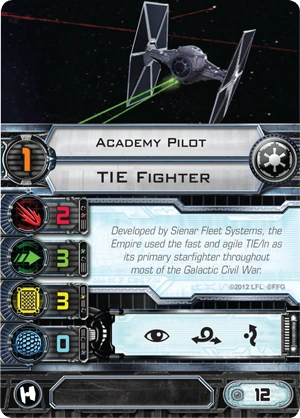
I like this solution, as it's simple and makes TIE fighters (with their high maneuverability) actually good. They're still fragile and undergunned, but even an Academy Pilot is hard to hit, and an Ace with high Gunnery can reliably nail targets whilst being nearly impossible to hit. This is nicely in-keeping with the Imperial theme of lots of chumps + a handful of Aces! They're also no longer wildly inferior to all the Alliance ships, despite being the height of Imperial technology...

...but they'll still drop like flies to a talented gunner on a quad laser turret with a little help from the Force.

Edited by Talkie Toaster

And speaking of GtA, what happens if the target ships just moves away? Say an A-wing moving at speed 6 uses two maneuvers to move to long range. Any minion TIE fighter that had GtA on it would be unable to shoot at it because it would have to use both its action and maneuver just to keep up.

This is actually a common tactic, and one we see being performed in the movies by outmaneuvered X-wings. Unable to shake the Tie fighters, they would punch it in an effort to keep the TIE from taking the shot, even if they were holding their superior position.

A much anticipated and great show, lot of people's Q's got answers and think most listener's would have gotten a lot out of it.

However!

Its still here...

The 800lb gorilla vs the 800lb pane of glass

It was kind of interesting that they pretty much denied there was any problems with it, but basically anyone who gets shot down in 2 rounds like most of us do, still see the problem inherant in the system itself.

I can full appreciate the space combat system is dangerous and needs to be fast paced, but like most things in life, some of us move at our own pace when we run our games to suit our own predilictions or even just because some of our players are a bit 'dim' and take ages to figure stuff out.

Moving on because FFG won't address it.

Houserule a reaction dodge/parry effect for space combat in your games.

That sucks and I'm not entirely happy with it.

well they did say zero hull trauma is not boom but dead in the water, They also said don't have space empty. have terrain to hide behind. and that starship combat is supposed to be deadly because it is in the movies. also take advantage of the squad rules.

well they did say zero hull trauma is not boom but dead in the water, They also said don't have space empty. have terrain to hide behind. and that starship combat is supposed to be deadly because it is in the movies. also take advantage of the squad rules.

To clarify:

-A ship is not disabled until its Hull Trauma Threshold (HTT) is exceeded. (AoR CRB, page 256) Merely meeting one's HTT is not enough to disable a ship. The same applies to Wound Threshold (WT) in personal scale combat.

-A ship whose HTT is exceeded is not destroyed unless the vehicle is smaller than (or equal to) Silhouette 3 and "of no particular importance." (AoR CRB, page 256) Ships larger than (or equal to) Silhouette 4, ships with player characters in them, or other ships (at the GM's discretion) are not destroyed when HTT is exceeded. In this case, those ships' systems shut down, revert to emergency power, and begin to drift lifelessly. These ships also suffer one Critical Hit.

-A ship not of "no particular importance" or one with a PC in it can be revived with a hard Mechanics check. (AoR CRB, page 256) This brings the ship's hull trauma to one below its threshold, sets the maximum speed at 1, and reduces handling to -3.

I just want to make it clear that within the rules, a craft is not disabled until HT exceeds its HTT, and a craft being occupied by a PC is not destroyed when HT exceeds the HTT; it is merely disabled.

Edit: Minor clarification.

Edited by Yoshiyahu

well they did say zero hull trauma is not boom but dead in the water, They also said don't have space empty. have terrain to hide behind. and that starship combat is supposed to be deadly because it is in the movies. also take advantage of the squad rules.

To clarify:

-A ship is not disabled until its Hull Trauma Threshold (HTT) is exceeded. (AoR CRB, page 256) Merely meeting one's HTT is not enough to disable a ship. The same applies to Wound Threshold (WT) in personal scale combat.

-A ship whose HTT is exceeded is not destroyed unless the vehicle is smaller than (or equal to) Silhouette 3 and "of no particular importance." (AoR CRB, page 256) Ships larger than (or equal to) Silhouette 4, ships with player characters in them, or other ships (at the GM's discretion) are not destroyed when HTT is exceeded. In this case, those ships' systems shut down, revert to emergency power, and begin to drift lifelessly. These ships also suffer one Critical Hit.

-A ship not of "no particular importance" or one with a PC in it can be revived with a hard Mechanics check. (AoR CRB, page 256) This brings the ship's hull trauma to one below its threshold, sets the maximum speed at 1, and reduces handling to -3.

I just want to make it clear that within the rules, a craft is not disabled until HT exceeds its HTT, and a craft being occupied by a PC is not destroyed when HT exceeds the HTT; it is merely disabled.

Edit: Minor clarification.

It's an important thing to remember.

I would make on change, and that would be that the PC's ship does not lose power, but starts accruing crits. Fits the fluff when a pilot comes back from a battle in a fighter that's lost half the armament, shields and engines and still manages to limp back due to the combination of the fluffy lord loving them and one seriously cheesed off astromech.

I've recommended that myself in a few places as well, although it's also worth noting that handling 3 speed 1 and most systems offline is rarely any better than "dead in the water", and an extremely bad idea in combat - not because the handling and speed mean anything by RAW, but because if you're not a drifting hulk you're far more likely to get 'finished off' again.

Of course, That entire 'drifting and disabled' bit brings on yet another hole in the rules: The fact that Ion weapons are TERRIBLE at disabling many ships in comparison to lasers because of how disabling a ship works/requires.

In regards to not having space empty, there's limits to that. Not EVERY battle is a capital-battering asteroid field, not EVERY capital ship is constant cover for every nearby fighter from all angles and directions, and not every planet or moon is going to involve peek-a-boo. A lot of space is empty, a lot of hyperspace routes involve not being too close to gravity-wells, and not every fight can be a convenient space warehouse with convenient space barrels in convenient space shelves for convenient space dogfighting as though this were a cheapo action film. More importantly perhaps though, by the rules combat just doesn't last anywhere near long enough for people to reliably get into defensive terrain when there is any.

well they did say zero hull trauma is not boom but dead in the water, They also said don't have space empty. have terrain to hide behind. and that starship combat is supposed to be deadly because it is in the movies. also take advantage of the squad rules.

I don't have a convenient squadron at my disposal to provide "ablative armour", I don't get to 'pick' where I fight battles in space.

I fight battles in space when I MUST

Regardless of the terrain, you don't always get to just pack your bags and run away when its inconvenient or unfavourable to do so or simply because we're always outnumbered.

Sometimes you just have to escort another vehicle to clear space so it can jump.

Maybe you get ripped out of space by an interdictor or pirates in empty space, have to get out and get stuck in to buy time.

You just sometimes have to fight and ultimately the system really sucks balls when it comes to doing much more than 2-round combats for your starting fighter pilots who don't have the benefit of 300xp worth of ace talents and skills along with 2-300xp in mechanical specialisations to actually do an emergency repair.

That is my point that off the bat with starting characters, its really bad and there's also really no reason it should be except for poor design, in both the D6 and D20 systems prior to FFG's system, starfighter combat really wasn't this unenjoyable.