Objectives

By Mikael Hasselstein, in Star Wars: Armada

So, as we learned from the news release last month, there are going to be these objectives. I'll quote the statement:

Your selection of ships and fighters to fly into battle isn’t accompanied only by your decisions of how to upgrade them and who to assign as commander. There’s another, critical step to fleet-building in Armada.

Along with its ships, fighters, and upgrades, your fleet must include three objectives. These add variety to each battle by providing a narrative for why your fleets are fighting each other. Importantly, they also change how you score points, so you want to make sure that your choice of objectives fits into your overall strategy.

There are three categories of objectives:

ObjectiveFade1.png

Assault: Assault objectives typically identify one or more ships that are worth extra fleet points when destroyed.

ObjectiveFade2.png

Defense: Defense objectives encourage you to position your ships so that they control specific sections of the battlefield.

ObjectiveFade3.png

Navigation: Navigation objectives reward you for maneuvering aggressively and with precision.

You have to bring one objective from each category. Then, at the beginning of the game, the first player chooses one of the second player’s three objectives to use throughout the game. All other objectives are set aside.

Like Most Wanted, each objective introduces additional rules to impact your setup, as well as a number of unique game effects that can shape the course of a game. Additionally, most objectives introduce ways for you to score points that aren’t based solely upon the costs of the ships and squadrons you destroy.

So, first things first, there's a 'first player' and 'second player', which I suppose distinguishes between the players in a similar way as Initiative does in X-Wing.

Is there more that has been learned about this that you all can disclose, or speculate on? I'm wondering if different ships might come with new and interesting objectives - more than the original twelve that presumably come with the core set.
They have explained initiative and it does indeed work as it does in X-Wing: Whoever has the lowest fleet points decides who has initiative.

Combined with objectives its an interesting mechanic - I see initiative being more important in Armada, but going second and choosing the objective could also be a game changer.

Edited by Ghost Dancer

They have explained initiative and it does indeed work as it does in X-Wing: Whoever has the lowest fleet points decides who has initiative.

Combined with objectives its an interesting mechanic - I see initiative being more important in Armada, but going second and choosing the objective could also be a game changer.

Okay, so the person with initiative is the 'first player', and the one without is then the 'second player'.

You're probably right that it'll matter more. In X-Wing, it's not infrequently the case that initiative does not mean anything more than who gets to place the first asteroid. Because in Armada there isn't a PS system, it will always matter.

I wonder if the objectives will induce the players to think up a bit of a story of why they're skirmishing, taking the text of their cards as an inspiration.

Edited by Mikael Hasselstein

Okay, so the person with initiative is the 'first player', and the one without is then the 'second player'.

Yes.

You're probably right that it'll matter more. In X-Wing, it's not infrequently the case that initiative does not mean anything more than who gets to place the first asteroid. Because in Armada there isn't a PS system, it will always matter.

I think so as there are certain situations where moving your ship first could be crucial (e.g. getting a killing shot, or moving your ship out of range to repair it)

I wonder if the objectives will induce the players to think up a bit of a story of why they're skirmishing, taking the text of their cards as an inspiration.

I'm sure one of the articles said something along those lines and it would certainly help to add a narrative to the game

Edited by Ghost Dancer

I like the idea of the "story" you mention. I lost the narrative feel in X-Wing a long time ago. Too many named characters being used ALL THE TIME. At least in fleet battles special characters being present makes a ton more sense.

I like the idea of the "story" you mention. I lost the narrative feel in X-Wing a long time ago. Too many named characters being used ALL THE TIME. At least in fleet battles special characters being present makes a ton more sense.

No defense dice, capital ships, and pre measures had me sold too.

Picture9.jpg

Edited by MaverickNZ

Picture9.jpg

I was hoping with the navigation one it would be more like move X ship to Y for victory points.

I think thats more the defense cards - controlling board areas. There will also be multiple variations for each category though, so don't dispair outright if you dont like the look of just those 3 cards. :)

Hesitant already about this. I am sure it'll be great but I'm hoping that all the missions are up to par with one another.

I was hoping with the navigation one it would be more like move X ship to Y for victory points.

There might still be a navigation card like that. We're only seeing one of the four navigation cards here.

Yeah, this is probably the thing that has me most excited about this game. Building your objectives as a part of the list was a stroke of genius imo (so long as the objectives are fair) it provides a great counter to the initiative if done correctly.

(I watched a demo and it doesn't look like initiative changes each turn so it can be extremely important to go first, but then you're fighting on the opponents terms. (unless you took the same objectives)

So player one selects one of player two objective cards. So is that supposed to be the objective of both players for the rest of the game? And im guessing that you have to include the cost of three objective cards in your fleet builds?

So player one selects one of player two objective cards. So is that supposed to be the objective of both players for the rest of the game? And im guessing that you have to include the cost of three objective cards in your fleet builds?

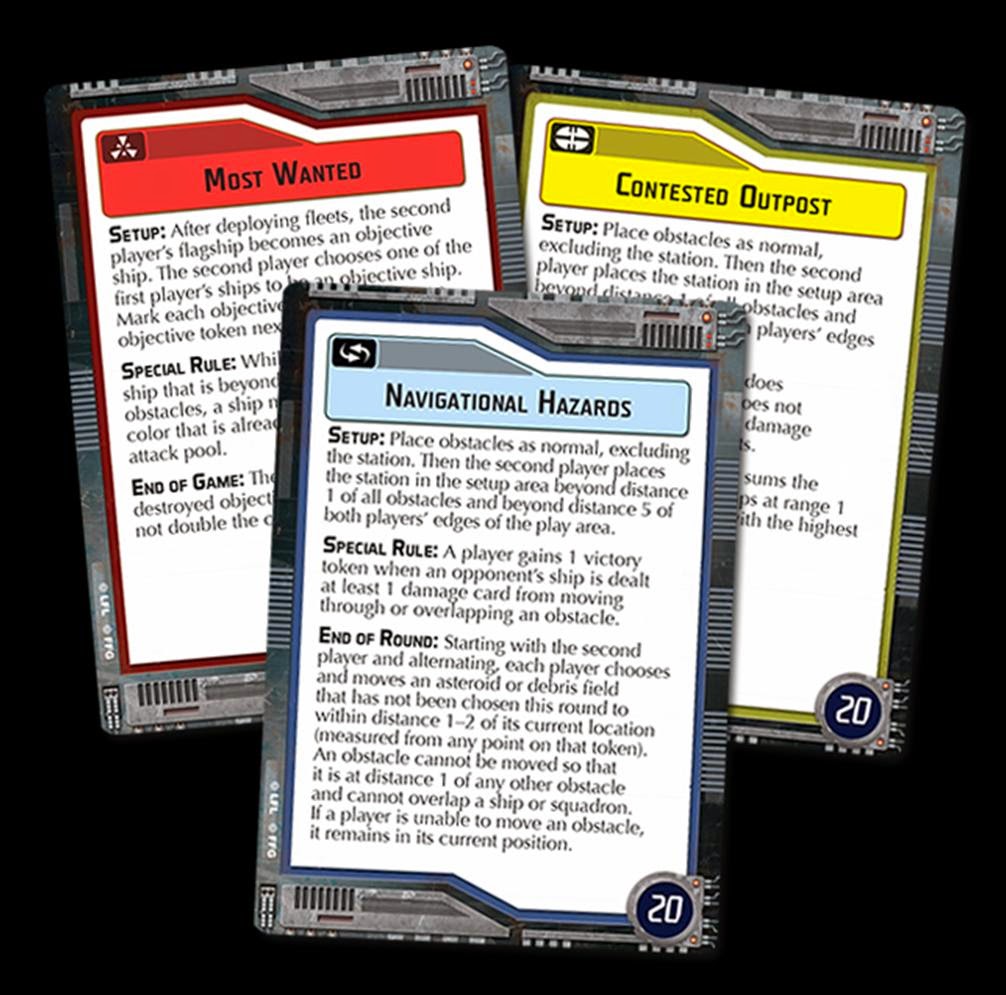
I think you bring three objective cards and the opponent chooses which one will be "in effect" for the match i.e. they choose the one that will benefit them the most or hinder them the least. No idea on the cost/fleet thing. The "20" in the lower right does suggest a cost though. Or maybe a potential score if completed?

So player one selects one of player two objective cards. So is that supposed to be the objective of both players for the rest of the game? And im guessing that you have to include the cost of three objective cards in your fleet builds?

I think you bring three objective cards and the opponent chooses which one will be "in effect" for the match i.e. they choose the one that will benefit them the most or hinder them the least. No idea on the cost/fleet thing. The "20" in the lower right does suggest a cost though. Or maybe a potential score if completed?

yeah, it could be there's a separate point total you have for objectives maybe, so that they can be balanced. I hope its not a fleet cost, as that would rather kill the whole fleet feel. 3 objectives and an admiral is 80 pts from that picture, would pretty much leave you at 2 caps. Plus you'd pay points for something you might not even use.

Well it would only be one objecctive "cost" wouldn't it? So it wouldn't be say 60 points (three 20's) from your fleet but only the cost of what gets chosen.

The separate objective point total seems reasonable. Your three chosen objectives must be X number of points or less so it would be harder to force your opponent into choosing the objective most beneficial to your build and other balance issues.

Well it would only be one objecctive "cost" wouldn't it? So it wouldn't be say 60 points (three 20's) from your fleet but only the cost of what gets chosen.

The separate objective point total seems reasonable. Your three chosen objectives must be X number of points or less so it would be harder to force your opponent into choosing the objective most beneficial to your build and other balance issues.

you can't really do a cost of what gets chosen unless they're all the same. Now that could be the inherent balance, say a set of 5's, 10's, 15's, and 20's so you can't cherry pick the best objectives for you

Well it would only be one objecctive "cost" wouldn't it? So it wouldn't be say 60 points (three 20's) from your fleet but only the cost of what gets chosen.

The separate objective point total seems reasonable. Your three chosen objectives must be X number of points or less so it would be harder to force your opponent into choosing the objective most beneficial to your build and other balance issues.

you can't really do a cost of what gets chosen unless they're all the same. Now that could be the inherent balance, say a set of 5's, 10's, 15's, and 20's so you can't cherry pick the best objectives for you

That's a very good point.

Good points . Ok so lets say the person you are playing with has picked his objective and thats what will be his objective for the game. What is your objective going to be? Do you then pick one of three objectives that he brings to the table? Im just trying to get the understanding of the objectives down. Because the actual article on objective gets vague after it says the player picks one of your three objectives .......ok but what about you???

Also the number at the lower right being the point value of the objective upon compleation sounds better than additional cost to your fleet build because if so what was in the picture would be 60 points to your fleet build....and that would kinda suck because well everything is pretty expensive in points and it doesnt take much to build a fleet to 300 points in this game.

Edited by Grave13

The objectives are for both, in the most wanted card they revealed its both players objective to blow up a specific ship for additional points. But the ships are selected by the second player, so if your with initiative, he picks that objective, then picks a ship for you to destroy and a ship for himself to destroy.

an interesting thing about it is there is no point total at the bottom, so perhaps the number is a victory point goal? Say first to reach 20 wins, or highest by the end of turn 6. Most wanted doesn't have one because it uses fleet points like in a death macth.

or like you said, its a bonus to your overall score, and the victory points is just a tally for the bonus. This is something that could really use a spoiler. Or the rulebook. I'd be down with either

Edited by Truegreek

I dont know what i want spoiled more the rebel ships or the objectives and how you add them in a fleet build

Objectives were explained in some detail at the GenCon demos, so we do not need to speculate on these things. You can also see some more of the Beta objective cards in the Team Covenant GenCon video (though they are a little fuzzy). Here is a brief run-down of the rules:

  • Each player chooses three objectives (one of each color) as part of his list. These do not have any "cost" associated with them (i.e. they do not take up any of your 300 points).
  • The player with the lower point total gets to choose whether he or his opponent has initiative. The player whom he chooses to have initiative is henceforth "the first player."
  • The objective for this match will be taken from the second player's hand of three objective cards. The first player will choose the card that best suits his fleet. The second player often gets a bonus (e.g. choose which ships are worth bonus points in "Most Wanted") to compensate partially for the inherent weaknesses of being the second player.
  • For this match, the first player always activates first every turn. Activations are done in alternation.
  • The primary victory condition is to destroy all of your opponent's capital ships in 6 turns or less. If this doesn't happen (and it seems like it usually won't), then victory is determined according to points at the end of 6 turns. You receive points equal to the ships you destroy (I am not sure whether you get points for destroying fighters, commanders, etc.). You also get bonus points for completing the objective. For "Most Wanted," you get doubled victory points for destroying the target ship. For "Navigational Hazards," you get one victory token (which is worth 20 points according to the bottom corner of the card) for each time your opponent's ships are damaged by obstacles. For "Contested Outpost," you get one victory token (which also happens to be worth 20 points) for every turn that you control the space station (I think). Most points wins.

I wrote this from memory, so there might be some minor mistakes, but that is the gist of it.

The objective cards will provide some interesting list-making decisions. It seems that a lot of lists will be specialized toward one of the three colors. For example, a tanky triple Victory list may be really good at controlling territory, so yellow would be its strong suit. Or a Corvette swarm list may be crazy maneuverable, so blue would be its strong suit. Thus, when you are the first player, you would probably always choose your strong color from your opponent's objectives. But what about when you are the second player? You need to have enough flexibility that you can find one objective of each of your weak colors which is not too bad for you. Also, if you really don't want to ever be the second player (or the first), you can build toward a lower point total to make it more likely that you get to choose who has initiative. In summary: your list does not have to be able to play every single objective equally well--you just need to be flexible enough to compete well in every objective from your strong suit plus one objective from each of your weak suits (or make a bid for initiative).

Thats the best explunation of the Objactive cards yet.. thanks for that write up on them

Well that is a breath of fresh air. So glad objective cards dont cost extra in fleet builds

Yeah, excellent write up, thanks chemnitz. I do like the way that it (hopefully) balances out going first and second, whilst adding some further depth to the game.