Vader Vaders and kills himself, but who wins?

By nimdabew, in X-Wing Rules Questions

This came up in a tournament yesterday and most people couldn't come up with a consensus on what happenbs, when it happens, and the order in which it happens.

Scenario:

Decimator w/Vader crew and 2 hull remaining

Other ship at higher pilot skill has already fired but with a single hull point remaining

Decimator fires and misses, and then Vaders the last hull off of the other ship.

Question: Does the Decimator get destroyed at the same time, before, or after the other ship that has been destroyed by the Vader critical damage? Since both ships are removed from play, is this an initiative question of who "wins" or does the decimator get removed at the same/before/after as the other ship?

Does the "Suffer 2 damage to cause the other ship to rsuffer 1 critical damage" mean that the Decimator gets destroyed first BEFORE the critical hit is suffered, or does the critical hit land before the Vader damage?
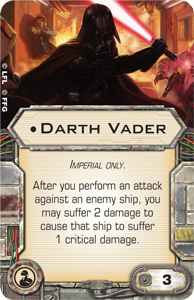
Darth-vader.png

I call into attention the rule book and its ruling on damage.

(Page 13)

When the number of Damage cards dealt to a ship
equals or exceeds its hull value (yellow number), that
ship is destroyed (see “Destroying Ships” on page 16).
(page 16)
Destroying Ships
When the number of Damage cards dealt to a ship
is equal to or greater than its hull value, the
ship is immediately destroyed (faceup and facedown
cards count toward this total). Immediately remove
the destroyed ship from the play area, discard all of
its Damage cards to a faceup discard pile next to
the Damage deck, and return all of its tokens to their
respective supplies.
The word immediately is an interupt for the Vader damage dealing crit. Does the damage for both ships happen at EXACTLY the same time, or does one type of damage happen first?
Also, winning the game (page 13)
Winning the Game
When one player destroys all of his opponent’s ships,
the game ends and that player wins. If playing a
mission, refer to its victory conditions.
In the unlikely event that each player’s final ship
is destroyed at the same time, the player with
initiative wins.
I will withhold my interpretation to foster an unbiased opinion.
Edited by nimdabew

When dealing damage cards, you deal all damage card before checking if a ship is destroyed. A ship with one damage remaining that suffers two damage receives both damage cards before destruction. You do not check for destruction after each damage card. (FAQ)

With Vader, I'd do the same. Deal all three damage cards before checking for destruction. That results in simultaneous destruction. Initiative wins.

When dealing damage cards, you deal all damage card before checking if a ship is destroyed. A ship with one damage remaining that suffers two damage receives both damage cards before destruction. You do not check for destruction after each damage card. (FAQ)

With Vader, I'd do the same. Deal all three damage cards before checking for destruction. That results in simultaneous destruction. Initiative wins.

In an elimination round, the player with init wins. In a swiss round, it goes down as a draw.

When dealing damage cards, you deal all damage card before checking if a ship is destroyed. A ship with one damage remaining that suffers two damage receives both damage cards before destruction. You do not check for destruction after each damage card. (FAQ)

With Vader, I'd do the same. Deal all three damage cards before checking for destruction. That results in simultaneous destruction. Initiative wins.

In an elimination round, the player with init wins. In a swiss round, it goes down as a draw.

To clarify this - the game ends in a Draw either way, but if it's an elimination rounds, draws count as wins for the player with initiative.

For the timing, we know the Draw rule checks simultaneous fire. Destruction in general has the same timing as simultaneous fire, with immediate removal, and we know that ships which have been destroyed still resolve triggered abilities before being removed (Vader, Gunner). I don't think winning is an instantaneous flash of victory - currently-running abilities have to complete, which could lead to a mutual kill, and a draw.

This is M.A.D.

When dealing damage cards, you deal all damage card before checking if a ship is destroyed. A ship with one damage remaining that suffers two damage receives both damage cards before destruction. You do not check for destruction after each damage card. (FAQ)

With Vader, I'd do the same. Deal all three damage cards before checking for destruction. That results in simultaneous destruction. Initiative wins.

In an elimination round, the player with init wins. In a swiss round, it goes down as a draw.

I have a question about this as it happened at a store last night. The last two ships remaining. Vader vadered and eliminated both ships. I thought that both ships would be destroyed and then it becomes a point total at that point. If both squads are at 100 points THEN it would come to initiative. Would that not be the correct way to calculate such a victory?

Lue.

If both squads are at 100 points THEN it would come to initiative. Would that not be the correct way to calculate such a victory?

Point value doesn't factor into win/lose, only the MoV.

If both squads are at 100 points THEN it would come to initiative. Would that not be the correct way to calculate such a victory?

Point value doesn't factor into win/lose, only the MoV.

You know, that could have some strange results. If 98 and 100 point squadrons play to a draw wouldn't that mean the 98 point squadron gets 100 points for MoV and the 100 point squadron gets 98 points? In this case the draw still would favor the initiative winner (the 98 point squadron) by giving it a slightly higher MoV.

If neither player has any remaining ships, the game ends in a Draw.
A Draw is determined solely by whether or not there are ships left - points has nothing to do with it.
Then, later:
If a player destroys all of his opponent’s ships, his opponent’s squad is worth 100 squad points, even if it is worth fewer squad points to begin with.

And this covers the MoV.

So if you have a case of simultaneous fire, it's a Draw because there are no ships left, and each squad counts as 100 points destroyed, so the MoV will be even.

MoV?

Note, the player with the 98 points has the "advantage" in that he gets to choose who has initiative (which matter in elimination rounds only). If he chose to give it away, then it is his own fault for losing the draw.

MoV?

Margin of Victory.

Margin of Victory.

Kill Difference = (Points Killed by Winner) - (Points Killed by Loser)

Winner MoV = 100 + (Kill Difference)

Loser MoV = 100 - (Kill Difference)

So if I win in a game where you kill 20 points of my ships, my MoV is 180, yours is 20.

Note, the player with the 98 points has the "advantage" in that he gets to choose who has initiative (which matter in elimination rounds only). If he chose to give it away, then it is his own fault for losing the draw.

Except that he doesn't lose the draw...

Note, the player with the 98 points has the "advantage" in that he gets to choose who has initiative (which matter in elimination rounds only). If he chose to give it away, then it is his own fault for losing the draw.

Except that he doesn't lose the draw...

If he chooses to give the other player initiative, he would lose the draw. He just has the choice of init, he doesn't necessarily have init.

Note, the player with the 98 points has the "advantage" in that he gets to choose who has initiative (which matter in elimination rounds only). If he chose to give it away, then it is his own fault for losing the draw.

Except that he doesn't lose the draw...

If he chooses to give the other player initiative, he would lose the draw. He just has the choice of init, he doesn't necessarily have init.

Ah, got it - sorry, I misread what you were saying there and thought you were connecting the bid on initiative to losing because he was down points. Except that if it worked like that, he'd win because his opponent destroyed fewer.

My bad.

My take is on a super close reading of the card:

You suffer 2 damage which then causes the critical hit attack... you die and are removed immediately....instantaneously ... losing the match essentially before the effect is put in place.

Margin of Victory.

Kill Difference = (Points Killed by Winner) - (Points Killed by Loser)

Winner MoV = 100 + (Kill Difference)

Loser MoV = 100 - (Kill Difference)

So if I win in a game where you kill 20 points of my ships, my MoV is 180, yours is 20.

That MoV example assumes that you kill all of my ships. If we go to time and I have killed 20 points of your ships but you win because you killed 40 points of mine would the MoV not be 120 and 80?

My take is on a super close reading of the card:

You suffer 2 damage which then causes the critical hit attack... you die and are removed immediately....instantaneously ... losing the match essentially before the effect is put in place.

I'd actually tend to agree with this. You suffer 2 damage to cause a critical damage. The suffering of 2 damage must happen first, as a precondition of causing the critical damage. Taken at its finest level of detail, it seems plausible that the ship with Vader dies before the ship that is getting hit by Vader receives its critical damage.

My take is on a super close reading of the card:

You suffer 2 damage which then causes the critical hit attack... you die and are removed immediately....instantaneously ... losing the match essentially before the effect is put in place.

I'd actually tend to agree with this. You suffer 2 damage to cause a critical damage. The suffering of 2 damage must happen first, as a precondition of causing the critical damage. Taken at its finest level of detail, it seems plausible that the ship with Vader dies before the ship that is getting hit by Vader receives its critical damage.

This is my stance as well, but I don't know. There are two camps right now, one that has this view point, the other as noted above, that it comes down to initiative and is a simultaneous event.

My take is on a super close reading of the card:

You suffer 2 damage which then causes the critical hit attack... you die and are removed immediately....instantaneously ... losing the match essentially before the effect is put in place.

We have multiple examples where it doesn't work like this, though:

- In a Simultaneous Fire situation, if my ship has been destroyed before firing but destroys you, it's a draw even though your removal is immediate and mine is only after I've had the opportunity to attack. This is a much wider time window than Vader's trigger/resolve.

- If I make an attack with both Vader and Gunner and trigger Vader on the first attack, destroying myself, I still get to make the second attack with Gunner. If a ship lingers long enough to make a completely separate attack, it certainly lingers long enough for Vader's ability to resolve once triggered.

So we have examples both in general gameplay and in tournament resolution that go against the "uber-instantaneous removal" theory.

I was just looking at when you actually check for winning the game.

After completing the End phase, the round is over. If
neither player has destroyed all of his opponent’s ships,
a new round begins, starting with the Planning phase

This is the last paragraph of the End phase. This is immediately followed by the section Winning the game, which clearly states:

In the unlikely event that each player’s final ship
is destroyed at the same time, the player with
initiative wins.

So Vaders ship was destroyed because it got as many damage cards as it's hull. And the oponent was destroyed by recieving the final Critical damage card. There are no more ships that can now activate and the End phase happens. And the unlikely event just occurred. both ships were destroyed.

Another instance where I can see this happen is during Simultanious Attacks where two opposing ships of equal PS destroys each other.

And as for the argument that Vader takes the damage first, I disagree. Both happen at the same time. Because if you do not deal the Critical damage to the opponent, then you would not pay the cost either. So one can not happen without the other. And if anybody believes that they can argue that one set of damage happens first, can the same argument not be applied to the opposite? do you pay the cost to deal the damage or do you pay the cost because you dealt the damage? I say Neither. you pay the cost when you deal the damage. Its all part of one ability that has to fully resolve.

It is painfully obvious who wins in a situation like this.

Darth Vader.

Edited by Keffisch

Yep, I would say a Dark Lord of the Sith trumps everything!

My take is on a super close reading of the card:

You suffer 2 damage which then causes the critical hit attack... you die and are removed immediately....instantaneously ... losing the match essentially before the effect is put in place.

We have multiple examples where it doesn't work like this, though:

- In a Simultaneous Fire situation, if my ship has been destroyed before firing but destroys you, it's a draw even though your removal is immediate and mine is only after I've had the opportunity to attack. This is a much wider time window than Vader's trigger/resolve.

- If I make an attack with both Vader and Gunner and trigger Vader on the first attack, destroying myself, I still get to make the second attack with Gunner. If a ship lingers long enough to make a completely separate attack, it certainly lingers long enough for Vader's ability to resolve once triggered.

So we have examples both in general gameplay and in tournament resolution that go against the "uber-instantaneous removal" theory.

Well, the simultaneous rules should not apply as the card has a explicit cause then effect syntax, that is not in the simultaneous rule.

Gunner happens independently of cause and effect to, so you always can take gunner simply after you perform an attack with the shuttle. This of course is a prereq. to vader and gunner. However, the Vader wording is not 'instantaneous' as gunner but requires a cause and effect time component- one thing must happen before the other.