New Player- couple of rule questions

By NDyse10, in X-Wing

I have played, in total, 3 games of X-Wing so far and I am having a blast.

I have been watching videos and listening to podcasts to learn more about the game and I do have a few rule clarifications I wanted to set straight.

- Do you take damage cards when you still have shield tokens up or do you remove all shield tokens and then once they are out start taking damage cards? What happens if your opponent gets a critical hit when you have shields up?

- If I have a focus token does that make all my focus results hits (if I'm attacking) or evades (if I'm defending) or does it only turn 1 focus result into a hit or evade?

- What is the appropriate way to measure if a ship falls within a firing arc?

- This isn't a rule question, but more of a general question. Do people have any tips on how not to jostle ships when you are measuring range, firing arc, moving etc etc. I have been having some issues with slight bumps here and there. I'm sure with practice it comes easier but was wondering if people had any tips to help with this.

Thanks in advance!

Also just realized there is an individual rules forum. My apologies for getting this in the main forum. If a moderator could move this that would be fantastic.

Thanks

Mod's don't visit here much, but I'll answer your questions.

- Do you take damage cards when you still have shield tokens up or do you remove all shield tokens and then once they are out start taking damage cards?

Until all the shields are gone, you don't deal any sort of card, face up or face down. Effectively a <hit> and <crit> have the same result as long as you have shields.

But remember you resolve <hits> first, so if you have 1 shield left and suffer a <hit> and a <crit> you lose the shield from the <hit> then are dealt a face up card from the <crit>.

or does it only turn 1 focus result into a hit or evade?

It turns all <focus> results into a <hit> or <evade>

- What is the appropriate way to measure if a ship falls within a firing arc?

Most people use the ruler, put it on the base of the attacking ship, and line it up with the printed arc, you should be able to tell that way. If you happen to have more than one range ruller, a lot of us cut one at the range 1 marker, so you have a range 3, a range 2 and range 1 ruler which can make it easier to get into tight spots.

Do people have any tips on how not to jostle ships when you are measuring range, firing arc, moving etc etc.

Just be careful. :) Some people will glue washers or some other kind of weight to the base, the extra weight helps keep them from moving as easily.

Edited by VanorDM

Welcome!

Do you take damage cards when you still have shield tokens up or do you remove all shield tokens and then once they are out start taking damage cards? What happens if your opponent gets a critical hit when you have shields up?


When you take damage, you remove shield tokens. It's one shield token for each uncanceled [hit] or [crit] result on your opponent's attack dice--that is, if your shields are up you can't take critical damage. Once your shields are gone, you start taking damage cards.

If I have a focus token does that make all my focus results hits (if I'm attacking) or evades (if I'm defending) or does it only turn 1 focus result into a hit or evade?


Spending a focus token changes all [eyeball] results into [hit] results or [evade] results.

What is the appropriate way to measure if a ship falls within a firing arc?


Use one edge of the range ruler to measure along the line indicated on the ship's base. You can actually use any ruler or straightedge, and a lot of players actually use laser levels to put down a long, perfectly straight line that doesn't risk moving or knocking over any minis.

Do people have any tips on how not to jostle ships when you are measuring range, firing arc, moving etc etc. I have been having some issues with slight bumps here and there. I'm sure with practice it comes easier but was wondering if people had any tips to help with this.


Practice makes it easier; the laser-level trick for measuring firing arcs helps, too, and having a high-quality play surface makes a difference. But honestly the biggest adjustment for me wasn't learning not to make those slight bumps, but learning not to mind them. It's actually even in the tournament rules that, basically, accidents happen and a reasonable margin of error is part of the game. ^_^

If you are taking damage, you remove shield tokens first and only once they are gone do you deal damage cards. There are a few cards however that specifically say to deal a damage card, those effects will bypass shields.

If you spend a focus token it changes all eyeballs into [whatever]. Just a side note, many new players seem to miss the distinction between actions and tokens. Spending a focus token is not performing an action, you perform the focus ACTION to gain a focus TOKEN, which you then later spend. I don't know if that was a confusing point for you, but it seems to be a common hang up for new players so I wanted to make sure.

Most people seem to check arc by holding the base down firmly with one hand and holding the range ruler so it lines up with the firing arc line on the base insert. Those more inclined to gadgets sometimes use a laser level type thing from a home improvement store to be more accurate without touching the ships.

There is going to be a bit of inaccuracy in measuring movement and position. Be tolerant. Generally it can be kept to a minimum by using one hand to hold down the ship, place the template, then firmly hold it down and move the ship. If you are dealing with a situation where the template is crossing another ship, just do your best. It is possibly, and frequently acceptable to mark the intervening ship's location with a spare 1 straight template and then remove it so the maneuver template can be placed more accurately, them replace the intervening ship once the moving ship is in its final position. Just be careful that you are not ignoring overlap situations when doing that (also remember not to move the template that is marking the troublesome ship's location before putting the ship back).

edit: gotta love 3 really long posts answering the questions showing up withing a minute of each other, and all saying exactly the same thing ;)

Edited by Forgottenlore

I have been watching videos and listening to podcasts to learn more about the game and I do have a few rule clarifications I wanted to set straight.

- Do you take damage cards when you still have shield tokens up or do you remove all shield tokens and then once they are out start taking damage cards? What happens if your opponent gets a critical hit when you have shields up?

- If I have a focus token does that make all my focus results hits (if I'm attacking) or evades (if I'm defending) or does it only turn 1 focus result into a hit or evade?

- What is the appropriate way to measure if a ship falls within a firing arc?

- This isn't a rule question, but more of a general question. Do people have any tips on how not to jostle ships when you are measuring range, firing arc, moving etc etc. I have been having some issues with slight bumps here and there. I'm sure with practice it comes easier but was wondering if people had any tips to help with this.

1. When you suffer damage you must remove all shield tokens before dealing damage cards. Note that you use Shield tokens on [boom] results before you can use them on [kaboom] results. Also note that there are a few things that do NOT "deal damage" but rather "deal cards" directly; you CAN be dealt cards in those cases even if you have shield tokens and it is even possible for those cards to kill you even if you have maximum shields.

2. The Focus token converts ALL [eye] results WHEN IT IS SPENT. If you do not spend it then it does nothing.

3. There are many ways to check a firing arc. The basic way would be to line up the edge of the range ruler with the arc and check that way. The way I learned to check LoS was to stretch a string tight and here you could use that to check an arc; the more modern tool to do that would be a laser line projector.

4. I hear that you can try better play mats which don't permit easy sliding (hear yoga mats are great.) You could also weight your ship's bases or otherwise add something to them (without altering their shape) to make them harder to wobble and move. For Range measurement some people have cut up a range ruler into R1 and R2 lengths so they fit into tight spaces better. Straight lines (firing arcs) can be projected or you could try that string method. Sometime you may find that you need to do something to mark a ship's base and then remove that base temporarily so it is not in the way when attempting a maneuver.

Edited by StevenO

There is a difference between suffering and dealing damage cards.

When you suffer damage (also known as the hits and critical hits in all attacks) remove 1 shield token for each damage suffered first with the hits and then the critical hits once the hits are all gone.

When you run out of shield tokens then each hit damage suffered you are dealt 1 face down damage card and for each critical hit suffered you are dealt 1 face up damage card.

Now there are some cards (pilot abilities and upgrades) that deal damage cards to you. Best example the proton bomb which when detonates, deals 1 face up damage card to all ships at range 1. The dealing the damage card goes past the shield tokens. (note: rule says deal, not suffer)

Now on Vader(crew) the card says suffer 2 damage to cause a ship you just attacked to suffer 1 critical damage. The damage is taken on the shield first (for both the ship Vader is on and the targeted ship) (note card: says suffer, not deal)

Also flipping damage cards (up or down) is different from both dealing or suffering damage. If there is an ability that discards a damage card when dealt you cannot used that ability on cards that are flipped. For example, using determination to discard a blinded pilot damage card flipped up by R2-D2(crew).

Hope this clarifies everything on how damage cards work.

Edited by Marinealver

Interesting rule thing that often gets overlooked until you've been playing for a while:

Roll attack dice first. Then all modifications to the attack dice are made.

Only once that happens are defense dice rolled.

All of that is very helpful, and makes total sense. Thanks to everyone who answered me.

Here's another one for you (related to damage again)

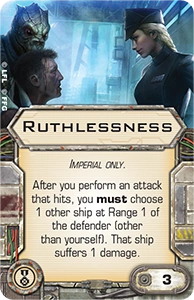
If I was playing Ruthlessness and say I chose a ship at range 1 that had 2 shields up. Ruthlessness states that ship would suffer 1 damage. Would that be one of the examples of bypassing a shield or would I still remove a shield token in this example?

All of that is very helpful, and makes total sense. Thanks to everyone who answered me.

Here's another one for you (related to damage again)

If I was playing Ruthlessness and say I chose a ship at range 1 that had 2 shields up. Ruthlessness states that ship would suffer 1 damage. Would that be one of the examples of bypassing a shield or would I still remove a shield token in this example?

Ruthlessness makes the target "suffer damage". That follows the rules for suffering damage on page 16 of the rulebook. Shields work.

Stuff that ignores shields deals a damage card.

Interesting rule thing that often gets overlooked until you've been playing for a while:

Roll attack dice first. Then all modifications to the attack dice are made.

Only once that happens are defense dice rolled.

And defender modifies the attacker's dice first, as well.

Would someone be able to link an example of a laser level people are using? The one being used in the 2014 World Championship Youtube video looks perfect, but can't find anything similar on the internet.

All of that is very helpful, and makes total sense. Thanks to everyone who answered me.

Here's another one for you (related to damage again)

If I was playing Ruthlessness and say I chose a ship at range 1 that had 2 shields up. Ruthlessness states that ship would suffer 1 damage. Would that be one of the examples of bypassing a shield or would I still remove a shield token in this example?

All of that is very helpful, and makes total sense. Thanks to everyone who answered me.

Here's another one for you (related to damage again)

If I was playing Ruthlessness and say I chose a ship at range 1 that had 2 shields up. Ruthlessness states that ship would suffer 1 damage. Would that be one of the examples of bypassing a shield or would I still remove a shield token in this example?

Ruthlessness makes the target "suffer damage". That follows the rules for suffering damage on page 16 of the rulebook. Shields work.

Stuff that ignores shields deals a damage card.

I already explained what suffering damage and what dealing damage cards is. But yes page 16 of the rule book.

Ruthlessness.png

Note: the card says suffer, not deal.

Edited by Marinealver

Would someone be able to link an example of a laser level people are using?

Try looking at a home improvement store like Menards or Home Depot. They're just laser levels.

Although a guy I play with on league night has a really nice one one, it's the same size and shape as a laser pointer, but it projects a line rather than a dot. But he got it from someone who ordered a bunch from China so he has no idea were to get more.

All of that is very helpful, and makes total sense. Thanks to everyone who answered me.

Here's another one for you (related to damage again)

If I was playing Ruthlessness and say I chose a ship at range 1 that had 2 shields up. Ruthlessness states that ship would suffer 1 damage. Would that be one of the examples of bypassing a shield or would I still remove a shield token in this example?

All of that is very helpful, and makes total sense. Thanks to everyone who answered me.

Here's another one for you (related to damage again)

If I was playing Ruthlessness and say I chose a ship at range 1 that had 2 shields up. Ruthlessness states that ship would suffer 1 damage. Would that be one of the examples of bypassing a shield or would I still remove a shield token in this example?

Ruthlessness makes the target "suffer damage". That follows the rules for suffering damage on page 16 of the rulebook. Shields work.

Stuff that ignores shields deals a damage card.

I already explained what suffering damage and what dealing damage cards is. But yes page 16 of the rule book.

Ruthlessness.png

Note: the card says suffer, not deal.

Must of missed it, my bad! Thanks for answering again.

Everyone has been extremely helpful in here and it is very much appreciated.

I have played a few more games and am absolutely loving it. I feel I have a pretty good understanding of the rules but I am sure there are some things I am unknowingly doing incorrectly.

I do have one question that popped up (I'm pretty sure I know the answer but I want clarification).

- Do you get your extra attack die at range 1 only in your primary firing arc? Or do you get it regardless? The way I understand it you get your extra attack die at range 1 regardless, but wanted to be sure.

The range 1 die happens in any attack made with a primary weapon. So Han gets 4. Turret upgrades get nothing. Similarly defending from a Heavy Laser Cannon at range 3 gives no bonus dice.

Edited by Stelar 7

You only get the extra attack die with your primary attack at R1. That attack does NOT need to be within the ship's firing arc unlike a number of other abilities so if you get close to Han you'll be facing 4 dice.

The range 1 die happens in any attack made with a primary weapon. So Han gets 4. Turret upgrades get nothing. Similarly defending from a Heavy Laser Cannon at range 3 gives no bonus dice.

You only get the extra attack die with your primary attack at R1. That attack does NOT need to be within the ship's firing arc unlike a number of other abilities so if you get close to Han you'll be facing 4 dice.

Perfect. Sounds I was doing it right!

Thanks again.

Other questions answered, I'll just show how I resolved bumping issues.

I use a single washer on small ships and four washers on large ships. I spray them with plasticoat (dipping gave too uneven a surface but a more robust coating).

yO2Z0rsh.jpg

I've also tried filling the entire base cavity with silicone sealant and although it offers superior grip the washer keeps the center of balance low and I think that's more important. Silicone was a giant mess to work with, too.

The play surface itself is also important. I've played on most types available and though I prefer the looks of my mouse pad type mats the superior one seems to be felt as it sort of snags the base.

Edited by Mauser101