Initiative, still not sold on the idea

By verdantsf, in Star Wars: Edge of the Empire RPG

I'm a fan of SWRPG's combat, with the exception of the initiative system. While it might sound like a cool idea for players to choose who acts in each PC initiative slot every round, in actual practice it bogs combat down. In previous games, I've done a modified version of the official rules, where players choose their lineup once, then keep that order for the rest of the encounter. What's your preference?

*Edit*

I've been convinced ;)!

Edited by verdantsf

I misread the initiative instructions about how the PCs could pick the order early on. My Players got used to their roll choosing their order and they never deviate from this. It became the de facto house rule for handling it.

Honestly, I think this system is great. Folks I've played with are pretty good about deciding who goes when, even if they need to change it up with circumstances. The alternative is to have fixed initiative with ready/delay actions, over which I'll take this the SW system in a heartbeat.

I think I might house rule it to have everyone choose their order for the first round and stick to that, unless an tactical opportunity/emergency pops up, and then they can rearrange as needed.

I find in almost every combat the order will change on the fly, and having a set order would actually make combat dryer and duller.

I think your house rule of "emergency only reorder" would slow the game down more, because players debate every action and say "Should we reorder" instead of just "Who's going?". So it's an extra step?

Honestly, I think this system is great. Folks I've played with are pretty good about deciding who goes when, even if they need to change it up with circumstances. The alternative is to have fixed initiative with ready/delay actions, over which I'll take this the SW system in a heartbeat.

Ditto.

The FFG SW initiative isn't "awesome sauce" but it's work great for the Narrative style of the game. In a crunchier tactics based game I'd use something else, but here it I like it.

I honestly really don't like it. You're right that it bogs combat down, and it just makes it more work for me because I (the gm) end up having to keep track of who has and has not had a turn yet and I'd much rather be thinking about ways to make the encounter fun and exciting. Buuuttttt... My players love this initiative system so I guess we're sticking with it.

I bet with two or three players this initiative method is fantastic. But with six it just leads to more bookkeeping.

I have no idea how it "bogs combat down", certainly doesn't for me. There is some player activity making the decisions, but it tends to be short, and the narrative potential makes up for it: "Oskara will go next because I just shot and missed, but splinters on the crate are flying and the target dodged giving her a clear shot..."

Then again, maybe it's because I generally don't set up big fights...those bog down in any game...so maybe the action is over before combat fatigue sets in.

I've never had a problem with it, and in fact, I prefer it to a d20-esque turn order. After I create the tracker, I just look at it and say "You guys have three slots to use" or whatever, then I use my adversary slots, etc. To me, it speeds things up because you don't have to go down a list and call out everyone for their turn. It's usually PCs, Adv, maybe PCs again, and that's about it.

I (the gm) end up having to keep track of who has and has not had a turn yet

I just use the same trick as in Marvel Heroic: everyone has a turn counter (playing cards works fine). At start of round, counter is face-up, after character takes its turn, flip it face down.

Edited by Lorne

I've never had a problem with it, and in fact, I prefer it to a d20-esque turn order. After I create the tracker, I just look at it and say "You guys have three slots to use" or whatever, then I use my adversary slots, etc. To me, it speeds things up because you don't have to go down a list and call out everyone for their turn. It's usually PCs, Adv, maybe PCs again, and that's about it.

Not only that, I've found it keeps the whole party interested in the whole combat. You don't get a situation where a player says "oh, my turn is done, time to check my texts"

My players aren't as familiar with each other and their tactics yet. I can see how things might speed up as they get more games together. Though, I'm running a series of pick-up games, rather than a traditional campaign, so the team composition will change from game to game.

It's going to vary from table-to-table. In doesn't prolong combat at all in our games.

I've never had a problem with it, and in fact, I prefer it to a d20-esque turn order. After I create the tracker, I just look at it and say "You guys have three slots to use" or whatever, then I use my adversary slots, etc. To me, it speeds things up because you don't have to go down a list and call out everyone for their turn. It's usually PCs, Adv, maybe PCs again, and that's about it.

Now I see what the problem is. I've been going slot by slot, "okay, PC slot 1, who is up? PC slot 2, who is up?" This has prompted either several seconds of silence with everyone waiting for someone else to go or a rush of several players all wanting the same spot. Handing out the slots in bulk so the players can coordinate multiple slots together changes things a lot. I've been so stuck in the Pathfinder/D&D model that I didn't even think of that! Thanks for the input everyone!

Edited by verdantsf

I find that the the first part of rolling is a bit tedious. I have 4 players. So they all roll, and then I have to sort out the rolls. So I could have SSSAA, SSAAA, SS, AA. Then I have to roll for all my badies. Lets just say there are three rivals. I roll SSS, SSA and A. So the count will go PC / NPC / PC / NPC / PC / PC / NPC.

That is really the only hard part. After that the players decide when to go. I have one guy that has quickstrike, so he gets a boost to act against a NPC that has not acted yet, so he usually is the first to go in Combat Round 1.

After that my guys don't really fight over who has to go first or next. In my group we have a BH/Gad, Smug/Sco, Tech/OT, Smug/Pilot-Force Em.

So in the first round it goes.

Scoundrel

BH/Gad

Tech/OT

Force guy to usually commit a force die (which is an action) If something else comes up, he can then shoot or whatever.

After that, usually a support type goes in the hopes to get some Advantage to pass along to the BH/Gad.

But for every round you should keep the same count "PC / NPC / PC / NPC / PC / PC / NPC.", not re-roll initiative, the players and NPCs just which slot they want. I have seen where people roll initiative every round, to me that would slow the game down.

In the next Encounter the initiative counts could be NPC / NPC / PC/ PC/ PC/ PC or something else.

I like the fluidity of this way, as players can decide when they want to act in a round, and as combat is fluid, and things always change, the characters don't always have to go in the same order. I have played in games where you had a pretty good idea of when each player was going to go just by the stats they had. A lot of times, a character could do something cool if they went first, but no one will hold their action for them.

So anyway, I think it is a pretty good way to work the combat rounds. I find the only time it feels "bogged down" is when getting the symbols written down and lined up.

But if doing something else works good for you and your group, that's great.

Edited by R2builder

In my group, we mark Player and Enemy initiative slots on a white board with colored magnets. I have a small white board, about the size of a sheet of paper. To assist the GM, I as a player call out if it's a player or enemy slot. That lets the GM focus on running the game, tracking damage, and what NPCs do while I help keeping the combat moving.

It's also nice that our group is pretty laid back and "adult" about taking turns on who goes when. On the first turn of combat, usually the people with Quick Strike go first. Our medic always goes last. And the middle spots are determined on the fly based upon who has a good shot and when. After the first turn, it usually breaks down to balancing the shooters with the melee guys so that we aren't trying to shoot into melee combat.

All in all, I feel the initiative system works pretty well for this system. It just takes a bit to get over old habits and learn how to do something new.

I find that the the first part of rolling is a bit tedious. I have 4 players. So they all roll, and then I have to sort out the rolls. So I could have SSSAA, SSAAA, SS, AA. Then I have to roll for all my badies. Lets just say there are three rivals. I roll SSS, SSA and A. So the count will go PC / NPC / PC / NPC / PC / PC / NPC.

<snip>

So anyway, I think it is a pretty good way to work the combat rounds. I find the only time it feels "bogged down" is when getting the symbols written down and lined up.

But if doing something else works good for you and your group, that's great.

I've started to do shorthand when writing down successes and advantages. Number dot number. For the example above, I'd write on my white board:

3.2

2.3

2.0

0.2

Well, actually, it's usually a bit more jumbled than that because they are never called out in order of who goes when. lol

Then I eyeball the results and place my colored magnets on the whiteboard in order of PC and NPC slots. Makes it pretty quick and easy. I also do this as a player, so the GM can organize his notes for the battle, and roll NPC rolls, while I'm sorting out initiative.

So anyway, I think it is a pretty good way to work the combat rounds. I find the only time it feels "bogged down" is when getting the symbols written down and lined up.

But if doing something else works good for you and your group, that's great.

Have you used the initiative tracker I include on the encounter sheets for the GM Tools? I find it helps quite a bit with this. I have two charts, one for the rolls and one for the order. I just call out initiative, everyone rolls, and tells me "3 and 2" or "0 and 3" or whatever, and I mark it on the first chart. I do the same for my NPC groups. Then, I just eyeball the first chart, and mark off PC or NPC in the second. It actually goes pretty quick.

And dittos on the system allowing coordinated attacks by the PCs. It's one of its great strengths. If the PCs have several slots to use, they might wait on the heavy-hitter to go in order to give him some boost dice, or maybe have another PC use a talent to help his attack. My players do this all the time.

And more dittos for helping keep the players' attention on the game. When I ran a d20 campaign, encounters generally caused my players to go into ADD mode when it wasn't their turn. They'd play with their phones (or PSPs), leave the table, and generally just stop paying attention until it was their time to roll. When they all need to coordinate what they're doing in a particular round, and how they want to use their init slots, it helps keep them focused on the action.

Edit: The chart also has a column for Triumphs, but they don't come up too often. If it does, the player generally says "X and Y, and a Triumph".

Edited by OggDude

I find that the the first part of rolling is a bit tedious. I have 4 players. So they all roll, and then I have to sort out the rolls. So I could have SSSAA, SSAAA, SS, AA. Then I have to roll for all my badies. Lets just say there are three rivals. I roll SSS, SSA and A. So the count will go PC / NPC / PC / NPC / PC / PC / NPC.

<snip>

So anyway, I think it is a pretty good way to work the combat rounds. I find the only time it feels "bogged down" is when getting the symbols written down and lined up.

But if doing something else works good for you and your group, that's great.

I've started to do shorthand when writing down successes and advantages. Number dot number. For the example above, I'd write on my white board:

3.2

2.3

2.0

0.2

I actually use three numbers, e.g.: 1.2.0...because some of my players have actually invested in Vigilance, and sometimes get a Triumph :)

I actually use three numbers, e.g.: 1.2.0...because some of my players have actually invested in Vigilance, and sometimes get a Triumph :)

I'll try out the system as written first, but I'm wondering if the Marvel Cortex initiative style would be easier to manage. Essentially, the GM eyeballs whoever is the fastest (in that system you may have superspeed, super reflexes, etc). That person would usually be chosen to go first. From there, that player selects who goes next (it could be another player, and NPC ally or an enemy).

Potential hazards of using that style would be if all the PC go one after another against an enemy and taking him out quicker. Then again, if you have a large group of enemies, that style could be disastrous once whoever is left gets a series of uninterrupted attacks.

In that system, the GM could give out hero points (can't remember what they're called) to interrupt the order and have a bad guy go. I suppose this could be done with the Destiny Points, but it seems a little off.

I do like the idea of open slots that the players decide what character fills it. It's a nice middle ground between the ridged D20 mechanic and the "loosey-goosey" Marvel style.

I used to use fancy initiative trackers, but I learned from watching GM Chris that it's super easy to manage without any of that.

Everybody just tells me "I rolled 2 and 3", "1 and 0", etc, and I mark it on the whiteboard. Then I order them and use simple annotations for PC and NPC turn order. In my case I use a short thin line for PC and a short thick line for NPC. GM Chris used different color markers but I sped things up by not having to switch colors.

In theory it *can* slow things down a bit when the players get into discussing strategy in too much detail rather than someone just stepping up to take the turn. If that starts to happen, I'll get a feel for what they are suggesting, then say "So Oskara, do you want to go now?"

I keep track of rounds and turns by marking dots next to the lines on my whiteboard, so if a line has a dot next to it, that's a turn already taken. I just wanted to get to a system that required as little notation as possible.

I actually use three numbers, e.g.: 1.2.0...because some of my players have actually invested in Vigilance, and sometimes get a Triumph :)

Forgot about mentioning the Triumphs. It seems so rare for our group to actually roll Triumphs that I haven't needed a third number yet. I just draw a little "T" next to the Triumph roll if needed.

Our dice seem to be extra spotty when it comes to Triumphs. We'll go weeks without rolling one, then we'll all roll two on each roll for a few turns, then never see a Triumph again for a couple weeks.

this is my cheap arcane way of keeping track if initiative... highly potable and inexpensive.

YOu need:

4X6 index cards

1 pen

small binder clips

Optional: highlighter

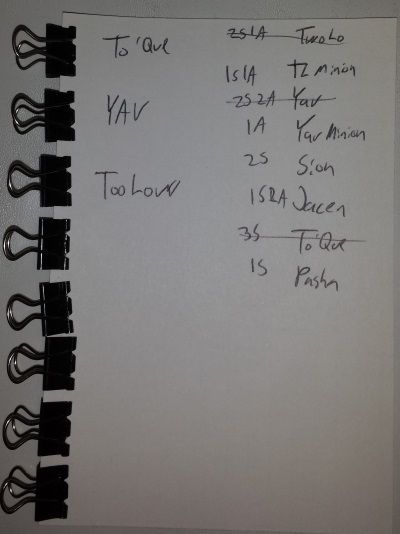
I have a 3 x 5 index card with a bunch of small binder clips on a long side. I usually have the NPCs and players names written down on the side away from the binder clips.

next to the names in the middle i write down the result of their initiative. usually a shorthand type of chicken scratch where i write "3S2A, 2S1A, 2A, 1S" where S=success and A= advantage

then i order the PCs and NPCs base on the result. to create my slots.

init1.jpg

here is where it gets interesting:

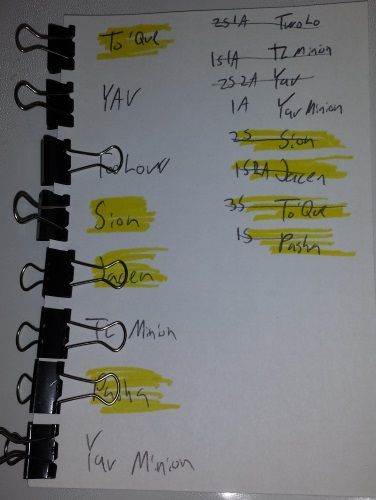
the back handle of the binder clips keep track of slots during a round, and the front binder clips keep track of who has taken their turn.

As you can see in this picture the round is halfway over (i highlighted the PCs for ease). 4 handles in the back are flipped in, and 4 handles on the front are flipped in according to who has gone

init2.jpg

first round i flip the handles in, second round i flip the handles out

my players are really good about discussing who goes when and strategy. There was some initial hesitation about how it worked but now it seems so simple and straightforward and intitive.

prefer this much better then other systems. ... and i have played a LOT of systems

Edited by kinnison

Kinnison, that's genius!