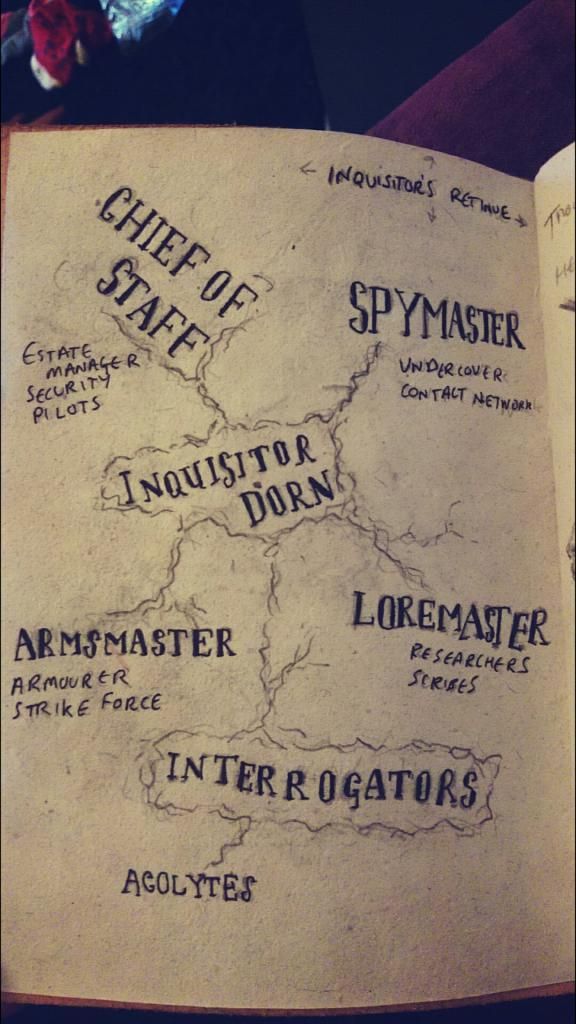
Inquisitor's retinue

By unitled, in Dark Heresy General Discussion

Hello all!

Recently got my copy of the 2nd Edition Rulebook, absolutely loving it.

One thing I'm slightly missing is a low-down on the Inquisitors of the Askellon Sector, like they did with the Calixis Sector in the original book (if there is anything there, I've not managed to spot it). As a result I've decided to have a crack at making my own Inquisitor from scratch, and I'm pretty glad I did!

Anyway, one thing I was wondering was, what does an Inquisitor's network look like? I'm having fun drawing a huge spider diagram thinking of all the things they might have available to them, all the people connected to their organisation, and it's giving me adventure ideas left right and centre! Even if it never comes up in the game, it's fun for myself plotting this out.

What the kind of things you can imagine your Inquisitor having access to?

For all intents and purposes Askellon is empty. There are a few (meaning single digits) if any inquisitors operating there.

As for an inquisitorial network that depends on the inquisitor, if you have the time I suggest reading the Eisenhorn Trilogy and the Ravenor trilogy by Dan Abnett to see what inquisitors are generally capable of doing/getting their hands on.

Eisenhorn for example had a large group of untouchables at one point, and Ravenor even visited a craftworld if I remember right.

I'd suggest he/she have access to a rogue trader they trust, relatively, so they can cart his acolytes around quietly.

I've read through Eisenhorn a few times, and Ravenor (and Pariah! looking forward to Bequin part 2...) and must admit it's really guiding me in this area. I really dig Abnett as an author, I've heard someone say he's way better than he needs to be to write this kind of licenced fiction!

The idea of an Inquisitor having an estate is a great one, I think (mine is based off-world). Good call on the Rogue Trader as well, that's going on the chart...

Side question: Is there no formal Inquisitorial presence in the Askellon sector, then? The Askellon Chapter in the rulebook is about the only one I haven't really tackled yet (just leafed through a few times). I guess that opens it up for more Inquisitor on Inquisitor conflicts if they don't know where each other are operating?

Short answer is no. I suggest reading the section to get a better idea.

Speaking of Abnett, am I the only one who would kill (ok, maim) for a Scarus Sector supplement?

Anyway, one thing I was wondering was, what does an Inquisitor's network look like? I'm having fun drawing a huge spider diagram thinking of all the things they might have available to them, all the people connected to their organisation, and it's giving me adventure ideas left right and centre! Even if it never comes up in the game, it's fun for myself plotting this out.

You might find GW's Inquisitor game interesting, then. It's chock-full of stuff like this, and even though some of it is contradictory to FFG's interpretation of the setting (starting with "cells" being cells of Inquisitors , not Acolytes, and Acolytes being a part of a fixed retinue rather than independently operating assets) you could perhaps find some inspiration there.

ptpk.jpg

The Inquisitor rulebook used to be available for free on GW's website, but ever since they've restructured it they seem to have removed all the neat PDFs. You should still be able to find it somewhere else on the web tho.

I have the Printed Inquisitor rulebook hidden in the attic! Thanks for the suggestion, that spider diagram is the kind of thing I was hinting at.

I guess the amount of resources and the extent of a network strongly depend on the influence of the inquisitor. A young just promoted inquisitor might only have a few allies and can maybe call upon his former master for advice and favors, while seasoned veterans or even a Lord-Inquisitor might have several cells of acolytes/agents, eyes and ears in several organisations, important people owning him favors and as well command over a small fleet, temporary or not.

To answer more detailed, you might want to say, if your inquisitor is a player or non-player character...obvious PCs should not get too much power ;)

I for my part have only acolytes as players and leting their inquisitor being a myterious figure, who tells them only what they need to know. Until now we had a lot of fun and it is quite a symbiotic process of development. The PCs find out new strengths and weaknesses of their master every now and then, drawing a more and more clear picture of him and his resources. For example a very fun evening was when they found out, that the woman they were monitoring was his daughter. She was no heretic, but the inquisitor wanted her protected in case, someone would try to use her against him...

Edited by Ripplo

My group has this info on their Inquisitor.

Inquisitor Octavius Electius - "The boss"

100+ years old

Ordo Malleus

Respects us for doing a good job last campaign

Might be Psychic.

Scarred and Augmetic with Exo-skeleton.

Has a big castle.

This is from their notepad of recorded information on key NPCs.

My notepad on him is somewhat more indepth though!

++++

Duke Inquisitor Octavius Electius of Esmerda V.

Inquisitor of the Ordo Malleus.

High Gamma Psyker.

Utterly grotesque, maimed in Interrogator duty when apprehending a Heretical Cult in the depths of a Promethium mine.

Extensive Exo-skeletal Augmetic Rig.

Mentor is long dead, purged by then-Interrogator Electius and earning him his promotion.

Private vessel: Unnamed, large Battleship (Shouldn't be used, re-evaluate campaign if PCs end up calling on it)

Operations: Subtle. He maintains three tiers of servants, Alpha, Beta and Phi. Alpha are reactionary, Stormtroopers sent in to contain and deal with Demonic incursions. Beta are investigative and pore over tomes and interview logs to find out Demon due dates. Phi are the new guys, they run errands and keep tabs on potential demon-dabblers.

The players are Phi II, receiving a data slate with their mission parameters and travel bookings to Agathine Prime.

+++

The Inquisitor is a fairly influential one and knows the ins and outs of his peers, now that the players have survived one campaign and are his personal aides they'll have to worry about Inquisitor Geralt Monort, obsessed with apprehending his Interrogator whose rank he cannot rescind and the players know his location. Inquisitor Elanora von Stross has her suspicions about the Adeptus Mechanicus at large, and the fact that the fallout of the first campaign has led to the promotion of Honourary Inquisitor XV18 of the Adeptus Mechanicus has pushed her over the edge.

OP, no Inquisitor likes another Inquisitor but they're all important characters.

Does anyone run a campaign with a radical inquisitor? I mean missions where the acolytes have to aquire chaos tomes or smuggle xenos tech, etc...

I've been thinking about this some more! I've come to an organisation like the following...

Basically, the Inquisitor has 4 key members of staff under them, a Chief of Staff, a Loremaster, a Spymaster, and an Armsmaster. They also have a number of Interrogators scattered through the sector, and these Interrogators have under them several cells of Acolytes. If the Inquisitor is the heart of the organisation, the Loremaster is the brain, the Spymaster the ears and eyes, the Armsmaster the sword, the Chief of Staff the muscles and blood, and the Acolytes are the hands and feet .

CHIEF OF STAFF

The Chief of Staff is the Inquisitor's effective second in command. They are in command of all of the everyday staff that keep the Inquisitor's organisation ticking over: estate managers, bodyguards, doctors, couriers, pilots, an astropath, and so on.

LOREMASTER

The Loremaster is in charge of archived knowledge, so has scribes, researchers, archivists, calculators, and so on under them.

SPYMASTER

The Spymaster is in charge of all covert information gathering. They will be in charge of deep cover operatives, possibly sleeper cells, and will work to make sure these operations aren't compromised by the Inquisitor's other activities. They will also be in charge of a contact and informant network; tip offs and information about what needs to be investigated will come through the Spymaster.

ARMSMASTER

Everything to do with combat will go through the Armsmaster. They will have a staff consisting of armorers, trainers, and tacticians, and also the Inquisitor's prime asset: a small strike force, highly trained soldiers recruited from elite Imperial Guard and planetary defense forces. They are trained in combating heretics and even Demons. The Inquisitor allows other figures in the sector to use these troops for their own activities in the interests of maintaining his standing and earning return favours from the high and mighty (this ties into the background for my Inquisitor, as he was part of a Imperial Guard Stormtrooper unit commandeered by an Inquisitor).

INTERROGATORS

These are promising Acolytes who have been promoted to have more responsibility after proving themselves in the fields. They may have their own network of contacts or even retinues. The Inquisitor typically gives them a fair amount of autonomy over how they assign investigations, as they will typically know which of their cells is best suited to a particular task. They keep the Inquisitor informed of what the investigations uncover, and also which of the Acolytes under them are particularly promising.

IMG_20140911_114008_zpsb013be41.jpg

Edited by unitled