Does anyone else here think that capital ship crews are too large?
For example, the Nebulon B frigate requires 900 crew, but it's only a frigate. Shouldn't it have no more than 300 crew, carried troops and small craft/fighter crews included?
Does anyone else here think that capital ship crews are too large?
For example, the Nebulon B frigate requires 900 crew, but it's only a frigate. Shouldn't it have no more than 300 crew, carried troops and small craft/fighter crews included?
You are correct on all counts. It requires a minimum crew of 300ish, plus support crew, troops, gunners, pilots, fighter mechanics and technicians, armament techs, droid techs...
It adds up fast.
Edited by GhostofmanNo, I believe the crew size is correct at around 900. A frigate isn't a small ship by any means, and you have to remember the type of personnel it takes to crew something of this size and keep it operational 24/7. I would say a crew at 300 would be bare minimum requirements and that's a "skeleton" crew.
Yeah I'm running a campaign on nebulon, it won't be fully staffed but it still a lot of npcs, I have a large playing group so at least I can keep them all in the action.
Also keep in mind that there will be at least two, probably even three shifts of people. That means that of those 900, only 450 are actually needed to do the work. Of course, they have to sleep sometime, hence the total crew number.
Crew sizes for a subtype of ship like Frigate and even the retaliative size and role of the subtype change from fictional setting to fictional setting, and change between fictional settings and RL. They also change depending on period. Just in history alone Frigates have been everything from short range raiders to long range escorts, scouts, and raiders, to the most powerful ships in most navies to dedicated anti-sub or anti-aircraft escort ships and back to multi-role ships. And all those changes occurred within around 400 years.
Important to keep in mind the tech is a bit more 'hands on' in Star Wars, so not a lot of 'point and click' automation.
As a man who served in the United States Navy, for some of that aboard the USS Theodore Roosevelt (CVN71), which is an aircraft carrier, I can talk a bit to this subject. First of all, original poster, I think you are trying to assign crew numbers by ship class, rather than by their volume. The volume of a ship is always going to be the best indicator of crew size. Calling it a frigate is fine, but the Neb B is 250 meters long. Thats 820 feet. By comparison, an aircraft carrier is 1100 feet long, and when fully loaded with aircraft and squadrons, has a total ship's complement of somewhere around 5,800 men and women.
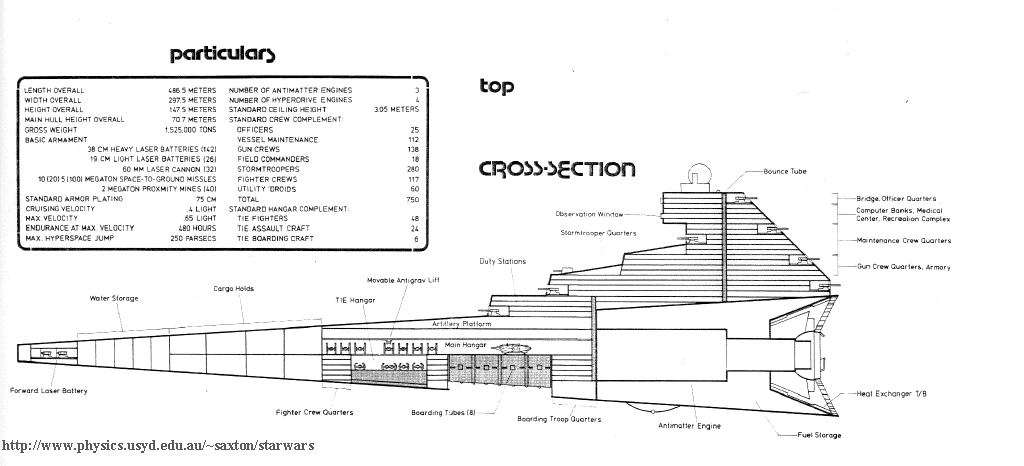
Using this as a metric, you might say the crew sizes are mercifully small. Of course, you can argue that they needed fewer crew members because of their advanced technology. Still, if you look at an ISD bridge, you see twenty-some odd men at various crew stations. This suggests that technology hadn't made it possible to easily or effectively fight the entire ship from one station, or only a few. Optimum combat efficiency took all of those separate stations. This is likely due to the complexity of all of the various technological subsystems, and just the large size of the ship.
For Star Wars, you also have to consider that ship design isn't limited by what floats in the water. Length alone isn't an accurate predictor of crew demand. There are spherical ships like the Death Star or Torpedo Sphere that are every bit as tall and wide as they are long. The Neb B, for instance, has a massive forward structure that is quite tall (though narrow).
Now, once the ship is fully crewed once, you have to add about a third to double that to account for shifts, illness, and combat redundancy in the case of combat losses. Then you have to question if that number includes the squadrons and their launch crews and maintenance staff, because in the real world, this often isn't the case. It takes a LOT of bodies to fight one of the big ships. 900 is just fine.
There's kinda the thing; I think that the ship sizes are also bigger in the books than they're supposed to be in the movies.
For example, the C. Corvette is 150 meters in the WEG books; I think it's supposed to be no more than 100 meters. It's a speedster car, not a small naval vessel.
Where did you get that info from? Granted I'm A WEG guy, and what they have written is almost canon in most cases. I have never seen the Tantive IV as anything but 150 meters. There are other corvettes that are smaller, like the diplomatic cruiser that Qui Gon and Obi Wan were on. The Star of Alderaan was a bit different configuration ipad I remember correctly, and was a little smaller until she got revamped and renamed the Tantive IV.
WEG estimated the size of the ship when compared on screen to the ISD. They gave the ISD a length of 1600 meters or .99 miles long. In some early draft work, this space cruiser was listed to be over 10 miles long. But when compared to the corvette, the Falcon, and other sources it was brought down to a mile.
Being retired USAF, I know the crew size of large aircraft (typically 3-7) and airfields (hundreds if not thousands). These would be part of a capital ships crew size as well. Hanger decks require a lot of people/droids to operate safely.
And we have to remember that Star Wars is based off of the 1970s and WWII tech. The movies and games never caught up with our own stuff! 
I have always wondered why the ships are not just giant droids that people ride inside of...
Using this as a metric, you might say the crew sizes are mercifully small. Of course, you can argue that they needed fewer crew members because of their advanced technology. Still, if you look at an ISD bridge, you see twenty-some odd men at various crew stations. This suggests that technology hadn't made it possible to easily or effectively fight the entire ship from one station, or only a few. Optimum combat efficiency took all of those separate stations. This is likely due to the complexity of all of the various technological subsystems, and just the large size of the ship.
There's also the matter of redundancy. Even if the bridge crew and a minimal engineering staff could at least direct the automated weapons batteries and systems, there is so much that could go wrong. Star Wars technology is hardly reliable even at the best of times, and warships need to maximize their fighting capabilities even in the most adverse circumstances. Efficiency and effectiveness are two very different things.
The combat scenes during the Battle of Coruscant at the beginning of Episode III clearly show clones manning individual weapon mounts. Issues of accuracy and speed aside, this allows individual batteries to continue fighting even after surrounding compartments suffer critical damage. As long as there is stiil charge in the capacitors or rounds remaining in the magazine, an isolated weapons crew could continue to engage without exterior coordination where an automated or centralized system might fail.
And crews do more than just fight the ship in space. A large crew complement can supply personnel for maintenance and medical teams, marine detachments for boarding parties or planetary operations, prize crews for captured or salvaged ships, and any number of other roles.
Edited by Joker TwoPretty much going to echo what everyone else said. If anything, crew sizes in Star Wars are too small.
I suspect that WEG overestimated the size of the ISD, since there was no specification in the movies.
Geroge Lucas got it backwards when he started naming classes of ship. It is practically backwards. Is most wet navy fleets the Destroyer is the smallest, and the Battleship or carrier is the biggest.
Use size and volume of the vessel to estimate crew sizes, not the class.
IIRC it nroamlly goes : Corvette<Destroyer<Frigate<Crusier<battleship<Deadnaught<SuperDreadnaught (carriers are a differant animal)
For star wars it has become : Corvette<Frigate<Cruiser<Destroyer<Executor Class<Death Star
Basically though there;s a Heavy Cruiser grade in Star Wars between Cruisers and Destroyers, and there are two grades between the Destroyer and Death Star. Battlecruisers and Dreadnoughts (The Executor is a Dreadnought.)
Um, George didn't come up with the classes of the ships, that was the game people.
For the whole story of the ISD, it is a long and convoluted one. But I will try to explain it. But the basic point is that the it was not WEG who determined the size the ISD, It came from Lucasfilm.
With the original story ideas, the size of the ships varied through each draft. When the film was being made, even the models that ILM created were differnet in how long they "were supposed to be".
Steve Sansweet mentions in his book From Concept to Screen to Collectibles, that the original artists working on the model seemed to have the intention that the ship was supposed to be 5 or 6 miles long. The models were built in different sizes, but they were supposed to be about 6 miles long.
Side note, the term Star Destroyer is not used until Empire Strikes Back. That movie had the most detailed model built yet of an ISD. They had built that monster of a model (it was 8.5 ft long) using an industry standard scaling, making the vessel to be about 1606 meters long.
After jedi came out, Lucasfilm employed Geoffry Mandel to make some blueprints for this ship and some others for the blueprint set. In this the ship was again listed at 1600 meters. Lucasfilm gave these sets to WEG in 1986 when they acquired the rights to the RPG and started working on the game. They were told to use these blueprints for the sizes of the ships.
When looking at the Falcon on the conning tower, and the imperial shuttle leaving the docking bay in Jedi, people have done measurements that do back up the idea that the ISD is around one mile length.
So Lucas wanted the ship to be super huge, but just got huge from the model makers. It was really the guys at ILM that set the length of the ship. The naming convention again was done by the gaming industry. Nebulon-B, Corellian Corvette, MC-80, Carrack Class Cruiser, Lancer, and all the other ones were made by WEG and others not George or even ILM in most cases.
Hope you all enjoyed the history lesson...I really need to get a life... 
I'm going outside now.
Edited by R2builderNot sure about anyone else, but I don't believe you are going outside. And taking your tablet, laptop, phone, or a book with you does not count.
After jedi came out, Lucasfilm employed Geoffry Mandel to make some blueprints for this ship and some others for the blueprint set. In this the ship was again listed at 1600 meters.
The only Mandel Star Destroyer blueprints I've seen are those from the Technical Commentaries. Where the length is listed at 686 meters (or something around that, the scan is poor).
Is there another?