Remember what Kirk did in the Wrath of Khan, where he went up and down while Khan stayed in 2 Dimensions
Edited by librarian101What does a Koiogran turn look like?
It is the measurement of weight per unit mass. To over simplify, mass in motion generates energy. This energy is a weight-like force that moves in the same direction as the mass that created it. The more mass and the faster it goes, the more energy it creates.
And what you just described is inertia. You know, the thing he said was being dampened.
Also, when you said
The body couldn't handle the g-force this kind of maneuver would cause. The F-22 Raptor CAN do this maneuver, but no human pilot will be conscious by the end of it.
It depends on how fast the maneuver is performed. Hovercraft can spin around and accelerate in the opposite direction without KO-ing the pilot no problem.
I love that we're talking about advanced physics in the X-wing forum. lol
There is no "dampening" g-forces. It is created by the body it self. "g-suits" are merely tight fitting clothes that help restrict blood flow, as this is what causes you to black out. You can only restrict blood flow to a point. lol Also, one still FEELS every bit of pressure while in a g-suit. If you ever get the chance (and your heart is healthy enough) get on an aviation simulator that will put 3 gs on your body. This is why drones, among other reasons, seems to be the future of aviation warfare. A computer can take as many gs as its structure will physically allow.
Inertia is not the same as g-forces. Inertia is a part of the mathematical calculation though (but only part).
This article is a great explanation of g-forces at play in a roller-coaster.
http://science.howstuffworks.com/engineering/structural/roller-coaster5.htm
And this is a science fiction universe that has invented a way to bypass that effect. It is a piece of techno-babble that was invented as a shorthand way of saying "We know this wouldn't really work in the real universe, but it looks cool/is necessary for the story so we are making up a bit of technology that we say circumvents the laws of physics so that it can happen in our make-believe universe."
Edited by ForgottenloreThat would be true, except that Star Wars has a technology called "inertial dampeners" that eliminates the effects of inertia on the pilots. Pilots in Star Wars never experience g-forces from maneuvers.
Edit: Forgottenlore beat me to it.
Edited by kraedinThere is only one force in the Star Wars universe, and that is the Force.
In Star Wars it's called a Koiogran. On Earth it's called an Immelman.
But in space, it should be something much different. More like the examples from B5 or BSG.
It is the measurement of weight per unit mass. To over simplify, mass in motion generates energy. This energy is a weight-like force that moves in the same direction as the mass that created it. The more mass and the faster it goes, the more energy it creates.
And what you just described is inertia. You know, the thing he said was being dampened.
Also, when you said
The body couldn't handle the g-force this kind of maneuver would cause. The F-22 Raptor CAN do this maneuver, but no human pilot will be conscious by the end of it.
It depends on how fast the maneuver is performed. Hovercraft can spin around and accelerate in the opposite direction without KO-ing the pilot no problem.
I love that we're talking about advanced physics in the X-wing forum. lol
There is no "dampening" g-forces. It is created by the body it self. "g-suits" are merely tight fitting clothes that help restrict blood flow, as this is what causes you to black out. You can only restrict blood flow to a point. lol Also, one still FEELS every bit of pressure while in a g-suit. If you ever get the chance (and your heart is healthy enough) get on an aviation simulator that will put 3 gs on your body. This is why drones, among other reasons, seems to be the future of aviation warfare. A computer can take as many gs as its structure will physically allow.
Inertia is not the same as g-forces. Inertia is a part of the mathematical calculation though (but only part).
This article is a great explanation of g-forces at play in a roller-coaster.
http://science.howstuffworks.com/engineering/structural/roller-coaster5.htm
What are you talking about? You could spin round in space as much as you like, if you were moving at a constant speed going forward then you might as well have not been moving at all. Indeed, if you took all surrounding objects away you'd have no concept of being in motion at all. Acceleration is all that matters.
I knew that was coming... lolI've always pictured it as a flat spin, sliding through space to do a 180. No horizontal or vertical involved.
The body couldn't handle the g-force this kind of maneuver would cause. The F-22 Raptor CAN do this maneuver, but no human pilot will be conscious by the end of it.
But the K-turn is in space, in ships with inertial dampers.
I don't want to bore you with physics, but g-forces have nothing to do with gravity. It is the measurement of weight per unit mass. To over simplify, mass in motion generates energy. This energy is a weight-like force that moves in the same direction as the mass that created it. The more mass and the faster it goes, the more energy it creates.
Now, imagine this body suddenly changing directions. In the extreme example that is the maneuver we are talking about, it would be like running into a punch.
A "safe" way of feeling this is to walk forward at a steady pace and then after a few strides quickly spin 180 degrees and proceed in to opposite direction. What you'll feel when you do that is not caused by gravity. Now, imagine what it would feel like if you were going 500 miles per hour!
It is the measurement of weight per unit mass. To over simplify, mass in motion generates energy. This energy is a weight-like force that moves in the same direction as the mass that created it. The more mass and the faster it goes, the more energy it creates.
And what you just described is inertia. You know, the thing he said was being dampened.
Also, when you said
The body couldn't handle the g-force this kind of maneuver would cause. The F-22 Raptor CAN do this maneuver, but no human pilot will be conscious by the end of it.
It depends on how fast the maneuver is performed. Hovercraft can spin around and accelerate in the opposite direction without KO-ing the pilot no problem.
I love that we're talking about advanced physics in the X-wing forum. lol
There is no "dampening" g-forces. It is created by the body it self. "g-suits" are merely tight fitting clothes that help restrict blood flow, as this is what causes you to black out. You can only restrict blood flow to a point. lol Also, one still FEELS every bit of pressure while in a g-suit. If you ever get the chance (and your heart is healthy enough) get on an aviation simulator that will put 3 gs on your body. This is why drones, among other reasons, seems to be the future of aviation warfare. A computer can take as many gs as its structure will physically allow.
Inertia is not the same as g-forces. Inertia is a part of the mathematical calculation though (but only part).
This article is a great explanation of g-forces at play in a roller-coaster.http://science.howstuffworks.com/engineering/structural/roller-coaster5.htm
What are you talking about? You could spin round in space as much as you like, if you were moving at a constant speed going forward then you might as well have not been moving at all. Indeed, if you took all surrounding objects away you'd have no concept of being in motion at all. Acceleration is all that matters.
And this is a science fiction universe that has invented a way to bypass that effect. It is a piece of techno-babble that was invented as a shorthand way of saying "We know this wouldn't really work in the real universe, but it looks cool/is necessary for the story so we are making up a bit of technology that we say circumvents the laws of physics so that it can happen in our make-believe universe."
Technically those forces still exist, they are just dampened. The shadows of the empire comic book shows Boba Fett suffering after a pretty stressful maneuver, despite the dampeners, IIRC.
And this is a science fiction universe that has invented a way to bypass that effect. It is a piece of techno-babble that was invented as a shorthand way of saying "We know this wouldn't really work in the real universe, but it looks cool/is necessary for the story so we are making up a bit of technology that we say circumvents the laws of physics so that it can happen in our make-believe universe."
Technically those forces still exist, they are just dampened. The shadows of the empire comic book shows Boba Fett suffering after a pretty stressful maneuver, despite the dampeners, IIRC.

A discussion on aerobatic maneuvers and X-wing? I had to make an account for this.
The Immelman doesn't have anything to do with yaw. It's a half loop with a half roll. The K-turn could either be a Split S or an Immelman.
The OP is correct about the original Immelmann involving yaw, and does well to differentiate the original maneuver from the "modern day" Immelmann.
The original maneuver was flown in an Eindecker, Germany's first piston engine fighter aircraft. It was a monoplane with a poor power to weight ratio. More importantly it didn't have ailerons, but instead used "wing warping" whereby the shape of the wing was altered to increase or decrease lift on the respective wing. The thing apparently rolled like a dog. If you ever have the opportunity to try an Immelmann in a Citabria or an Aerobat, you'll find that they're barely capable of performing the modern day Immelmann; and that's with a similar power to weight ratio as the Eindecker, but proper ailerons. In the Eindecker that Immelmann flew, the modern half-loop-up with a roll off the top Immelmann would be impossible.
So what maneuver did he fly? I think there's room for debate on that, but it definitely involved yaw input. Some descriptions have it looking/sounding a bit like a wing over, and some are closer to the half-loop and roll. In any case, the roll required for the maneuver would have come from yaw input, accelerating the airflow over one wing and slowing it over the other via yaw to create differential lift which produces roll.
Even when flying a modern day Immelmann in a low powered aircraft (right up to a Super Decathlon), you'll use quite a bit of rudder/yaw input to properly fly the maneuver. The Aresti catalogue, which is a close as there is to a standard for aerobatic maneuvers, specifies that no horizontal line should be flown between finishing the half-loop up and starting the roll. This means the roll has to be initiated when the aircraft is flying very slowly as it's finishing the half-loop up; there's reduced airflow over the ailerons and they won't have sufficient effect to finish the roll with a flyable airspeed resulting in a stall buffet/loss of altitude, or you'll get a dip in altitude as you're rolling from the point where you finished your loop. In any case, to fly it nicely without a high performance aircraft, you'll need some rudder/yaw input to "assist" the roll rate produced by the ailerons.
So the Immelmann actually has quite a bit to do with yaw.
Anyways, it looks like the votes are for an Immelmann, a Battlestar Galactica style pivot about the vertical axis, or possibly a lag displacement roll. I think it's most likely a looping/rolling figure like the Immelmann; looking at the way the ships maneuver in the original trilogy and given the WW2 fighter inspiration for the OT space combat scenes, it seems the likeliest of the options. It might also look a bit like a half Cuban or reverse half Cuban eight since those would put the nose back on target at the starting "elevation".
Edited by CongosquidYeah, in star wars it seems they are stuck on a 2d surface, or at least multiple levels of a 2 d surface and are all oriented parrallel to each other. Except for that one episode in Clone War where Ashoka decides instead of going at the CIS ships the traditional way she has the SD deploy so it only shows the keel....
If I was a space naval commander I would be directing my ship to go at all sorts of wierd angles just to mess the opponent up....
Well, Star Trek is much the same way, all the ships are the same way up and in the same orbit. Just makes it easier on the viewers I guess.
Ahsoka's maneuver was also in The Heir to the Empire where Thrawn has the Chimera's superstructure rotated to the enemy so the TIE's could exit the hangar out of danger.
That is why ender is so awesome.
Wait, you mean zero g means there is no up?
This is called a Lag Displacement Roll and is absolutely the inspiration of the K-turn:
I never knew the proper term for this ACM. I either called it a high or low yoyo.
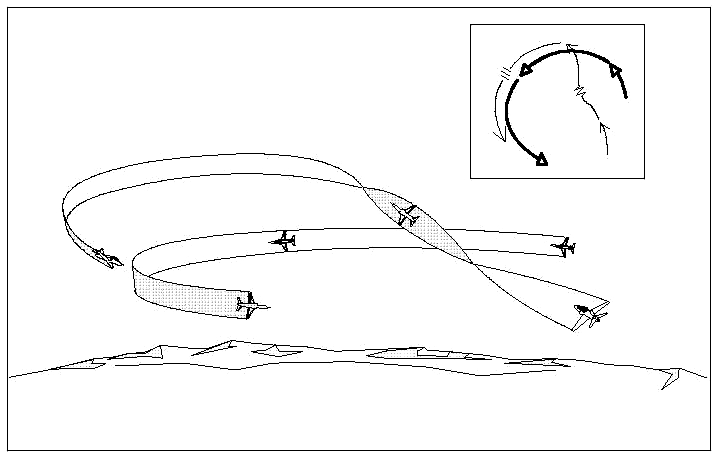
A high speed yo-yo would take the attacker up and over and keep him inside the defender's flat turn, whereas a low speed yo-yo would take him down and back up still inside the defender's turn. Either maneuver should allow the attacker to bring guns to bear. The Lag roll (shown) is a more lateral version where you don't get so vertically separated, but you can create separation or distance.
I can't see it as the inspiration for a K-turn at all as the K-turn runs of a straight template. This maneuver would be the same as 2 tight turn templates. The K-turn is probably more akin to a half loop and as we don't have to worry about up and down in space, it doesn't really matter how you're pointing when you come out of the maneuver.
An immelman is designed to get you back up the right way at the end, but in space, what is the right way up?
Changes in direction are acceleration.
Direction (motion) is relative. Turning round in space while travelling at thousands of miles per hour relative to a tie fighter nearby is no different from turning round with that tie fighter not there. You're actually travelling through space at thousands of miles per hour right now relative to other objects in space. Try standing up and turning round, see if it kills you.
Edited by mazz0That's not at all the same as being on earth. The gravity of earth makes all of your movements relative to earth, not other objects in space.
Direction of motion IS relative. If you're flying in a spaceship and you suddenly change direction with that spaceship, your body is still traveling in the original direction, except the spaceship won't let it. The inertia of your body carries you in a different direction relative to the spaceship. You get pressed into the ship in the direction you were headed and the blood does the same (depending, of course, on your speed relative to the spaceship), pooling in parts of your body closest to the outside of the turn.
Yep it's called centrifugal force and it's basic physics. Star Wars universe or not, it's still going to be there.
If every ship has such effective inertial dampeners, why do we see the pilots bobbing around in their cockpits during their trench runs in ANH? You've got to remember that inertial dampeners are just a plot fix to explain away why spacefarers don't get turned into a red splat when their ships go into hyperspace. Star Trek has been using the concept for decades, but you still saw the bridge crew getting thrown around all the time.
Because George Lucas didn't look into the physics of space travel. One of the rogues squadron novels explained that the internal feel of the manuevers was left slightly intact to givbe the pilots some lvel of awareness of motion. That point is largely moot, as it was also explained that Porkins died because he had his dialed all the way off, so they can be dialed off for the craziest of manuevers.
Again, without inertial dampeners every pilot in the series would be a red smear almost instantly. These ships are accelerating at well over 300 g's. The tech compensates for that to a very very very large extent. Enough where it by necessity has to compensate for quite a bit more than the base acceleration of the ship. I don't know how the tech works, as it's largely a necessary conceit of sci-fi(and thus is largely space magic), but they are in the ships, making the g-forces of any given manuever a moot point. They just don't matter, except where the story writers want them toom typically without regards to any kind of calculation. Consider, an A-Wing is significantly faster than an X-wing. It's internal compensator has to handle a ton more g's than an x-wings, so if you put that into an x-wing suddenly there are no g-forces to any manuevers at all. By and large there will be no G-forces in space travel. Because if there were, again, SPLAT!
OK, I have been through the flight surgeon course down at Fort Rucker, so I know a good bit about what is being discussed here. First, physics and star wars don't exactly go together, but we devide Gs (acceleration measured in units of earth gravity) into 3 axis, with positive and negative directions. Gx is fore and aft, Gz is elevator axis, Gy is lateral. The human body can tolerate at least 5 or 6 G's in forward acceleration. More with a G suit and a Valsalva like breathing manuver, but 8 to 9gs is definitely GLOC territory. Speed is not the issue, change in velocity over time is, as is the direction of the change. We can ascend up quickly in a turbolift, at least 5 or 6 G's for someone in good shape, but negative Gz we are only good for 2 or 3. Gy is poorly tolerated. And you are right, modern aircraft can execute manuvers that the pilot cannot stay conscious through. I think the immelman is a good explanation, but in space, you could coast, spin around, then hit the gas. Think of it like pulling the ebrake in a car, or riding the scrambler at a county fair. The only question is how quickly you decelerate and go back the other way, and that of course depends on your initial velocity and how quickly you do the manuver.
Edited by DarthfishOK great follow up question here: In game when I get a stress token, does that illustrate the stress (G forces) put onto the pilot OR the stress done to the ship due to limitations with is engine/hull design?!
And we have no explanation for inertial dampeners. The completely ignore all attempts to explain them through Newtonian physics. And I know this last part will make me sound like a snob, but there is no such thing centrifugal force in physics. It is an effect of angular acceleration on an occupant that is within a vehicle or other object being accelerated.
Also, the body can tolerate Gx in a much higher range for short periods of time. I cannot remember a cut off at the moment, I think north of 30gs, very briefly. Can't remember what the catapults generate, maybe someone else can chime in here.
I think it is pilot stress and workload more than airframe stress
OK great follow up question here: In game when I get a stress token, does that illustrate the stress (G forces) put onto the pilot OR the stress done to the ship due to limitations with is engine/hull design?!
It signifies a mentally stressful task. That can be anything from having to flick a whole lot of levers to dealing with negative side affects to the ship, to hitting your head due to a critical hit. Stress tokens are on the pilot, not the ship itself.
And we have no explanation for inertial dampeners. The completely ignore all attempts to explain them through Newtonian physics. And I know this last part will make me sound like a snob, but there is no such thing centrifugal force in physics. It is an effect of angular acceleration on an occupant that is within a vehicle or other object being accelerated.
More appropriatley, it isn't a "FORCE" in physics. It's a semantic definition thing, but important to differentiate.