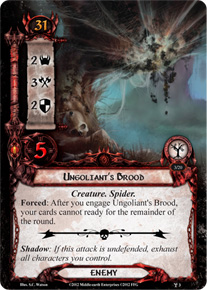
If you kill him..., his forced is anyway active? You engage him, in combat phase you kill him... can't you anyway ready your characters the next refresh phase?
Edited by Mndela
If you kill him..., his forced is anyway active? You engage him, in combat phase you kill him... can't you anyway ready your characters the next refresh phase?
Edited by MndelaThink so, yes.
the forced ability triggers and will stay as a passive for the "remainder of the round" I'd say.
No No No. Once cenemies are in the discard pile their text is no longer active. I'll find some more examples, but in my eyes its pretty clear cut.
Old Tomnoddy: Forced: At the end of each round, each player must give a hero he controls 1 poison.
If you kill him, you don't have to do this.
Old Tomnoddy: Forced: At the end of each round, each player must give a hero he controls 1 poison.
If you kill him, you don't have to do this.
In this example, the trigger is 'At the end of the round...', and if you kill him before the end of the round, the card is out of game then.
But in Ungoliant's Brood, the trigger is 'After you engage...', the forced ability will become active just in that moment, and if you kill Ungoliant's Brood the forced ability is already active (because it has been triggered).
Yeah, kill or no kill, if engaged - no readies for today, son.
Edited by MyNeighbourTrololoI hates that card. It burns, IT BURNS!
Yeah, kill or no kill, if engaged - no readies for today, son.
yes sure....bad day.... Ungoliatn spawn is not a joke....
i concur, the forced effect triggers by the act of engaging the brood - so the ability is already triggered before you kill the enemy. it's quite a nasty effect, indeed!
I dunno its a forced ability, but if the card is gone why would you still do things that arent in play? Need a official ruling or something from the Rules/FAQ, otherwise I dont see why this is the one exception.
I dunno its a forced ability, but if the card is gone why would you still do things that arent in play? Need a official ruling or something from the Rules/FAQ, otherwise I dont see why this is the one exception.
this isn't an exception - there are tons of cards just like this.
the effect has already triggered by the simple act of engagement. killing it happens a few steps/stages later - after the effect has "gone off."
just like an event that is played that lasts til the end of the round - the event card isn't still technically in play, but its effect lasts:
For example, Durin's Song: Action: Choose a Dwarf hero. That hero gets +2WP, +2ATK, and +2DEF until the end of the round.
Or, the same with a treachery card that lasts til the end of the round - but that treachery card also gets discarded before the end of the round:
Hidden Trees from the Hobbit Saga is an example: When Revealed: Characters get -1WP and cannot attack until the end of the round.
The card gets discarded right away, but the effect still persists even if the card isn't in play.
Edited by Dain IronfootThe Trigger creates a passive effect that lasts until the end of the round. The only way that killing the brood would change this is if the card was instead worded: "As long as Ungoliant's Brood is in play, your characters cannot ready". Since the effect says nothing about the Brood needing to be in play, it will be active until the end of the round, no matter what you do to the Brood. It is important to remember that card effects are independent of the card which actually created them. Think of the game state as a stack of papers on your desk. The Forced effect of Ungoliant's Brood causes you to add a paper to your desk, that you are not allowed to throw away until the end of the round. Once the new page is on your desk, it doesn't matter what happens to the card that made you add the new page (the forced effect).
The best solution that I have found to this enemy is to quest with characters that don't exhaust (Glorfindel, Hobbit Gandalf) or have readying abilities (Core Aragorn). Then optionally engage the Brood and chump block them. Don't counter attack but instead wait until the next round to kill them. Obviously, if you have Dunhere or Great Yew Bow, it is better to kill them in the staging area, otherwise these guys are a real pain.
I hate these guys, but Ranger Spikes do love eating them for breakfast.
I dunno its a forced ability, but if the card is gone why would you still do things that arent in play? Need a official ruling or something from the Rules/FAQ, otherwise I dont see why this is the one exception.
Something like this ? :
Q: If a location is revealed after Treacherous Fog
(CORE 118) was revealed during the same quest phase,
does the revealed location get +1 $ from the “When
Revealed” effect on Treacherous Fog?
A: Yes. The “When Revealed” effect on Treacherous
Fog creates a lasting effect until the end of the phase
that affects each location in the staging area. This is
different from Driven by Shadow (CORE 92) which
uses the language “currently in the staging area” when
it is revealed and only affects enemies and locations in
the staging area at the time it is revealed.
On a similar note we have this thing from Fords of Isen:

The dealing of shadow cards is directed to Orc enemies in play, but the second sentence seems to apply to all Orc enemies (including ones that are revealed later) until the end of the round, although the wording is a bit ambiguous (is the -15 until the end of the round, or does the effect apply to all Orc enemies until the end of the round?). I've been following the "go with the hardest" rule and having this apply to all Orc enemies, including those that are revealed after this treachery resolves.
The Trigger creates a passive effect that lasts until the end of the round. The only way that killing the brood would change this is if the card was instead worded: "As long as Ungoliant's Brood is in play, your characters cannot ready". Since the effect says nothing about the Brood needing to be in play, it will be active until the end of the round, no matter what you do to the Brood. It is important to remember that card effects are independent of the card which actually created them. Think of the game state as a stack of papers on your desk. The Forced effect of Ungoliant's Brood causes you to add a paper to your desk, that you are not allowed to throw away until the end of the round. Once the new page is on your desk, it doesn't matter what happens to the card that made you add the new page (the forced effect).
The best solution that I have found to this enemy is to quest with characters that don't exhaust (Glorfindel, Hobbit Gandalf) or have readying abilities (Core Aragorn). Then optionally engage the Brood and chump block them. Don't counter attack but instead wait until the next round to kill them. Obviously, if you have Dunhere or Great Yew Bow, it is better to kill them in the staging area, otherwise these guys are a real pain.
Can you explain the example I gave before then? Tomnoddy says 'at the end of the round, give poison'. Can you argue that this is another 'passive effect' etc. etc.? The card doesn't say 'As Long as Old Tomnoddy is in Play' give a poison.
The Trigger creates a passive effect that lasts until the end of the round. The only way that killing the brood would change this is if the card was instead worded: "As long as Ungoliant's Brood is in play, your characters cannot ready". Since the effect says nothing about the Brood needing to be in play, it will be active until the end of the round, no matter what you do to the Brood. It is important to remember that card effects are independent of the card which actually created them. Think of the game state as a stack of papers on your desk. The Forced effect of Ungoliant's Brood causes you to add a paper to your desk, that you are not allowed to throw away until the end of the round. Once the new page is on your desk, it doesn't matter what happens to the card that made you add the new page (the forced effect).
The best solution that I have found to this enemy is to quest with characters that don't exhaust (Glorfindel, Hobbit Gandalf) or have readying abilities (Core Aragorn). Then optionally engage the Brood and chump block them. Don't counter attack but instead wait until the next round to kill them. Obviously, if you have Dunhere or Great Yew Bow, it is better to kill them in the staging area, otherwise these guys are a real pain.
Can you explain the example I gave before then? Tomnoddy says 'at the end of the round, give poison'. Can you argue that this is another 'passive effect' etc. etc.? The card doesn't say 'As Long as Old Tomnoddy is in Play' give a poison.
it's because Old Tom's forced effect doesn't trigger until the end of the round; while the Brood's triggers when it engages. Old Tom has to be around at the end of the round for his Forced effect to "go off." The Brood's forced effect "goes off" when it engages.
It's not the "Forced" keyword itself that determines when the ability happens - the "forced" keyword simply "forces" you to trigger the ability when the ability itself specifies (at engagement, during questing, end of round, etc).
in other words, different "forced" effects "go off" at different times in the game - one at the engagement step, one at the end of the round.
Edited by Dain Ironfootfrom the Core Set Rulebook:
Forced effects are initiated by specific occurrences throughout a game, and they occur automatically, whether the card’s controller wants them to or not. They are denoted by a bold “Forced:” trigger on a card. These effects initiate and resolve immediately, whenever their specified prerequisite occurs. The enemy card Marsh Adder provides an example of a forced effect that must be triggered whenever its specified trigger (“each time Marsh Adder attacks”) is met.
____
italics added for emphasis.
I guess I'll submit here, never usually let him engage me, but I think its confusing. Is he literally the only enemy card that affects you after you kill him without specifically saying so?
I guess I'll submit here, never usually let him engage me, but I think its confusing. Is he literally the only enemy card that affects you after you kill him without specifically saying so?
the excerpt from the rule book explains it clearly, i believe (perhaps more so than i have). forced effects happen immediately when the pre-req occurs (in this case, engagement is the pre-req). it's not that confusing. his forced effect happens before you defend or attack.
i'm not going to look through all of the enemies, but yes, he is the only one that comes to mind with this effect currently. but this effect is found on many other encounter cards (as i provided examples above) - the card being in play has nothing to do with the length of a forced (or when revealed) effect.
Edited by Dain Ironfoot